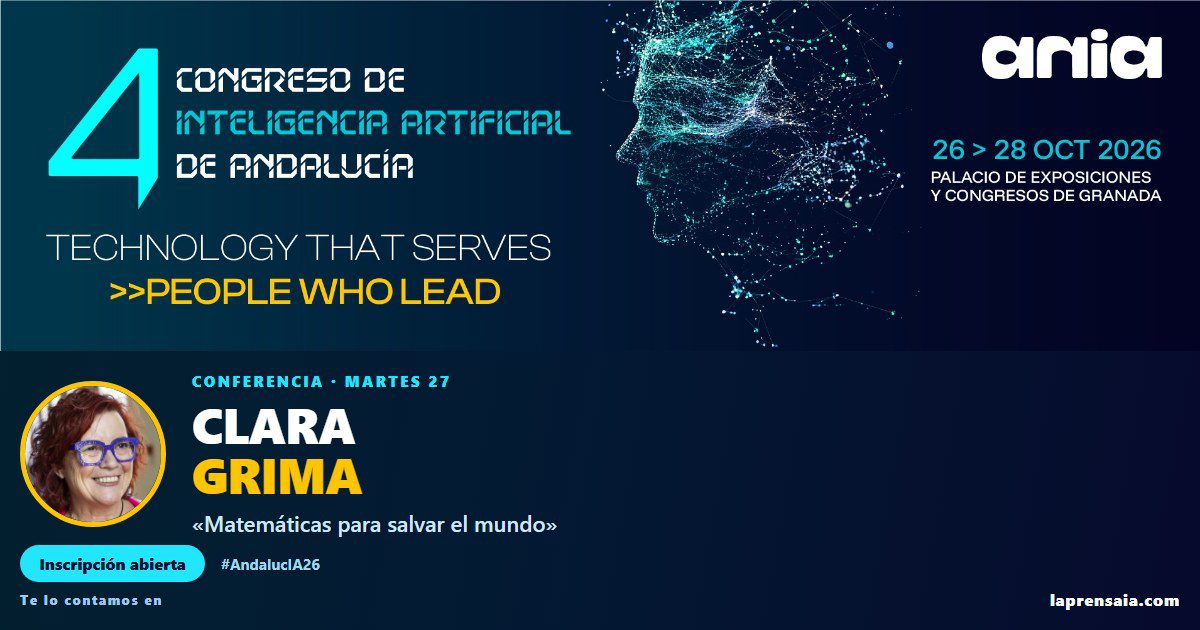
Mathematician Clara Grima takes the stage this Tuesday at the IV AI Congress of Andalusia in Granada to speak about something that sounds ambitious: how mathematics can save the world. She does so at a time when generative artificial intelligence has slipped into the daily lives of millions of people, many of whom have no idea what lies behind tools like ChatGPT.
A PhD in Mathematics and a tenured professor of Applied Mathematics at the University of Seville, Grima spoke to LaPrensaIA via a voice note recorded between classes. Her lecture, titled Mathematics to save the world, is scheduled for 12:30 PM on Tuesday, October 27, as part of a congress with the motto "Technology that serves. People who lead."
AI is already saving lives, according to Grima
For Grima, mathematics is the tool used to model science. Mathematical models, she explains, serve to understand what is happening and to anticipate what might happen, although she prefers not to use the word "predict" because, she says, it sounds like a crystal ball.
Applied to artificial intelligence, she gives three examples that she considers already real: AI is diagnosing diseases with a precision that humans could not achieve, it is deciphering the structure of proteins that seemed indecipherable, and it is helping to design antibiotics against superbugs, a health problem that, according to her, is only surpassed by cancer.
Why ChatGPT is not magic, but probability
When asked what part of the mathematics behind ChatGPT anyone without technical training can understand, Grima does not hesitate: probability.
As she explains, these systems have read vast amounts of text and have learned which words usually appear after others. Reduced to its essence, what they do is calculate, in a probabilistic way, which word is most likely to come next. She acknowledges that there is more complexity behind it, such as neural networks that learn over time, but she sticks with this explanation as it is the most accessible for the general public.
What to know so that AI does not deceive us
Grima points to percentages and probability as basic knowledge useful for dealing with artificial intelligence. But she insists especially on another idea: understanding logic.
More than mastering advanced mathematics, she emphasizes the importance of reading comprehension: knowing how to interpret what an AI says well and having the ability to cross-reference it with what one already knows.
“A wonderful tool,” not a magic trick
To those who distrust artificial intelligence and see it as something almost esoteric, Grima responds firmly: it is not magic, it is a tool built with a lot of mathematics and a lot of programming.
She admits she does not have a simple formula to convince a skeptic, but she proposes explaining its operation in two parts: the probabilistic part she has already described and another based on trial-and-error learning, in which the system is rewarded or penalized according to its results until it improves. If those mechanisms are not understood, she acknowledges, it is normal for something to seem magical. Even so, she insists on calling AI a wonderful tool.
The gender gap that worries Grima
A large part of her talk in Granada will revolve around a problem she considers urgent: the low female presence in the development of artificial intelligence.
Grima recalls that the percentage of women studying computer science has been low since the 1980s. But what worries her most is another piece of data: the proportion of women in mathematics degrees, the other key discipline for AI, has fallen significantly since the early 2000s, coinciding with the rise of technological development.
That is why she argues that the algorithms that will condition the future should be designed by diverse teams, with a real representation of women, who are half of the world's population.
The message she wants to leave in Granada
Grima summarizes her proposal in two ideas. The first is to speak well of mathematics so that boys and girls are drawn to it, because she believes these will be the careers of the future and society will need many more professionals trained in this area.
The second is to take care of the narrative conveyed to girls about this discipline: not to present it only as something useful for video games or finance, but as what she considers it truly is, the most powerful tool available to try to save humanity.
Frequently asked questions
Who is Clara Grima?
She is a PhD in Mathematics and a tenured professor of Applied Mathematics at the University of Seville, as well as a science communicator recognized for bringing mathematics to the general public.
What is her talk at the AI Congress of Andalusia about?
It is titled Mathematics to save the world and addresses how mathematical models underpin advances in artificial intelligence, in addition to focusing on the gender gap in this field.
When and where is the conference?
It is scheduled for Tuesday, October 27 at 12:30 PM, within the framework of the IV AI Congress of Andalusia, held in Granada.
What mathematics is behind ChatGPT according to Grima?
Mainly probability: the system calculates which word is most likely to follow another, based on the enormous amount of text with which it has been trained.
What knowledge does she recommend to avoid being deceived by AI?
Grima highlights understanding logic and having critical reading skills, in addition to basic notions of percentages and probability.
Why does she talk about the gender gap in artificial intelligence?
Because she points out that the percentage of women in computer science has been low since the 1980s and that in mathematics it has dropped significantly since the early 2000s.