
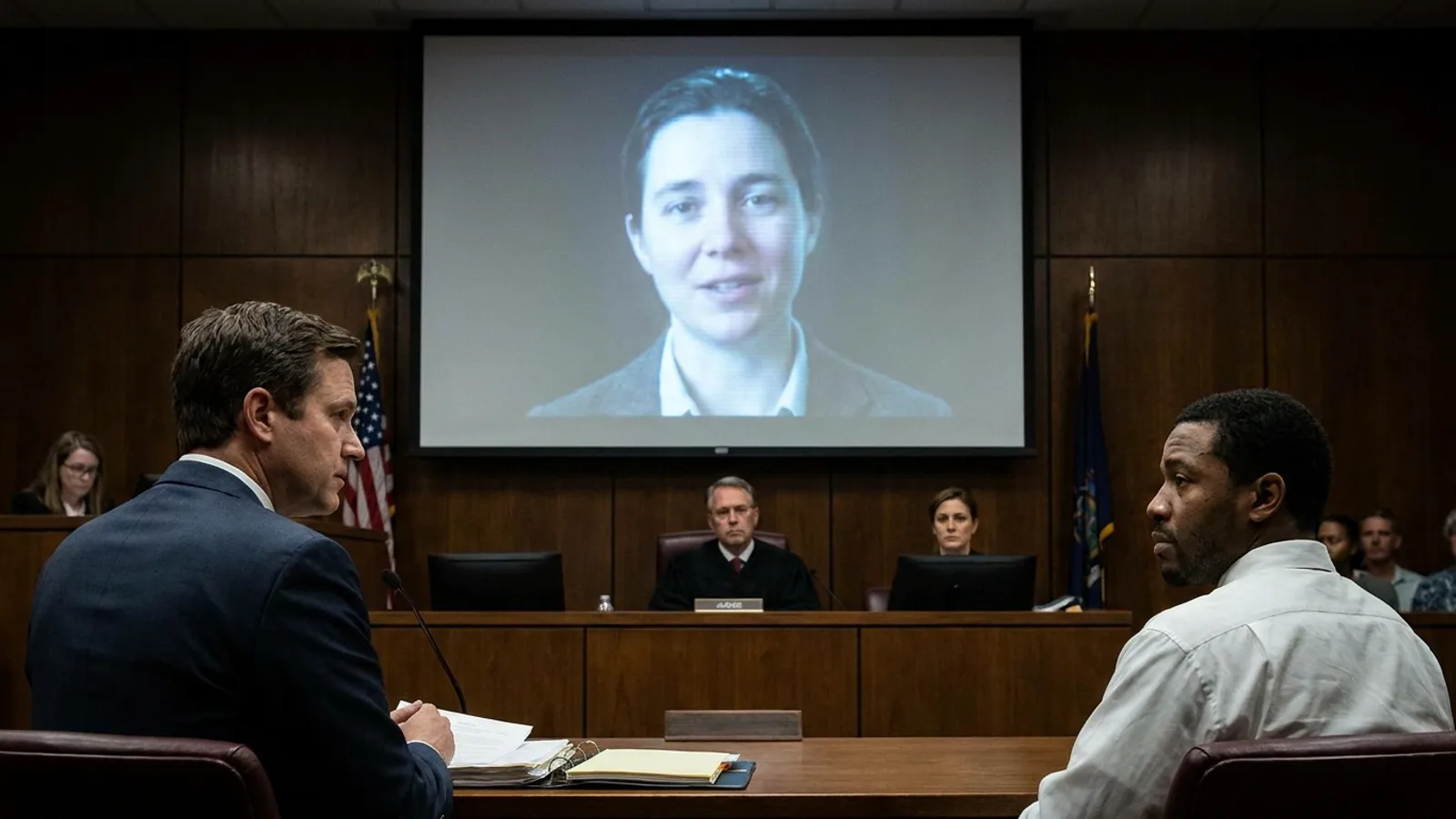
A United States court completely overturned a manslaughter conviction after discovering that a video presented at the sentencing hearing had been generated with artificial intelligence. In the footage, the victim appeared to be speaking and forgiving the person convicted of their death, but those words were never actually spoken.
The case is already considered a legal precedent in the country and raises a question that still lacks a clear answer in Spain, Mexico, Argentina, and Colombia: what to do when an AI-created video reaches a court as if it were real.
A message of forgiveness the victim never gave
According to the reconstruction of events, the victim's family presented the video during the hearing where the perpetrator's sentence was being decided. In the recording, the deceased appeared to address the court with serenity to forgive the person who had killed them.
The face, voice, and content of the message were generated by artificial intelligence. None of those words actually came from the victim, who could not give consent or confirm that stance.
When the court detected that it was a fabricated piece, the response was not limited to removing the video from the record. The judge decided to overturn the entire conviction, leaving the process without a valid sentence.
Why the judge invalidated the entire sentence
The court's central argument is simple: a statement created with AI does not reflect the actual will of the person to whom it is attributed. Using such material within a judicial process contaminates the final decision, even if the intention of the person presenting it was not to deceive anyone.
The forgiveness shown in the video was not expressed by anyone capable of backing it up. For the judge, that is equivalent to putting words in the mouth of someone who can no longer confirm or deny them, which has no place in a sentencing hearing.
Intention does not change the legal effect
Nothing in the case suggests that the family sought to manipulate the court. It is plausible that their goal was to give a final voice to someone who could no longer speak for themselves. But the court separated the intention from the legal effect: what matters is what that material does within the process, not why it was presented.
In sentencing hearings, the words of victims or their families can directly influence the penalty imposed. Introducing a fabricated apology altered that balance, according to the judge's criteria.
A legal vacuum in Spain and Latin America
The ruling joins a short list of precedents regarding artificial intelligence in US courts. In Spain, Mexico, Argentina, and Colombia, however, there are still no specific regulations that dictate how to handle videos or evidence generated with AI in a trial.
That lack of rules leaves the decision in the hands of each judge, without a uniform criterion to rely on. If a similar case were to reach any of these countries, there is no established protocol to determine whether such material should be admitted, rejected, or if it should directly invalidate a process.
What this means for those involved in a trial
The case leaves some practical lessons for families, lawyers, and parties in judicial processes where the temptation to use AI to represent someone who can no longer speak might arise:
An AI-generated video that makes a deceased person say something can invalidate an entire process, including a conviction that was being defended or reinforced.
If one wishes to convey what the deceased might have thought or desired, the appropriate way is to do so in the first person, through one's own testimony, without attributing those words directly to someone who can no longer confirm them.
Before presenting any audiovisual material in a hearing, it is advisable to consult with a lawyer as to whether that content is generated or altered with AI and whether the court should be informed from the beginning of the process.
A question still unresolved
The underlying dilemma remains open: whether these videos should be permitted under certain conditions or directly prohibited in judicial proceedings. For the moment, no court in Spain, Mexico, Argentina, or Colombia has set a clear criterion on the matter.
The answer will predictably depend on which country or which court first faces a similar case and decides to set a precedent, just as it happened in the United States.
Frequently Asked Questions
Why was the entire conviction overturned and not just the video?
The judge considered that the AI-generated video introduced a false element into the sentencing hearing that could have influenced the final decision, so they invalidated the entire process instead of just excluding that evidence.
Who presented the AI video in court?
It was the family of the manslaughter victim who presented the material during the sentencing hearing, apparently with the intention of giving a voice to the deceased.
Does Spain have rules on AI videos in trials?
No. Currently, Spain, along with Mexico, Argentina, and Colombia, does not have specific rules that regulate the admission of videos or evidence generated with artificial intelligence in judicial processes.
Is it legal to use AI to create a message from a deceased person in a trial?
This case demonstrates that, at least in the United States, a court can consider it inadmissible and overturn a process if AI is used to attribute words or stances to a deceased person without there being evidence that it was their actual will.
What should families do if they want to express what a deceased person thought?
The recommendation derived from the case is to speak on one's own behalf, as a witness, instead of putting those words directly into the mouth of the deceased person using a synthetic face and voice.
Does this case create jurisprudence in other countries?
The ruling is considered a legal precedent within the United States, but it has no automatic effect in Spain or Latin America, where each court would continue to decide without a common criterion until the matter is legislated.