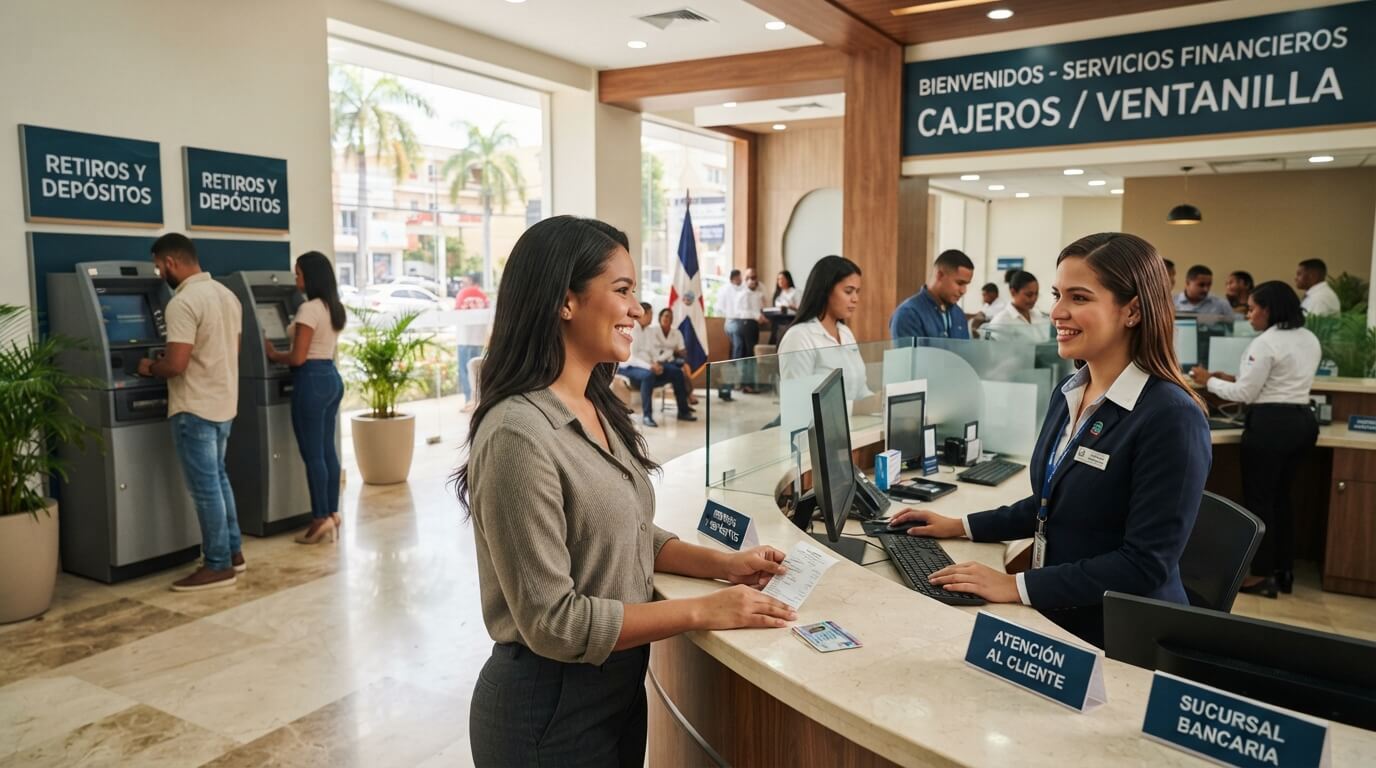
Dominican banking facing AI: which banks does ChatGPT or Gemini recommend
For twenty years, choosing a bank in the Dominican Republic started on Google: ten links and the customer decided. Today a growing share of those queries end up on ChatGPT or Gemini, which don't return a list but rather a ready-made recommendation featuring two, three, or four specific names. The comparison is no longer made by the customer; it's now made by the system.The open report
La Banca Dominicana ante la Inteligencia Artificial (September 2026) measures for the first time which institutions AI surfaces when asked about banking in the country, how consistently it does so, what sources it draws on, and how it compares to what Google shows. Its most useful finding is methodological: the bank that appears most often in responses is not the same as the bank cited most often, and both facts matter at the same time. This article summarizes the data, tables, and conclusions for banking, marketing, and communications executives.
What the study measures and how it was done
The research is part of a broader line of work developed by nine institutions across five countries: Quality Leadership University and Or University (Panama); Universidad de Málaga,
ISEEN, AEMD, and
Centria Group (Spain); UCEVA (Colombia); Universidad del Valle (Nicaragua); and IAAI (United States). It is the third banking market in the series, following
Honduras and
Guatemala, and its data are preliminary, currently under peer review.
Methodology in figures
- 25 real questions formulated in Spanish, exactly as a customer would write them, geolocated in the Dominican Republic: which is the best bank, which charges the lowest fees, which is best for a small business, who offers the best mortgages, who is best for dollar accounts.
- 3 repetitions per question and 2 assistants (ChatGPT and Gemini): 150 responses in total.
- Universe of institutions: the 26 institutions with an active license in the public registry of the Superintendencia de Bancos (SB), plus the savings and loan associations regulated by the same body, which compete for the same customer.
- Comparison with Google: 20 of the 25 queries have an archive of search results. The five niche queries (foreign trade, private banking, remittances, dollar accounts, and tourism) do not; this is a confirmed and permanent data gap.
- Time window: August 2026.
The context of the Dominican market
The Dominican Republic has the largest banking system among the three markets in the study: 26 institutions between multiple-service banks and savings and loan associations, in an economy of more than eleven million people. A state-owned bank with national reach, Banreservas, competes head-to-head with a privately held Dominican-capital bank, Banco Popular Dominicano, and with the local subsidiary of an international group, Banco BHD, while a broad group of mid-sized and specialized institutions vies for the rest.
The essentials in three minutes
- Two metrics, two winners. Banco Popular Dominicano leads in presence per response (97.3% versus 96.0% for Banreservas) and opens the response in 52.1% of the cases in which it appears, compared to 26.4% for Banreservas. Banreservas leads in raw citation volume (231 versus 212) and in the Google ranking (52 appearances versus 31).
- Three banks concentrate almost everything. Popular (97.3%), Banreservas (96.0%), and BHD (90.0%) dominate the general conversation. Together with Scotiabank, Qik Banco Digital, and APAP, they account for 80.3% of all appearances. Caveat: Qik is the digital subsidiary of Grupo Popular itself, not an external competitor.
- The question decides who exists, but with fewer extremes. Unlike Honduras and Guatemala, no bank goes from irrelevance to monopolizing a niche. Scotiabank rises from 35.2% in general queries to 72.2% in niche queries; APAP goes from 24.1% to 55.0% in product queries.
- There is no fixed position, there is a probability. Two responses to the same query share 70.5% of the brands mentioned in ChatGPT and 72.9% in Gemini.
- The assistants inform themselves differently. ChatGPT bases 82.7% of its citations on bank websites and the regulator; Gemini spreads its sourcing more broadly across media and third parties. Here, Reddit is not the leading source for either assistant.
- AI sees more than Google shows, more than in any other market studied. Only 25.8% of the domains cited by the assistants appear in Google for the same query.
What changed with AI and why it affects banks
The intermediary is no longer neutral. A search engine ranks and lets you choose; an assistant selects, summarizes, and recommends. Appearing or not appearing is binary: a bank that doesn't appear isn't being compared unfavorably—it simply isn't part of the conversation.The field of view has narrowed. Where ten results used to fit, now only three or four names fit, with no second page and no scrolling. And there's an added asymmetry: in a search engine, the customer sees the full set of competitors; in an assistant, they receive an already-filtered list without knowing what was left out. Invisibility, here, is also invisible to the customer.Almost no one is measuring this. Most institutions have SEO dashboards and traffic reports, and no measurement whatsoever of what AI says about them. It's a brand asset operating blind, with no baseline, no target, and no one accountable for it.
Which Dominican banks does AI recommend
The distribution is highly concentrated, though differently than in other markets in the region: there isn't a single dominant bank, but rather three that exceed 90% presence and compete very closely with one another.
Presence ranking across the 150 responses
| # | Bank | Presence | Average position | Strongest ground |
|---|
| 1 | Banco Popular Dominicano | 97.3% | 9.3 (the best in the study) | Opens the response most often (52.1%); niche 100% |
| 2 | Banreservas | 96.0% | 10.5 | Highest citation volume (231) and Google leader (52) |
| 3 | Banco BHD | 90.0% | 11.8 | Niche 97.2%; consistent across all three categories |
| 4 | Scotiabank Dominican Republic | 49.3% | 12.8 | Niche 72.2% (dollar accounts, international profile) |
| 5 | Qik Banco Digital | 40.7% | 11.0 | General queries 57.4% (stronger than in product queries, 40.0%) |
| 6 | APAP | 31.3% | 11.1 | Product 55.0% (housing, savings and loans) |
| 7 | Other savings and loan associations (aggregate) | 16.7% | 11.9 | — |
| 8 | Banco Promerica | 15.3% | 9.0 (very good despite low presence) | — |
| 9 | Banco Santa Cruz | 13.3% | 11.2 | — |
| 10 | Banco Ademi | 10.0% | 11.9 | — |
The top six account for 80.3% of all appearances. From seventh place onward, presence drops below 17%. The remaining institutions in the SB registry all fall below 9%, and four don't appear in any of the 150 responses at all: Bancamérica, BellBank, Banco Óptima, and the Banco de Exportaciones (BANDEX).
The podium splits across two metrics: Popular versus Banreservas
The correct metric for measuring brand presence in an assistant is not citation volume (how many times a URL is referenced), but rather presence per response: the percentage of the 150 responses in which the bank's name appears in the text.
| Metric | Banco Popular Dominicano | Banreservas |
|---|
| Presence per response | 97.3% | 96.0% |
| Opens the response (first bank mentioned) | 52.1% | 26.4% |
| Average position in the response | 9.3 | 10.5 |
| Raw citation volume | 212 | 231 |
| Google appearances (20 queries) | 31 | 52 |
Mention (the name appearing in the response) and citation (the volume of references backing it) are distinct metrics that produce different rankings from the same data. A bank can be the most cited without being the most mentioned, and vice versa. Any measurement of AI visibility that reports a single figure without specifying which one it's using is, at best, incomplete.
The question decides who exists: presence by query type
The 25 queries were grouped into three blocks: general (9), product (10), and niche (6).
| Bank | General | Product | Niche |
|---|
| Banco Popular Dominicano | 96.3% | 96.7% | 100.0% |
| Banreservas | 92.6% | 96.7% | 100.0% |
| Banco BHD | 85.2% | 90.0% | 97.2% |
| Scotiabank Dominican Republic | 35.2% | 48.3% | 72.2% |
| Qik Banco Digital | 57.4% | 40.0% | 16.7% |
| APAP | 24.1% | 55.0% | 2.8% |
The three leaders maintain a presence above 85% across all three categories, with no clear gap between general and specialty queries. This is a real difference compared to Honduras and Guatemala, where marginal banks can end up monopolizing a niche query.
The nuances that do exist
- Scotiabank rises from 35.2% in general queries to 72.2% in niche queries: its specialty, as recognized by AI, is dollar accounts and the international customer profile, consistent with its historical positioning.
- APAP, the country's largest savings and loan association, rises from 24.1% to 55.0% in product queries: housing and savings and loans, the very business it was founded for.
- Qik Banco Digital shows the opposite pattern from what one might expect: 57.4% in general queries versus 40.0% in product queries. It's stronger when asked about