
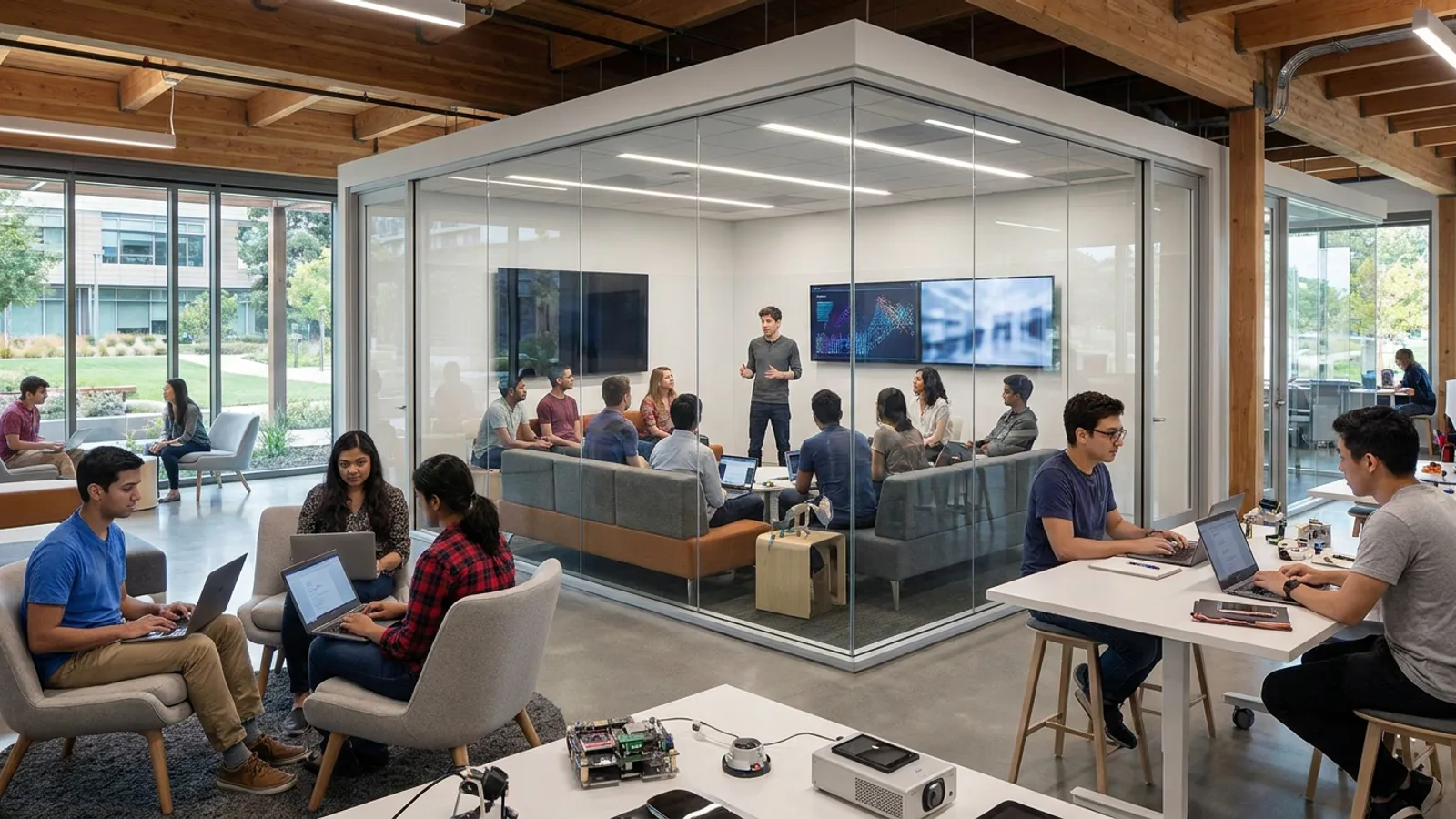
Venture capital firm Andreessen Horowitz (a16z) has unveiled a new educational model that breaks with traditional universities: no degrees, no exams and no grades. It's called the Horowitz Andreessen Academy, and it will offer 50 free seats to young people who want to train in artificial intelligence alongside companies such as OpenAI, Google, Meta and Palantir.
The announcement comes at a time when the debate over the usefulness of university degrees versus practical tech training has intensified in the United States, particularly in the artificial intelligence sector, where hands-on experience with models and tools is gaining weight over academic credentials.
How the program works: short classes and internships at leading companies
The project has initial funding of 42 million dollars and the participation of ten tech companies as founding partners: Anduril, Anthropic, Coinbase, Google, Meta, NVIDIA, OpenAI, Palantir, Replit and Stripe.
Unlike a university degree, the academy grants no academic accreditation upon completion. Instead, students will receive short classes taught by Silicon Valley founders and executives, combined with hands-on stints inside the partner companies, internally referred to as "co-ops."
Among the confirmed instructors is Sam Altman, CEO of OpenAI, who will teach classes as part of the program, according to official information from the academy.
No exams, no assignments, no grades
The program completely eliminates traditional academic assessment elements. There will be no exams, grades or conventional assignments. Time not spent in training sessions will be devoted to working on and exploring projects within the partner companies' ecosystem.
More than $50,000 in computing credits per student
Each of the 50 admitted students will receive a resource package that includes more than 50,000 dollars in computing credits, plus an additional budget of 5,000 dollars for travel and research.
These figures place the material value of the program above the cost of many private tech master's degrees in the United States, though without the academic credential that those programs do confer upon completion.
The condition that limits access: living in San Francisco on your own dime
To take part in the academy, admitted students must relocate to San Francisco for the duration of the program. The organization does not provide housing or financial assistance to cover it, according to the FAQ section published by the academy itself.
This requirement acts as an economic and geographic filter from the outset. San Francisco's cost of living is among the highest in the United States, which in practice narrows access to the program to those with their own resources or enough family support to sustain a year of residency in the city, even though tuition is free.
A bet that echoes a16z’s critical stance toward universities
The creation of this academy is not an isolated event in the trajectory of its founders. Last year, a16z co-founder Marc Andreessen described Stanford and the Massachusetts Institute of Technology (MIT) as institutions that, in his words, act as lobbying operations opposed to American innovation, according to a report by The Washington Post based on a group chat with White House officials and tech leaders.
Ben Horowitz, the firm's other co-founder, has also publicly expressed his distrust of conventional university programs.
Against this backdrop, the Horowitz Andreessen Academy presents itself as a concrete alternative, funded and designed by the very investors who have questioned the traditional academic model.
Not the first alternative school created by Silicon Valley
a16z is not the only tech firm that has tried to build its own educational path. In recent years, Elon Musk, Mark Zuckerberg and Jeff Bezos have all funded school projects with similar approaches.
The pattern repeats itself: replacing the traditional academic structure with models centered on hands-on practice, close ties to the tech industry, and the selection of profiles aligned with the interests of their own companies.
The main difference in a16z's case lies in its small scale—just 50 seats—and its network of industry partners, which turns the program into a direct pipeline for recruiting young talent for companies like Anthropic, NVIDIA or Stripe.
What prospective applicants should consider
For a recent high school graduate interested in artificial intelligence or startups, the program poses a decision worth weighing carefully before applications open in 2027.
First, the academy does not grant any recognized degree. Those aiming for positions that require formal academic accreditation—in public administration, university research or regulated sectors—will not have that need met by this program.
Second, computing credits worth more than 50,000 dollars represent a real and scarce resource for those wanting to develop their own AI projects, since access to computing infrastructure is often one of the main obstacles for independent students.
Third, the requirement to live in San Francisco without housing assistance constitutes the program's real hidden cost. Even though tuition is free, that expense should be factored in as part of the effective price of the training before applying.
The first edition of the Horowitz Andreessen Academy will begin in fall 2027 and will be aimed mainly at recent high school graduates.
Frequently Asked Questions
What is the Horowitz Andreessen Academy?
It is an educational program created by venture capital firm Andreessen Horowitz (a16z) that offers free tech training without granting academic degrees, combining short classes with internships at partner tech companies.
When does it start and how many seats are available?
The first edition will launch in fall 2027 with only 50 seats available, aimed mainly at recent high school graduates.
Which companies are participating as program partners?
Ten tech companies are founding partners: Anduril, Anthropic, Coinbase, Google, Meta, NVIDIA, OpenAI, Palantir, Replit and Stripe.
Does the academy grant any degree upon completion?
No. The program does not confer any recognized degree or academic accreditation at the end of the training year.
What financial resources does each student receive?
Each participant receives more than 50,000 dollars in computing credits and an additional budget of 5,000 dollars for travel and research.
Is it necessary to live in San Francisco to participate?
Yes. Admitted students must relocate to and reside in San Francisco during the program, and the academy does not offer housing or financial assistance to cover that expense.
Who will teach in the program?
Among the confirmed instructors is Sam Altman, CEO of OpenAI, along with other founders and executives from Silicon Valley companies.
