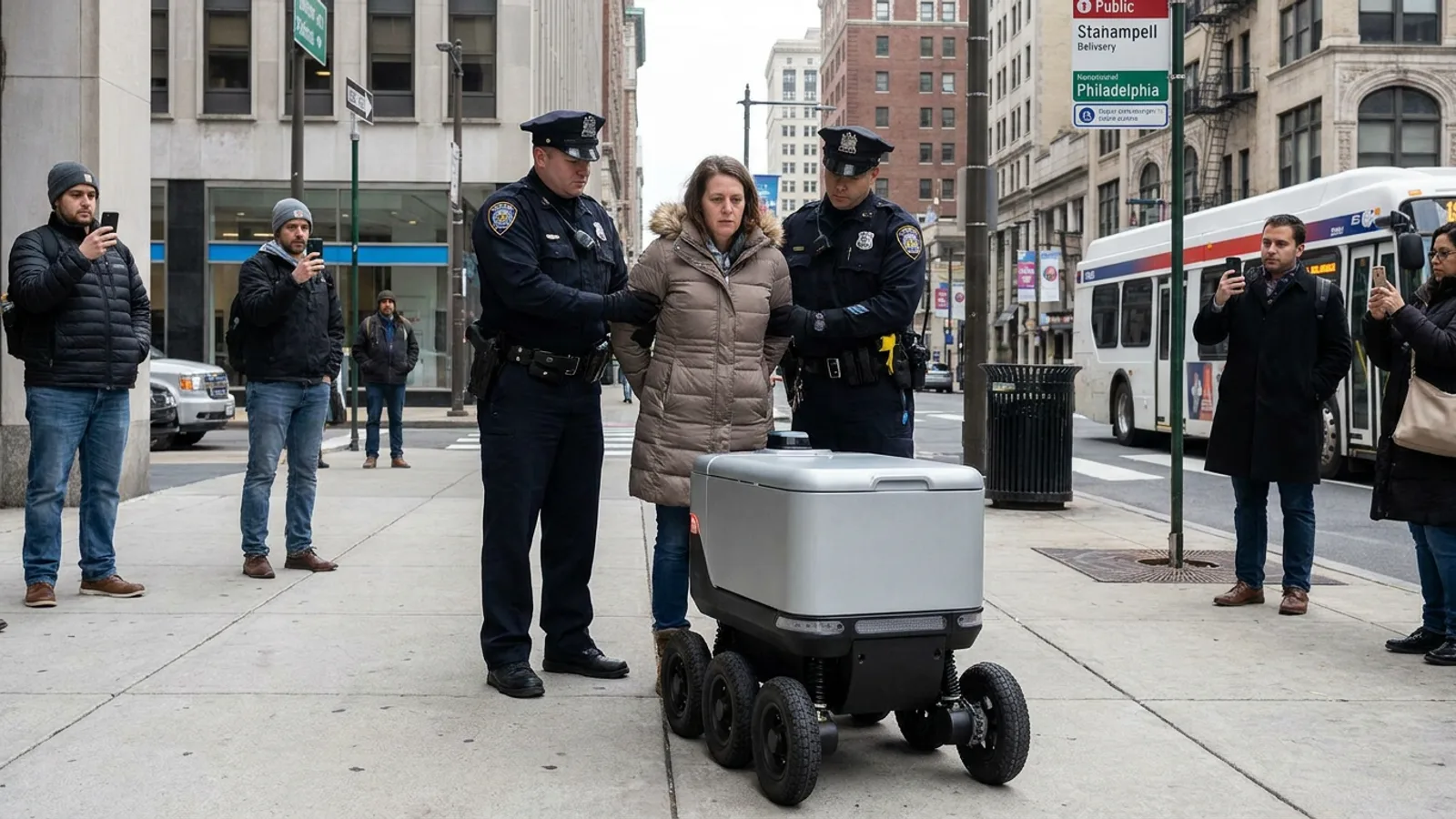
A video recorded in downtown Philadelphia has reignited the debate over the place of delivery robots on American streets. A local resident, Carolyn Marvin, was handcuffed and arrested after standing in front of one of these Uber-operated devices and refusing to move.
The case gains relevance just as several U.S. cities are considering imposing limits on autonomous vehicles and robots operating on sidewalks and roads, amid growing concern over the effect of these technologies on low-skilled jobs.
How Carolyn Marvin’s arrest occurred
As Marvin herself told local station ABC13, her gesture was not accidental. The woman deliberately placed herself in the path of the delivery robot and remained there, preventing it from continuing its route.
Police arrived at the scene and asked her to clear the way. Marvin refused to move. The officers then proceeded to handcuff and arrest her, and she was subsequently charged with disorderly conduct, a legal term in the United States applied to behaviors that disrupt order in public spaces.
The incident was captured on video and the images have circulated widely, generating significant media attention surrounding the case.
A protest that she claims is recurring
Marvin explained that her stance against the robot was not an isolated event. According to her own testimony, she has been standing in front of these devices for some time whenever she encounters one, as a form of rejection of their presence on the streets.
In fact, this would not be the first time Marvin has had a run-in with these machines, although details about previous episodes are unknown. What is clear is the method used: a passive protest, carried out with her body, without ever damaging the device.
Uber robots, an increasingly common presence
Delivery robots have become a daily sight in downtown Philadelphia, and their arrival has not been without controversy among some residents.
In fact, another episode occurred this year in Center City, the city's downtown area, when one of these robots was kicked over. This is a different incident from the one involving Marvin, who never touched the machine, but it illustrates the same climate of tension.
Uber, the company behind the country's best-known passenger transport and food delivery platform, is responsible for operating the robot involved in the arrest, as part of its home delivery business.
Employment, at the center of the protest
Marvin's motivation has a labor-related component. According to her own account, she believes these robots are displacing human delivery workers from their jobs, which is why she has decided to act against them whenever she has the opportunity.
The case is part of a broader concern about the impact of autonomous systems on employment, especially among lower-skilled workers. This group usually includes robotaxis, delivery robots, and artificial intelligence-based assistants.
It is no coincidence that, in parallel with these types of incidents, various U.S. cities are evaluating restrictions on robotaxis, confirming that the Philadelphia conflict is not an isolated case within the current technological debate.
Lessons from the case
The Carolyn Marvin episode leaves several practical lessons for those who live with these devices in their cities.
First, physically blocking the path of a delivery robot and refusing to move after a police warning can lead to an arrest, as happened in this case.
Second, the form of protest is decisive. Marvin did not damage the robot at any time and was still arrested. Attacking or knocking over one of these devices, as happened months earlier in Center City, is a different scenario and potentially carries greater legal consequences.
Finally, for those who depend on the home delivery sector, it is advisable to keep an eye on how local regulations regarding these robots evolve, although no specific regulations have been approved in Philadelphia on the matter so far.
What is known and what remains pending
The facts confirmed so far are clear: one woman arrested, a charge of disorderly conduct, an Uber robot blocked, and a video that has gone viral on social media.
The judicial outcome of the case and Uber's official position on what happened have not been made public. There are also no figures available on how many robots of this type are currently operating on the streets of Philadelphia.
What is evident is the immediate effect of the incident: a citizen protest against the automation of delivery has ended in criminal charges, and the debate over who wins and who loses with the arrival of these machines is now moving directly to the city's sidewalks.
Frequently Asked Questions
Why was Carolyn Marvin arrested in Philadelphia?
She was arrested for deliberately blocking the path of an Uber delivery robot and refusing to move when asked by the police. She was charged with disorderly conduct.
Did Marvin damage the delivery robot?
No. According to available information, she simply stood in front of the device and prevented it from moving forward, without touching it or causing any damage.
Was this the first time Marvin protested against these robots?
No. She herself has stated that she usually stands in front of these robots whenever she encounters them, and there are indications that it was not her first run-in with this type of device, although previous episodes are not detailed.
Which company operates the robot involved?
The robot belongs to Uber, as part of its home food delivery service.
Have there been other similar incidents in Philadelphia?
Yes. This same year, another delivery robot was kicked over in Center City, the downtown area of the city, in an episode separate from the one involving Marvin.
What is the underlying reason for these protests?
Concern about the impact of delivery robots and other autonomous systems on the employment of lower-skilled workers, a debate that also affects robotaxis and other forms of automation.