More and more people are describing their symptoms to a generalist chatbot before going to see a healthcare professional. This habit, now established among patients of all ages, raises an urgent question: where should artificial intelligence assistance end and where does irreplaceable clinical judgment begin?
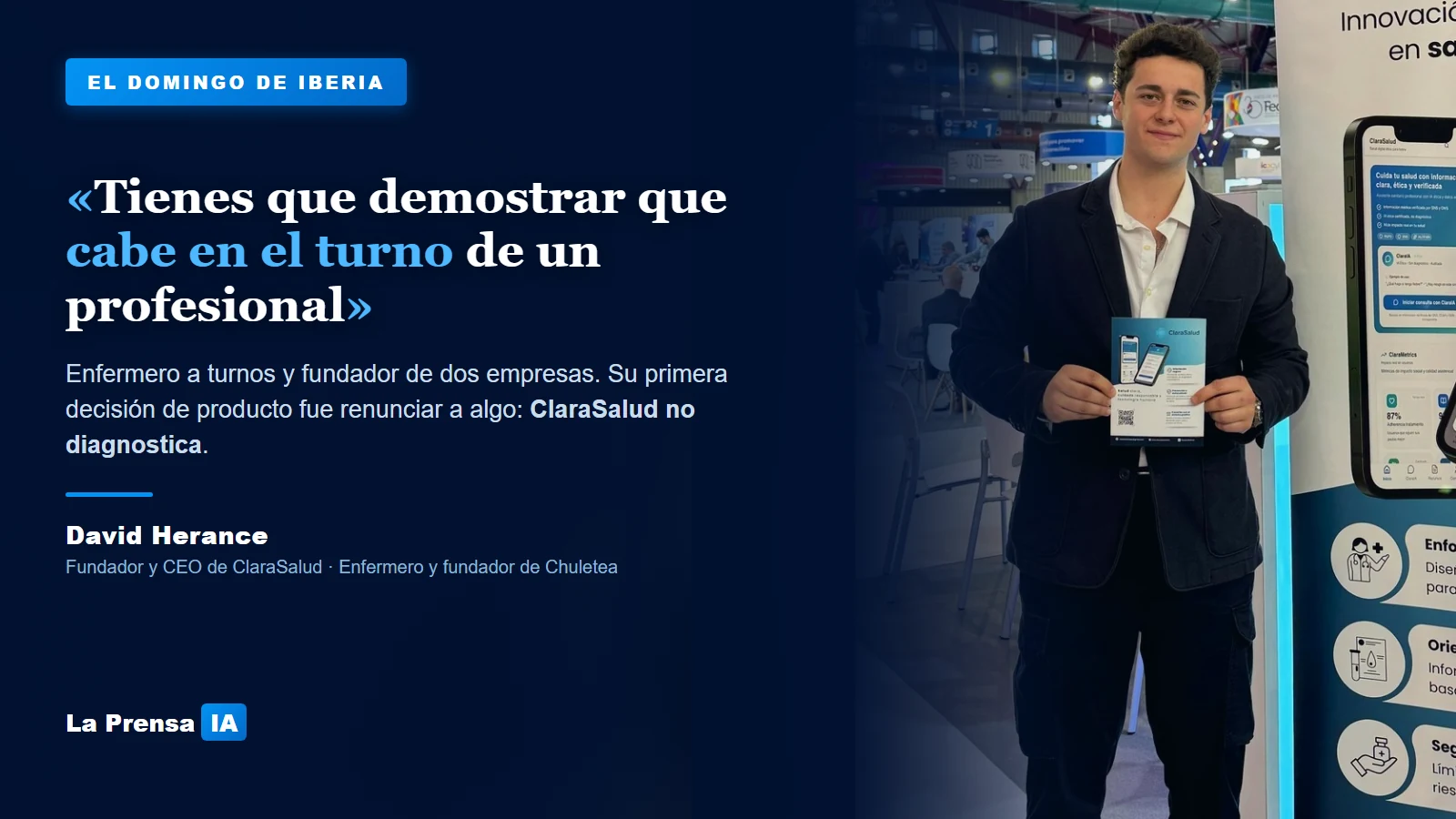
David Herance has an answer built from two different fronts. He is an active nurse, working shifts on the front lines of care, and at the same time, he has founded two companies: ClaraSalud, a healthcare guidance platform with artificial intelligence, and Chuletea, a tool where healthcare workers themselves document the practical knowledge of their departments that is usually never written down.
In an email interview, Herance explains why his platform decided from the design stage to forgo a function that would seem obvious for any healthcare AI product: diagnosing.
The line that ClaraSalud does not cross
"The line we do not cross is diagnosis," says Herance. ClaraSalud does not intend to tell the user what they have or replace the judgment of a professional.
As he explains, that decision responds both to regulatory evolution and the current limits of technology. "As of today, I do not believe that artificial intelligence is prepared to autonomously assume something as complex and with as much responsibility as a diagnosis," he maintains.
For Herance, the contribution of nursing at this moment of digitization lies in extending the healthcare system to the home: prevention, education, health promotion, and self-care. AI can help organize reliable information among the enormous amount of healthcare content available, relying on literature, protocols, and validated clinical guidelines.
But there is a boundary he is not willing to move: "Looking at a person, listening to them, touching them, understanding how they feel, or perceiving something that does not appear in the data remains an essential part of our work."
Designing uncertainty as a feature
One of the risks that worries Herance the most is not that the application will be wrong, but that someone will delay necessary care because the tool gave them a false sense of calm. "In health, an apparently reassuring answer can also be a serious error," he warns.
That is why ClaraSalud was built with a conservative logic: not to open the internet to the patient through AI, but to bring them validated and understandable knowledge, reducing to the maximum the space where the system can improvise.
"Knowing how to say 'I don't have enough information to guide you safely' is a feature, not a bug," he summarizes. That refusal to always provide an answer meant discarding certainties that the platform could not justify and preventing the user from delegating health decisions to a machine.
Chuletea: the knowledge that is never written down
Herance's second project starts from a different but connected observation: in healthcare centers, there is practical knowledge—where the equipment is, who to call, how the shift really works—that is almost never documented and is transmitted only from colleague to colleague.
For Herance, the reason is a mix of tools and culture, although he believes the latter carries more weight. "The healthcare system continues to operate in many aspects with quite old dynamics," he points out, without looking for culprits among supervisors or managers who work within a saturated system.
"They stop seeming small when you are the one arriving new on a Saturday night and don't know where the equipment is," he explains. Chuletea seeks to make that knowledge available even when the colleague who usually transmits it cannot help at that moment.
What hospitals buy that no one uses on the floor
From his experience as an active nurse, Herance makes a statement that might sound contradictory coming from someone who builds healthcare technology: "Digitizing more does not necessarily mean working better."
Many computer systems incorporated into care processes are not sufficiently adapted to the professional's real work, he points out. The problem arises when digital registration implies more time in front of a screen, duplicated fields, or constant switching between systems, to the detriment of time spent with the patient.
Hence his design principle: "In healthcare, it is not enough to demonstrate that a technology works: you have to demonstrate that it fits into a professional's shift." A solution may look magnificent from an office and fail in front of a nurse with patients in their care and constant interruptions.
Privacy as a design limit, not a formality
Health data is one of the most protected categories that exists, and Herance admits that working in that field forced a change in a mentality common in technology: having more data does not equate to having a better product.
ClaraSalud refused to store all conversations and interactions indiscriminately, even though that information would facilitate pattern analysis and system improvement. "Instead of thinking about what data we can save, we think about what data we really need to provide the service and for how long we need to keep it," he explains.
As a SaaS platform designed for institutions, Herance emphasizes that they seek to adapt to the security and data governance requirements of each organization, without shifting their own responsibility onto them. "Every piece of data you save is also a responsibility," he summarizes.
Clinical content validation
Herance acknowledges that ClaraSalud is in the construction and validation phase, and that today it does not have a large medical structure continuously reviewing every piece of content. His goal is for each piece of knowledge used to have an identified source, an incorporation date, and a review cycle, so that when a clinical guideline changes, the affected content can be identified and updated.
As the project progresses, he plans to incorporate clinical professionals responsible for that review alongside the technical team.
The message to professional colleagues
When asked what he would say to a colleague who sees artificial intelligence arriving in their department without knowing if it is a threat or a tool, Herance responds from his role as a nurse, not as a founder.
He reminds them that that person probably already uses ChatGPT or Gemini to resolve daily doubts, and that the key is not in rejecting technology but in not delegating professional judgment to it. "Use it to take work off your plate, not to take responsibility off your plate," he summarizes.
For Herance, the true transformation of AI in healthcare will not consist of getting a machine to replace a nurse or a doctor, but in recovering the time that is currently lost without being with the patient.
Frequently Asked Questions
What is ClaraSalud?
It is a digital healthcare guidance platform that uses artificial intelligence to help people better understand their health situation, relying on literature and validated clinical guidelines, without issuing diagnoses or replacing the healthcare professional.
Why does ClaraSalud not diagnose?
According to its founder, David Herance, current technology is not prepared to autonomously assume the responsibility of a diagnosis, and furthermore, the regulatory evolution of the sector points in that direction.
What is Chuletea?
It is another project founded by Herance where healthcare professionals share in writing the practical knowledge of their center or department, such as the location of equipment or the actual operation of the shift, information that is usually only transmitted orally between colleagues.
Who is David Herance?
He is an active nurse, based in Madrid, and founder and CEO of ClaraSalud and Chuletea. He defines his work as building technology for healthcare from the inside, combining his clinical practice with the development of both projects.
What user data does ClaraSalud store?
According to its founder, the platform avoids the indiscriminate storage of conversations and interactions, limiting itself to the data strictly necessary to provide the service and for the essential time, prioritizing patient privacy over technical convenience.
Does ClaraSalud review its content with medical professionals?
The platform is in the construction and validation phase. Its goal is for each piece of content to have an identified source, an incorporation date, and a review cycle, and to progressively incorporate clinical professionals responsible for that supervision.