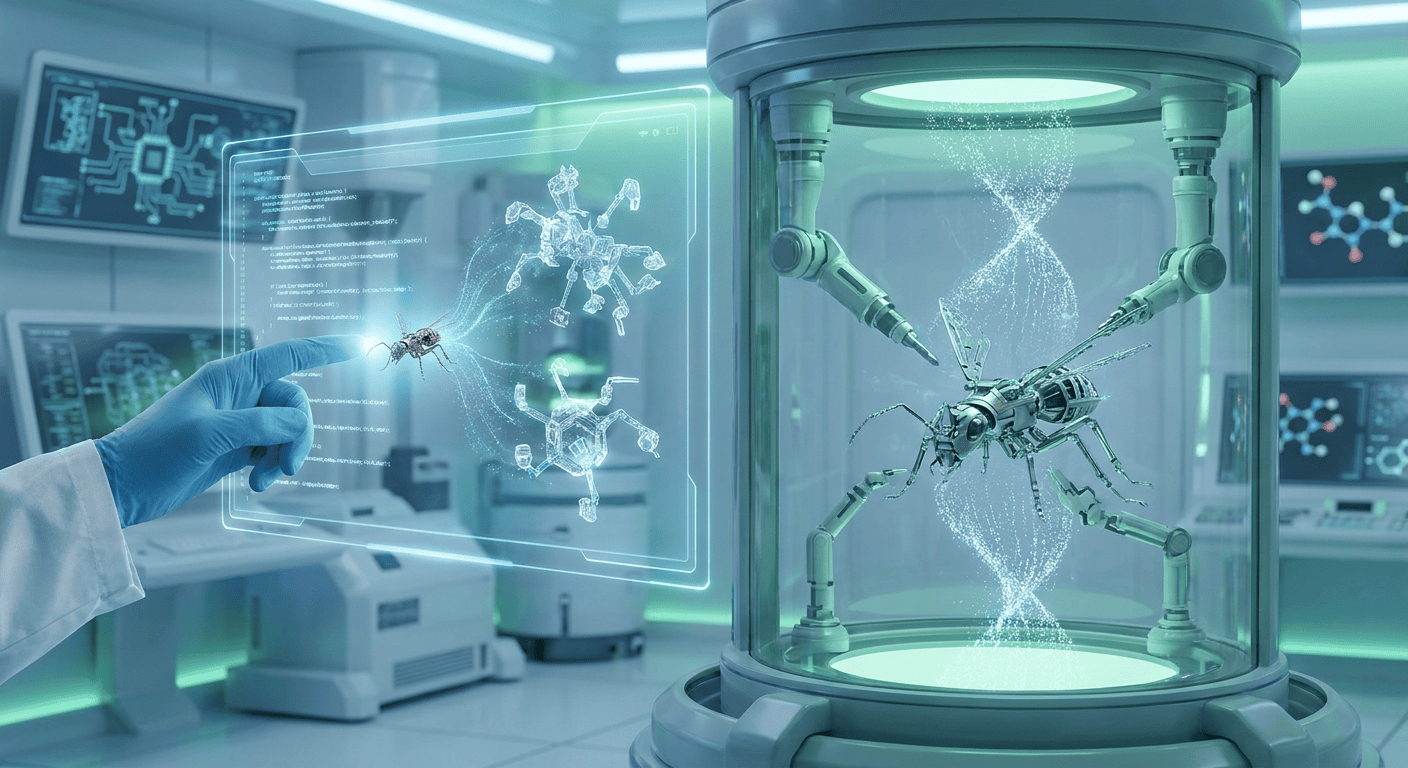
A California-based company has just unveiled a technology that has been in secret development for years: a factory capable of transforming code into physical, microscopic machines. Atomic Machines has announced a $250 million investment to scale a system that promises to change how precision hardware is designed and produced.
The announcement comes at a time when the demand for faster and more efficient electronic components is skyrocketing, driven largely by the infrastructure needed to support the artificial intelligence boom. For this reason, a tool that promises to accelerate and lower the cost of manufacturing tiny parts is particularly relevant right now.
What is the Matter Compiler
The core of Atomic Machines' proposal is called the Matter Compiler. It is not a conventional 3D printer that merely molds an existing material. This system builds a complete, operational device from scratch, following digital instructions.
In practice, anyone wanting to manufacture a tiny machine only needs to describe it using code. From there, the artificial intelligence takes care of assembling it piece by piece, checking each component during the process and deciding which materials fit best according to the function it must perform.
The company summarizes its goal with a simple phrase: going directly from code to the final product, without the intermediate steps required by traditional manufacturing.
PrimeSwitch, the first device born from this system
The first tangible result of this technology is PrimeSwitch, a power switch designed for servers that support artificial intelligence workloads.
As reported, it is a miniature electromechanical power relay capable of conducting 150 amps continuously and opening in just 50 microseconds. That speed would place it about a thousand times ahead of a conventional contactor, a difference that can be decisive in data centers where energy efficiency is increasingly critical.
Six years of quiet work before coming to light
Atomic Machines is not an improvised project. The company, founded by Jeff Holden, remained in stealth mode for six years before publicly presenting the Matter Compiler and confirming the $250 million funding round.
As the company itself has explained, its platform relies on programmable operations and constant measurements to design, build, and perfect devices without the need to create new molds, masks, or specific processes for each product. That flexibility is precisely what distinguishes this approach from traditional manufacturing lines, which are almost always designed for a single type of part.
An artificial intelligence that learns while it manufactures
One of the most striking aspects of the system is its capacity for continuous learning. The AI does not just execute instructions: it measures, corrects, and adjusts every step of the manufacturing process in real time.
According to information gathered by The New York Times, the system performs experiments during each build to extract insights and improve progressively. Even so, full automation is not yet complete. Engineers still intervene to move parts between the thirteen machines that make up the process and to collaborate on the final assembly.
The long-term vision aims to eliminate that human dependency on repetitive tasks, so that the same system can produce completely different devices simply by changing the digital instructions it receives.
What this technology implies
If this proposal fulfills its promises, it could open the door to much more accessible advanced hardware manufacturing. Professionals in sectors such as electronics, medicine, or robotics could design components at a microscopic scale without going through the expensive and rigid traditional manufacturing processes.
In theory, this would translate into shorter innovation cycles and cost reductions for those who need to prototype or produce highly specialized parts, from power switches to tiny medical components.
Frequently Asked Questions
What is Atomic Machines?
It is a California-based company that has developed the Matter Compiler, an AI-based manufacturing system capable of building functional micromachines from code instructions.
How much money has the company raised?
Atomic Machines has secured $250 million to drive the development and commercial application of its AI-native manufacturing technology.
What is the PrimeSwitch?
It is the first device manufactured with this system: a miniature electromechanical switch for AI servers, capable of conducting 150 amps and opening in 50 microseconds, making it about a thousand times faster than a traditional contactor.
Who founded Atomic Machines?
The company was founded by Jeff Holden, who kept the project secret for six years before presenting it publicly.
Is the manufacturing fully automatic?
Not completely. Although the AI directs the design, construction, and correction of each part, engineers still intervene to move components between machines and assist in the final assembly.
How does it differ from a 3D printer’s Matter Compiler?
A 3D printer only modifies the shape of a material. The Matter Compiler builds complete, functional devices from scratch, selecting materials and correcting the manufacturing process at every stage.