
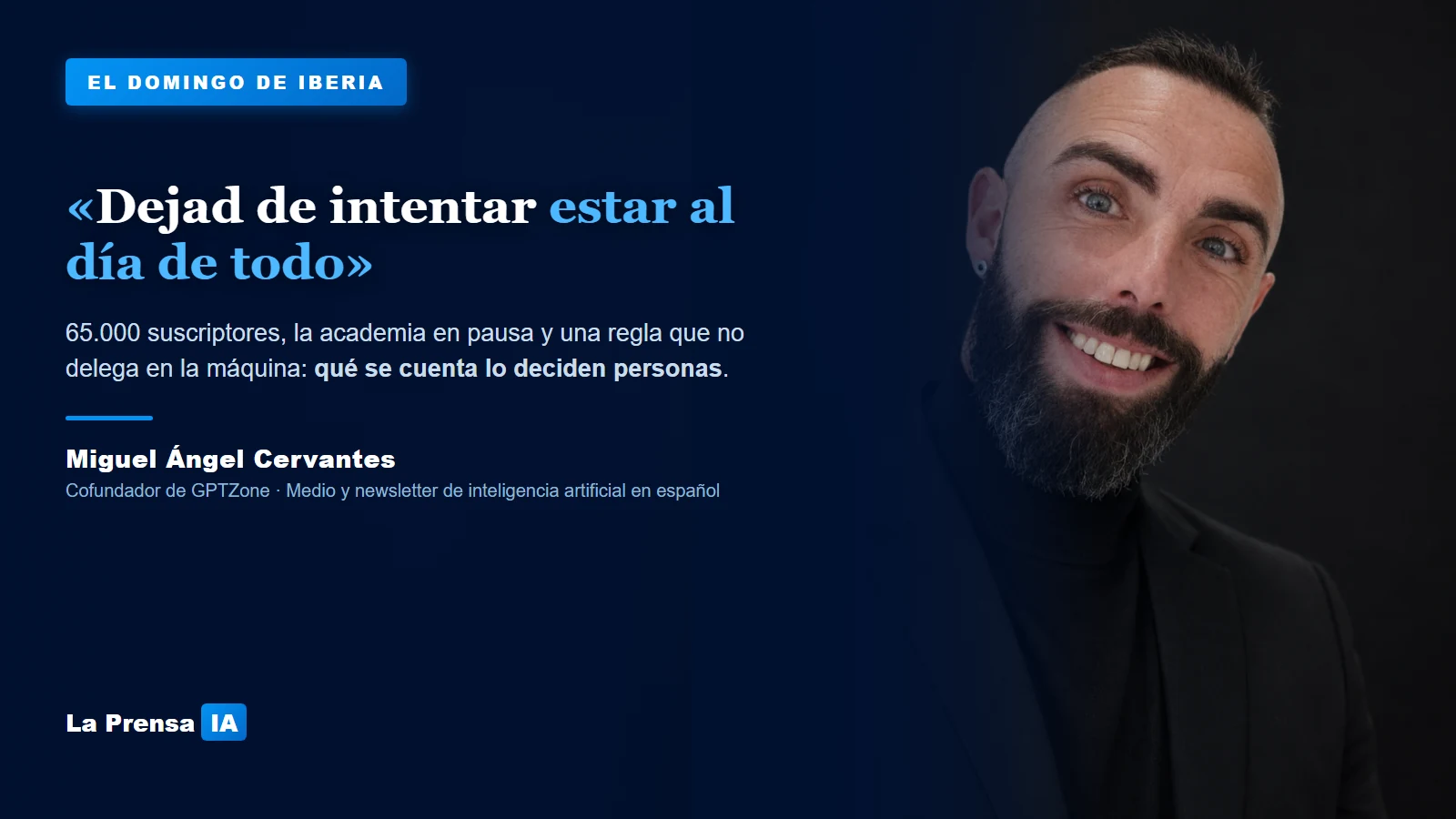
While Google reshapes its search engine with artificial intelligence and more and more users ask ChatGPT directly instead of typing three words into a search bar, tech-focused media outlets are undergoing a quiet transformation. One of the outlets that has best read this shift in Spanish is GPTZone, a project that today is nearing 65,000 subscribers on its newsletter.
Its co-founder, Miguel Ángel Cervantes, has shared in an interview the inner workings of that business: what gets automated with AI and what doesn't, where the real money comes from, and why he decided to freeze one of his most ambitious products. The conversation comes right as internal documents from OpenAI and Microsoft warn of a possible doom loop that could damage the entire web, and as publishers in the United Kingdom now have legal tools to stop Google from using their content in AI-generated summaries.
From wind energy to founding an artificial intelligence media outlet
Cervantes's path to GPTZone didn't go through a traditional newsroom. He worked for several years in the renewable energy sector, specifically in wind power, before making a radical shift toward mobile app development, an activity that supported him for more than a decade as he built and monetized apps.
That stage, he explains, trained him to spot patterns: which emerging technologies end up changing mass habits. When he started testing the first artificial intelligence tools, he became certain that this wasn't a passing fad but a deep, structural change. That intuition led him to pivot completely toward creating GPTZone.
What an AI media outlet actually automates (and what it doesn’t)
Although they publish several news stories a day, Cervantes is clear about the limits of automation in his newsroom. Artificial intelligence and automations work, as he describes it, like a radar that constantly scans media outlets, launches and updates in an industry that produces dozens of announcements daily.
However, the decision about what deserves to be published remains entirely human. As he explains, the final selection of content—what goes on the website, what makes it into the newsletter and what gets shared on social media—is never delegated to any automated system.
65,000 subscribers and a 30% open rate
Regarding the newsletter's numbers, Cervantes says they currently have close to 65,000 subscribers, with an open rate hovering around 30%. For him, how much that figure matters depends on the business model: if a publication lives off selling info products or brand collaborations, the list's actual engagement matters more than its raw size.
In GPTZone's case, beyond the open rate, they analyze which topics generate the most clicks and which stories spark the most curiosity among readers, using that as a criterion for adjusting content.
Where the real money comes from
Despite having several monetization channels—a free newsletter, a paid academy, a directory with links and advertising on the website—Cervantes notes that the main source of income right now is brand collaborations, channeled mainly through the newsletter and social media.
The area that most disappointed the team was precisely the academy, which is currently on hold. The problem, he clarifies, wasn't the quality of the educational product or student retention, but the growing difficulty of attracting new students in an AI training market that quickly became saturated with competition.
A partner, not a parallel company
Cervantes also clarifies a point about his business structure: Telvia, a company specializing in AI voice agents, is not one of his projects but belongs to Jota, whom he met while launching GPTZone's academy alongside Aitor. After putting that academy on standby, their professional paths separated. GPTZone is currently run by two partners: Cervantes and Aitor.
The challenge of writing for a reader who no longer searches on Google
One of the most relevant points in the conversation concerns the shift in user behavior. Drawing on his previous experience in the app world, Cervantes observes that more and more queries that used to start in a search engine now begin as a conversation with assistants like ChatGPT, Gemini or Claude.
That shift has given rise to a new concept starting to be discussed in the industry: GEO (generative engine optimization), as a natural evolution of SEO and ASO. Cervantes avoids offering set formulas for how to position content in this new landscape, insisting that any certainty about how this market will evolve in just a few years should be taken with caution.
The tension between monetizing and turning every story into clickbait
GPTZone's newsletter doesn't tell the full story in the email: it offers the essentials and directs readers to the website. Cervantes acknowledges that finding the right balance between monetizing that traffic and not testing the reader's patience is a constant process of trial and error, with no fixed formula, which they review almost daily through click and response metrics.
Where he draws the line with brands
On one of the most uncomfortable debates for any tech-focused media outlet, Cervantes confirms that they have turned down collaborations with tools that, despite offering good financial terms, they didn't consider good enough for their audience. Sponsored content, when it exists, is always labeled as such.
For GPTZone's co-founder, audience trust is the project's most valuable asset, and he prioritizes that long-term relationship over one-off income from specific campaigns.
Advice for anyone feeling overwhelmed by AI
Asked what a non-technical person should do in the face of the daily flood of AI news and tools, Cervantes is blunt: the first thing he recommends dropping is trying to keep up with absolutely everything.
Instead, he suggests identifying the everyday tasks that consume the most time and evaluating which ones could be improved with AI's help, starting by truly integrating two or three specific tools into your workflow, rather than spreading yourself thin trying out dozens of new releases every week.
Frequently asked questions
Who is Miguel Ángel Cervantes?
He is co-founder of GPTZone, a Spanish-language artificial intelligence media outlet and newsletter. Before working in AI he worked in the wind energy sector and, later, spent more than a decade building and monetizing mobile applications.
How many subscribers does GPTZone’s newsletter have?
It currently has around 65,000 subscribers, with an open rate close to 30%.
What does GPTZone actually live on?
Its main source of income is brand collaborations, channeled mainly through the newsletter and social media, although they have other diversified monetization channels.
Why did GPTZone pause its training academy?
It wasn't due to retention or quality issues, but because it became very difficult and costly to attract new students in an AI training market saturated with competition.
Is Telvia a company owned by Miguel Ángel Cervantes?
No. Telvia, dedicated to AI voice agents, is a project run by Jota, whom Cervantes initially met through GPTZone's academy before their professional paths separated.
What platform does GPTZone use for its newsletter?
They use beehiiv, chosen over Substack because it offers more flexibility for monetizing and working with brand collaborations.
What is the GEO that Cervantes mentions?
It refers to optimizing content so it appears and is relevant in responses generated by artificial intelligence assistants, as an evolution of traditional SEO and the ASO used in app stores.