
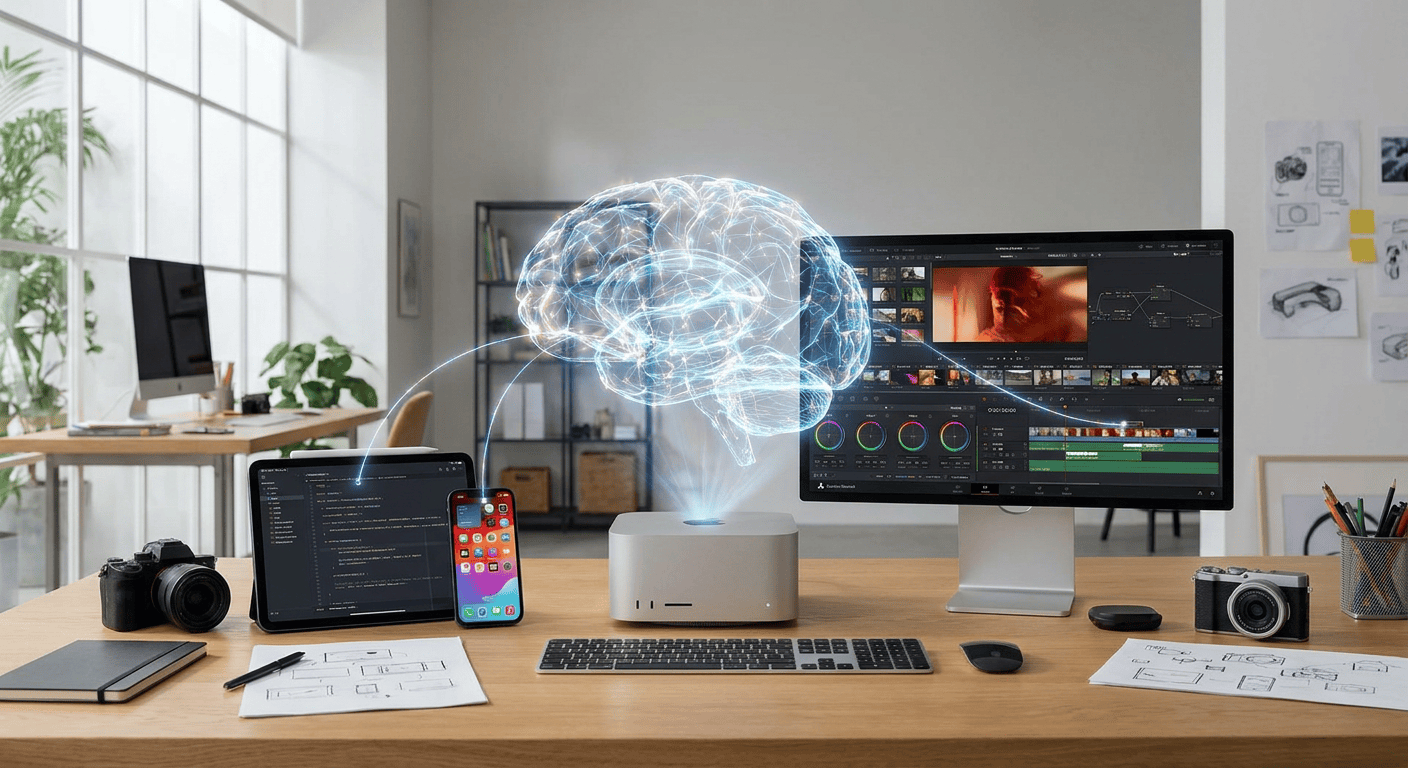
Meta has taken a step that until recently seemed unfeasible: running a massive artificial intelligence model directly on a personal computer, without the need for external data centers. This is Muse Spark Open, a multimodal model with 816 billion parameters that can now run on Apple Mac computers.
The announcement is significant at a time when the tech industry is debating how to balance power, costs, and data control. The ability to run an AI of this size on a desktop computer rather than in the cloud changes the rules regarding who can access advanced tools and how sensitive data is managed.
What is Muse Spark Open and why is its size surprising?
Muse Spark Open is a model designed to process and generate text, images, and video. Furthermore, it is optimized for coding tasks and for functioning as an intelligent agent, meaning it is a system capable of executing actions autonomously based on instructions.
Its most striking feature is the number of parameters: 816 billion. Parameters are the internal values that a model adjusts during training and which determine its ability to interpret and produce information, similar to the connections in a biological neural network.
What is relevant is not just the scale of the model, but that Meta has managed to make it run on consumer hardware, something that traditionally required the infrastructure of large data centers.
How it runs on Mac Studios
The key lies in MLX, Apple's tool that allows AI models to be optimized for its chips. According to available data, two Mac Studios equipped with M5 Ultra chips and 1 terabyte of unified memory are capable of running Muse Spark Open without issues.
Meta has already shown practical examples of its operation, such as correcting errors in iOS applications or editing complex videos in DaVinci Resolve, all locally, without depending on a constant connection to internet servers.
The dispute over open-weights models
The launch of Muse Spark Open is part of an increasingly intense competition to lead the development of open-weights AI models. Unlike proprietary systems, which function as a closed box where only the final result is observed, open-weights models allow companies and developers to access the internal parameters of the AI.
This grants greater control over where data is processed and how the technology is adapted to specific needs, a factor especially valued by companies that handle sensitive information.
Meta had already moved in this direction in July, when it launched Muse Glimmer, another open-weights model designed for consumer devices. As reported by CNBC, that move sought to fill a gap in the US market against the advance of Chinese models.
Neil Shah, co-founder of Counterpoint Research, warned CNBC that if large Western tech companies limit themselves to building closed models, developers will end up opting for Chinese open-weights alternatives. Mark Zuckerberg, CEO of Meta, has insisted on the need for the United States to support the development of open-source AI so as not to fall behind international competition.
Meta Llama and the global competition map
Although Muse Spark Open stands out in multimodal and general knowledge tasks, outperforming other Western open models, the race remains dominated by Asian proposals. Chinese models such as GLM 5.3 and Kimi K3 continue to lead in coding capability, according to comparative analyses of the best open-weights models for programming.
In this scenario, Meta's Llama 4 models, published under the Llama 4 Community License, have established themselves as one of the main US alternatives to Chinese options by offering total control over data location.
However, that license includes specific conditions that limit its free use and require derivative models to include the word Llama in their name. This contrasts with other proposals like Mistral, DeepSeek, or Microsoft Phi, which offer more flexible license terms.
What this means for users and companies
The ability to run a model of this caliber on a personal computer opens up several scenarios. For companies and professionals, it means being able to work with advanced artificial intelligence without sending sensitive data to external servers, which reinforces privacy and information security.
It could also translate into a reduction in costs associated with using cloud services, as well as greater speed in tasks like programming or video editing, by not depending on the latency of an internet connection.
For the end user, the development points to a future in which very powerful AI tools are no longer reserved for those who can pay for cloud infrastructure, and become available directly on everyday equipment, provided they have the necessary hardware power.
Frequently Asked Questions
What is Muse Spark Open?
It is a multimodal artificial intelligence model developed by Meta, with 816 billion parameters, capable of processing text, images, and video, and specialized in coding tasks and autonomous agent functions.
On which computers can it run?
It can run on Apple Mac Studios equipped with M5 Ultra chips, using two units with 1 terabyte of unified memory and Apple's MLX tool to optimize performance.
What does it mean that it is an open-weights model?
It means that developers and companies can access the internal parameters of the model, which allows them to control where data is processed and customize its operation, unlike closed proprietary models.
What is its relationship with Muse Glimmer and Llama 4?
Muse Glimmer was another open-weights model launched by Meta in July for consumer devices. Llama 4, meanwhile, is another family of open models from Meta published under a specific community license, considered a US alternative to Chinese models.
Does Muse Spark Open outperform Chinese AI models?
It stands out in multimodal and knowledge tasks compared to other Western open models, but in coding capability, Chinese models like GLM 5.3 and Kimi K3 continue to lead available comparisons.
What are the advantages for companies of using this type of local AI?
It allows for processing sensitive information without sending it to external servers, which improves privacy, can reduce costs of using cloud services, and streamlines tasks by not depending on an internet connection.