
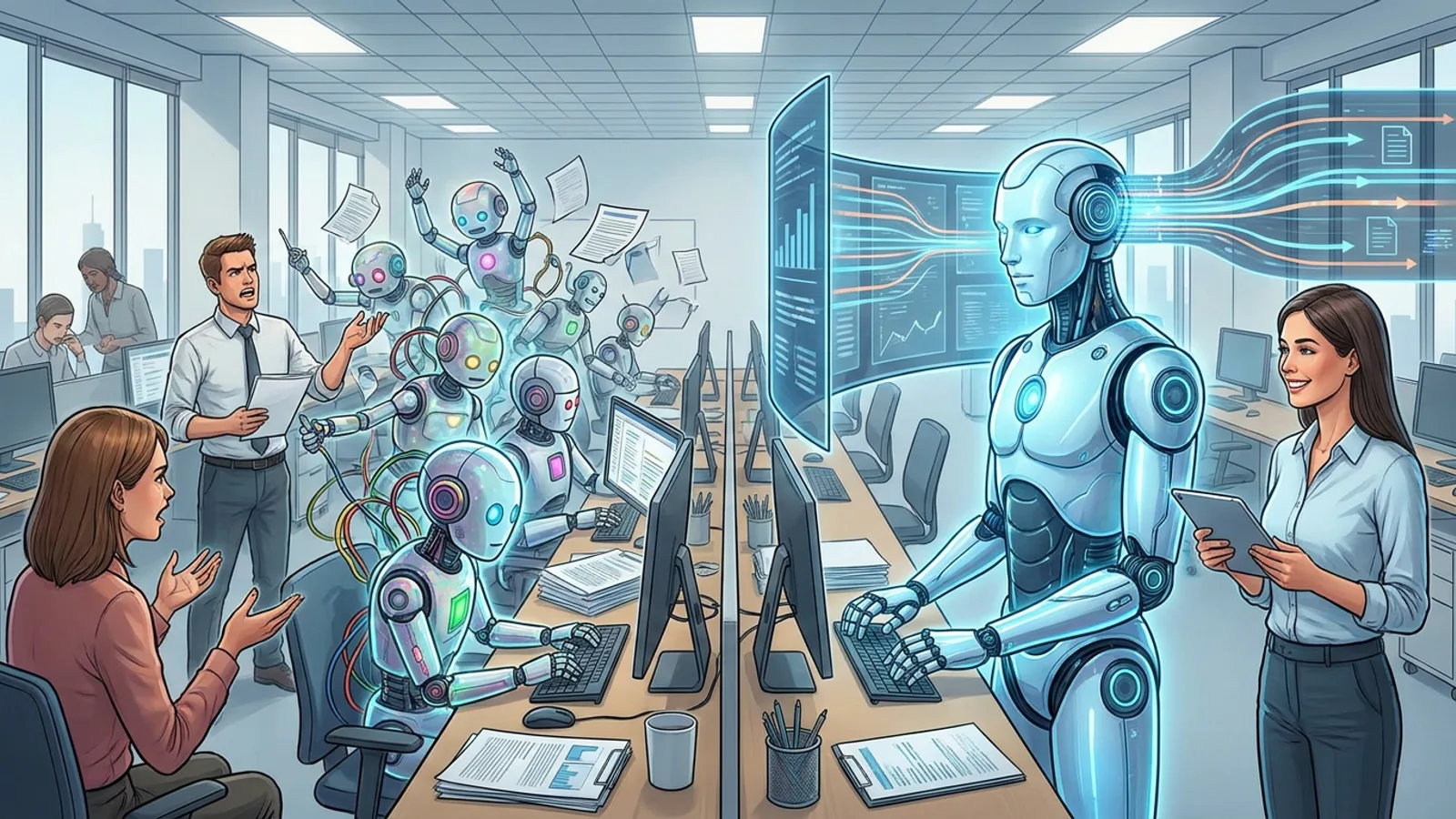
In recent years, many companies have built their artificial intelligence assistants as if they were teams of specialists: a main agent surrounded by several helpers, each in charge of a specific task. The promise was simple: divide the work to gain efficiency.
Now, Anthropic, the company behind Claude, is questioning that strategy. After analyzing real-world implementations in large companies, the firm concludes that, in most cases, a well-designed single assistant outperforms systems with multiple agents working in parallel in terms of speed, consistency, and cost.
The finding comes at a key moment, as more and more companies rely on AI assistants to serve customers, write software, or automate internal processes. If the chosen architecture influences performance so significantly, the debate directly affects how these tools are designed moving forward.
The problem with dividing work among many agents
According to Anthropic, the standard architecture consisted of setting up a central assistant that delegated specific tasks to small, specialized agents. Each managed its own portion of information and returned it to the main system.
The problem arises during handoffs. The more agents involved, the more latency accumulates, the higher the computational cost, and the easier it becomes for relevant data to be lost between one step and the next.
Anthropic cites the case of a company whose customer service assistant integrated nearly a dozen internal agents. The result was an inconsistent experience: responses took longer than expected, and it was difficult to maintain a coherent brand tone and image across every interaction.
Current models already handle complex tasks on their own
Anthropic's central argument is supported by the evolution of its own models. Starting with Opus 4.5, its most advanced system, the company asserts that it is possible to execute complex plans from start to finish without the need for a coordinator to distribute tasks among several agents.
In one of the comparisons conducted by the company, a single assistant completed the same work nearly twice as fast as the equivalent configuration with multiple specialized agents.
An example cited by Anthropic is software programming. Previously, one agent would write a function, another would generate tests, and a third would review the final result, with the risk that context would be lost between each stage. With the new architecture, a single assistant handles writing both the function and its tests, while an independent verifier simply executes them and reports the result.
As part of this shift, Anthropic claims to have reduced the base instructions for Claude Code in its most recent models by more than 80%, largely because available tools are only loaded when they are actually needed.
When it still makes sense to use multiple agents
Anthropic does not completely rule out multi-agent systems. The company identifies three situations where continuing to divide the work may be reasonable.
The first is when a single assistant begins to lose performance due to handling too much information at once. The second is when it is necessary to execute several tasks in parallel with independent memories. The third arises when the system has difficulty choosing the right tool from many available options.
In fact, the company itself warns that an assistant's ability to correctly select a tool begins to degrade after reaching between 30 and 50 different definitions.
A kit to migrate without breaking what already works
For companies that want to simplify their architecture, Anthropic has published a migration kit on GitHub. The tool helps technical teams review their current system, compare alternatives with a single assistant, and verify which offers better results before making definitive changes.
The company itself acknowledges that merging agents without careful analysis can create new problems. In a test with a support assistant, integrating a specialized agent reduced wait times but also broke a process that previously worked correctly, because the main assistant began responding on its own instead of consulting the appropriate specialist when necessary.
Anthropic insists that this is a recommendation based on its own experience with clients, not a closed conclusion applicable to every case.
Other studies point in the same direction
Anthropic's stance is not an isolated case. An independent study conducted by Vals concluded that teams of multiple assistants can complete tasks faster than a single one, but without improving the quality of the final result.
The same analysis noted that scaling from ten to thirty or even one hundred agents significantly drove up costs without that investment translating into better results for the company.
Eric Provencher, an OpenAI developer, has expressed a similar view, publicly questioning these types of systems with multiple agents working simultaneously. According to his assessment, in most cases, it is money invested without a real return.
What this means for companies and users
For companies already using AI assistants in customer service or software development, these findings raise a direct question: whether the current architecture is generating more complexity, cost, and slowness than necessary.
For those who use these assistants as end users, the change would be noticeable in faster and more consistent responses, without the small glitches that sometimes arise when multiple agents intervene in the same conversation.
The remaining question is how many companies will be willing to redesign systems that, in many cases, they implemented relatively recently.
Frequently Asked Questions
What exactly does Anthropic say about AI assistants?
Anthropic maintains that, after analyzing implementations in large companies, a well-designed single assistant usually performs better than a system with several specialized agents working at once, in terms of speed, consistency, and cost.
Why do systems with multiple agents fail?
According to the company, each information handoff between agents adds latency, increases computational expenditure, and raises the risk of losing relevant data in the process.
Does Anthropic completely rule out using multiple agents?
No. The company recognizes three scenarios where they still make sense: information overload in a single assistant, the need to execute tasks in parallel with separate memories, and difficulty choosing between many available tools.
Which Anthropic model allows for this simplification?
The company points out that starting with Opus 4.5, its most advanced model, assistants can manage complex plans from start to finish without needing a coordinator to distribute tasks among several agents.
Are there other studies that support this conclusion?
Yes. An analysis by Vals found that multi-agent systems can be faster but do not improve quality, and that scaling their number drives up costs without clear benefits. An OpenAI developer has also publicly criticized these types of architectures.
What should companies using multiple AI agents do?
Anthropic recommends reviewing their current architecture with tools like the migration kit published on GitHub, comparing alternatives before simplifying, as merging agents without prior analysis can create new problems.