
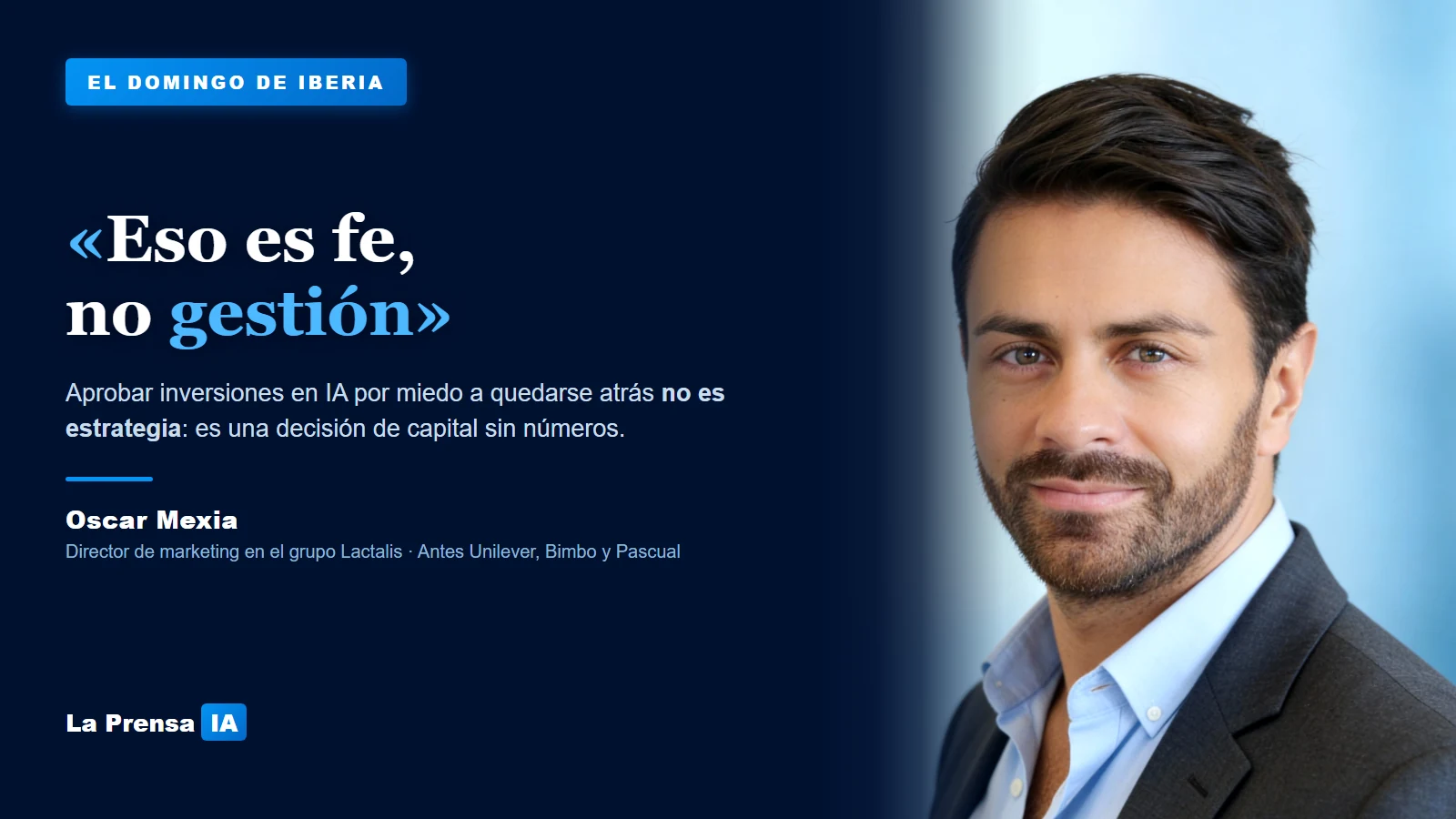
In the management committees of large consumer goods companies, a contradiction is becoming visible: no one would approve a media campaign today without a clear return objective, yet artificial intelligence projects are being approved without that same filter. This is denounced by Oscar Mexia, marketing director at the Lactalis group, in an interview granted to El Domingo de Iberia, the interview section of LaPrensaIA.
His diagnosis comes at a time when consumer goods companies are accelerating the adoption of generative and analytical AI tools, but without a common framework to measure whether that spending actually pays off. Mexia summarizes it with a phrase intended to be uncomfortable: many investment decisions in AI are made "out of conviction, out of fear of falling behind, or because it sounds good." And he states: "That is faith, not management."
Who is Oscar Mexia
Mexia has been with Lactalis Group for nine years, having joined in May 2017 as head of group marketing and the marketplaces channel. Previously, he worked at Calidad Pascual, where he led the relaunch of the milk and juice category—a business, he explains, that had been declining for eleven years. Before that, he spent six and a half years at Grupo Bimbo, with a stint as an expatriate at the headquarters in Mexico, where he participated in the international launch of TAKIS. He began his career at Unilever, in the out-of-home consumption division.
He holds a degree in Advertising and Public Relations from Pompeu Fabra University, an MBA from Esade (2013), and completed the Program for Leadership Development at Harvard Business School (2022-2023). He lives in Madrid and responds to this interview in a strictly personal capacity, not representing the position of Lactalis or any of his previous employers.
The economics of analysis: what has really changed
For Mexia, the real change that AI brings to consumer goods marketing is not spectacular, but economic. For years, a good part of the knowledge generated by companies—market research, consumer tracking, category history—remained untapped because cross-referencing it manually did not justify the effort.
"Today that barrier has disappeared," he explains. An analysis that no one considered before due to its cost is now viable, fast, and cheap. He gives a concrete example: asking how the perception of a product attribute in a category has evolved over ten years, cross-referencing different databases, and getting the answer in minutes. "It's not that AI gives us new information out of thin air: it's that it makes a cross-reference viable that was previously economically unviable," he points out.
The two sides of the hype
The executive distinguishes two types of risk that, in his view, are disguised as innovation. The first is a sequencing problem: organizations trying to solve complex strategic problems with AI without having sorted out basic operations first. "It's like wanting to go to the fifteenth floor without having finished the foundations," he illustrates.
The second risk seems more serious to him: replacing real market validation with a simulation. There are already tools that generate "synthetic consumers" and predict whether a concept will work before it hits the market. Mexia does not question the technical capacity of that simulation, but what he calls "the recklessness of making high-investment decisions relying solely" on it, without contrasting it with the real market.
Where AI performs best: pricing, insights, and creativity
Asked about the areas where AI adds the most value today, Mexia identifies pricing as the area with the clearest return, as it is a problem of cross-referencing variables—costs, history, competition, elasticity, region, channel—that is almost impossible to keep updated manually. But he qualifies something important: it is also where he grants the machine the least decision-making autonomy, "because the implications and the risk of a poorly calibrated price decision are too serious not to have human supervision in the final decision."
Regarding consumer insights, he believes the contribution is real but limited: AI detects patterns at a scale that no human team can match, but the deep meaning of a purchase motivation still depends on direct observation. He gives the example of research on infant nutrition: a mother may feel she is failing when her child does not eat the lunch she prepared, and that guilt may explain why she values preparing it herself so much. "That insight does not live in any database," he states. "It only emerges from a well-conducted qualitative question."
In creativity, he maintains that AI executes and produces extraordinarily well, but the original idea still stems from human tension. In media, he believes we are still far from a complete strategy orchestrated from end to end by AI, due to the fragmentation of the ecosystem.
As an example of what has surprised him most, he mentions the detection of a multi-level pattern: a competitor that adjusted its promotional calendar to systematically anticipate another's, saturating households with stock before the rival promotion arrived and thus neutralizing it. A strategic behavior, he says, that would likely have gone unnoticed by cross-referencing data manually.
The algorithm as the first buyer
Mexia was a pioneer of the Amazon channel and marketplaces within his company, and from that experience, he describes a fundamental change in the relationship between brand and consumer: "You negotiate with a buyer; you feed an algorithm" with data, content, availability, and speed.
He explains that the battle is no longer physical space on the shelf, but algorithmic visibility: appearing when the system decides what to show. And he warns of a phenomenon he considers key in online shopping: the consumer's first decision becomes disproportionately important, because breaking an established routine later requires much more effort than winning it the first time. They are, he says, "winner-takes-all scenarios."
Looking to the future, he anticipates a more radical chapter: when recurring purchases are delegated even more to assistants that decide and repeat for the consumer, "brands without a real preference built in the consumer's mind will be replaced by the cheaper equivalent without the consumer even noticing."
AI-generated advertising: opportunity with nuances
Regarding advertising created with artificial intelligence, Mexia is optimistic: content production has become cheaper and a brand with clear values can produce many creative pieces that express the same idea from different angles. But he warns that the real risk is not in the tool, but in using it "without having resolved a good underlying positioning first."
He also points out that the reputational risk is not the same for all brands. A brand built on closeness and the human element—a common territory in food—has more to lose if it uses AI in a way that betrays that promise, compared to a brand whose territory is already efficiency or technology.
The skills that will make the difference
For the next five years, Mexia anticipates that access to AI will become common for all companies, so the true competitive advantage will shift to those who know how to redefine the roles between who decides the objective and who executes the process.
To the professional who looks at AI with suspicion, he says that not using it is the real mistake, but that the fear of not being "technical" is a false obstacle: you don't need to program to get value out of it, you need to think strategically about what to apply it to. If he had to choose just one skill, it would be "knowing how to ask good questions": formulating a good briefing, he recalls, was always one of the scarcest skills in marketing, and now it is the most valuable, because "a brilliant model with a bad question only produces mediocrity at high speed."
AI as just another line on the P&L
Mexia closes his reflection with the idea that gives the interview its title: in a profit and loss statement, everything competes for the same euro—promotion, innovation, media, people—and AI should not be an exception with its own status. Today, however, it is exempted from the return discipline required of any other line item.
As soon as all companies have access to the same models, he argues, the competitive advantage will shift to three elements that cannot be bought with a subscription: the quality of proprietary data, the quality of the questions each organization knows how to ask, and the discipline to test, measure, and "kill quickly what doesn't work." The latter, he says, is the least flashy and most profitable skill of all, because recognizing a failed pilot in time costs a fraction of what it costs to scale a mistake with more budget.
His final recommendation is, in his words, unspectacular but profitable: concrete use cases, measurable return, and the courage to cut quickly what doesn't perform. "AI doesn't change the order. It only changes how quickly it becomes noticeable who doesn't respect it," he concludes.
Frequently Asked Questions
Who is Oscar Mexia?
He has been marketing director at Lactalis Group since May 2017, where he joined as head of group marketing and the marketplaces channel. Previously, he worked at Calidad Pascual, Grupo Bimbo, and Unilever.
What is Oscar Mexia’s educational background?
He holds a degree in Advertising and Public Relations from Pompeu Fabra University, an MBA from Esade (2013), and completed the Program for Leadership Development at Harvard Business School between 2022 and 2023.
Why does he say that AI investments are approved by faith and not by management?
Because, unlike what happens with a media campaign—which requires a clear return on investment before being approved—many AI projects are approved today out of conviction, fear of falling behind, or because the proposal sounds attractive, without the same rigor of measurement.
Where does Oscar Mexia believe AI adds the most value in consumer goods marketing?
He points to pricing as the area with the clearest return, due to the ability to cross-reference multiple variables of costs, competition, and elasticity. He also highlights the economics of analysis, which allows for data cross-referencing that was previously unviable due to its cost.
What risks does he see in the use of AI in the sector?
He identifies two: solving complex strategic problems without having sorted out basic operational processes first, and replacing real market validation with simulations using "synthetic consumers" without contrasting them with real data.
What does it mean that the algorithm is the first buyer?
He refers to the fact that in channels like Amazon or marketplaces, before reaching the final consumer, a brand must first convince the system that decides which products to show, feeding it with data, content, availability, and speed.
What skill does Oscar Mexia consider the most important for the future of marketing?
Knowing how to formulate good questions or briefings, since a powerful AI model used with a poorly posed question only produces mediocre results at high speed.