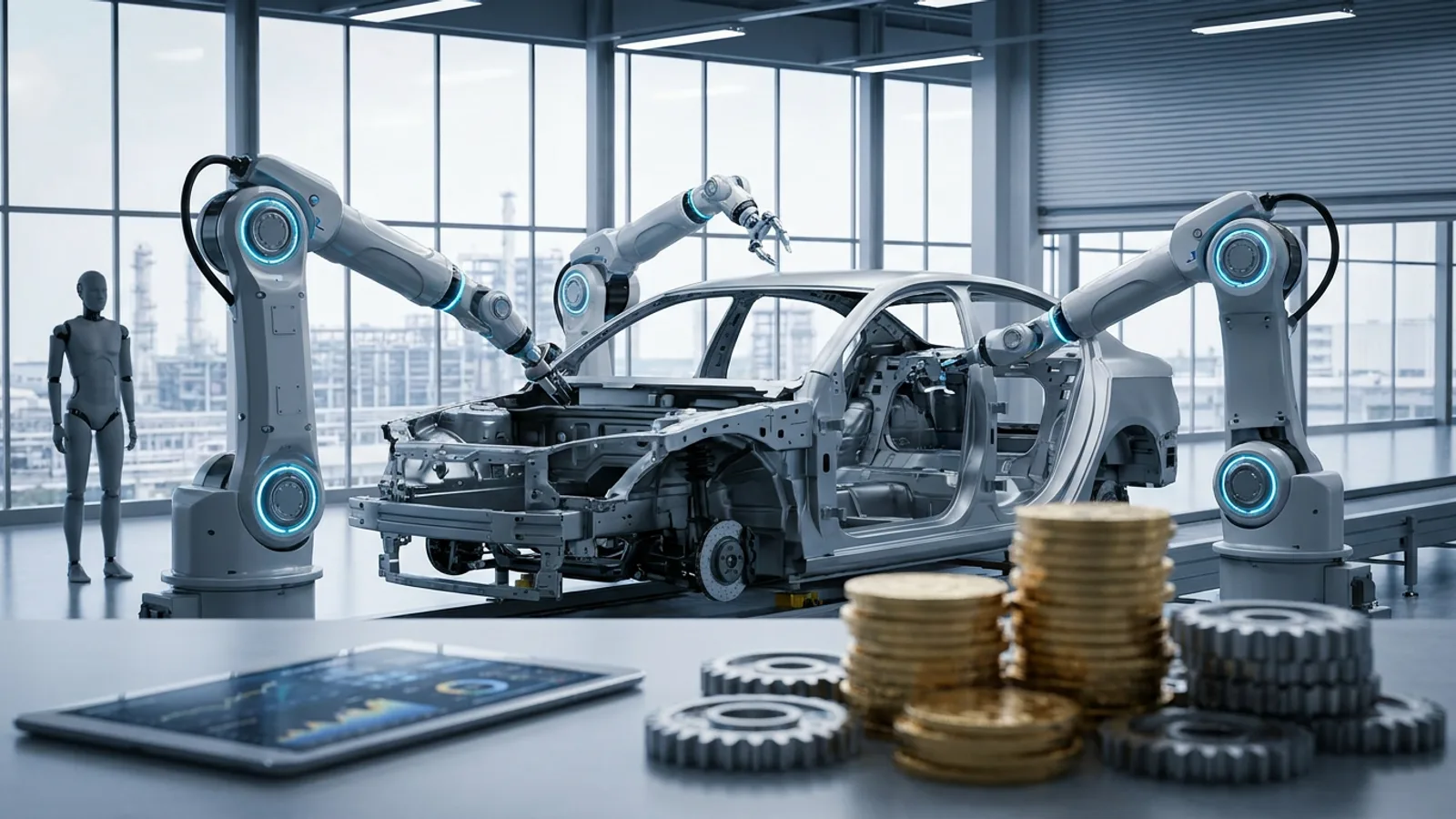
Toyota, the world's largest car manufacturer, has put an ambitious plan on the table: to deploy 400,000 robots in its facilities with an annual investment of $6.4 billion. The information, reported by the Financial Times, places the Japanese company at the center of the global race for industrial and humanoid robotics.
The announcement comes at a time when several automotive and technology giants are competing to lead the development of robots capable of working alongside humans or replacing them in manufacturing tasks. Toyota's bet is not limited to cars: it seeks to transform itself into a benchmark company in robotics as well.
From car manufacturer to robotics powerhouse
Toyota's strategy is supported by two pillars. On one hand, the development of humanoid robots, machines with a body structure similar to that of a human. On the other, the increasing automation of assembly lines, with more tasks taken over by mechanical systems.
This move does not come out of nowhere. In July, Walden Robotics, the AI robotics company born within Toyota, debuted on the stock market with a valuation of $1.1 billion, after receiving $300 million in funding. It is a young company that already exceeds a billion dollars in market value.
Factories as the first testing ground
As explained by a Toyota executive cited by the Financial Times, the company's own plants will be the first setting where the robots will be tested before considering other environments. The reason is simple: an industrial facility is a controlled space, where it is known which part arrives, at what time, and by what route, which is very different from a domestic environment.
Toyota is not competing alone in this field. Its rivals include Tesla, Xpeng, and Hyundai, the latter with plans to start manufacturing its Atlas robot in the United States in 2028. Goldman Sachs analysts estimate that Toyota could capture between 3% and 8% of the humanoid robot market by 2035.
Caution among investors
Not all reactions have been enthusiastic. The Financial Times points out that some investors remain cautious, recalling that Toyota has already fallen short of expectations in other technological bets, such as hydrogen vehicles and solid-state batteries.
It should be noted that the figure of 400,000 robots and the $6.4 billion annual investment correspond to a plan announced by the company, not a consolidated reality. Nor has the timeframe to reach that figure been specified, nor what proportion of those robots will be humanoid versus conventional industrial machinery.
What this plan means for workers, customers, and investors
For those working in the automotive sector, this announcement has direct relevance. Large companies in the sector are seriously evaluating which tasks can be transferred to machines, making it advisable to identify which part of a job is repetitive and which requires human judgment.
For Toyota customers, no change in vehicle prices is expected in the short term. And for those who follow the company's evolution as an investment, the precedent of previous promises not fully met invites them to closely monitor whether this bet on robotics will achieve results different from those of hydrogen or solid-state batteries.
Frequently asked questions
How many robots does Toyota want to deploy?
The company is proposing a plan to incorporate 400,000 robots into its operations, according to the Financial Times.
How much money does Toyota plan to invest in robotics?
The plan includes an investment of $6.4 billion per year, although the total timeframe to complete the deployment has not been specified.
Where will these robots be used first?
According to a Toyota executive, the company's own factories will be the first testing environment, as it is a more controlled space than other contexts.
What is Walden Robotics?
It is the AI robotics company born within Toyota. In July, it went public with a valuation of $1.1 billion and $300 million in funding.
Who are Toyota’s main competitors in humanoid robotics?
Its rivals include Tesla, Xpeng, and Hyundai, which plans to manufacture its Atlas robot in the United States starting in 2028.
What share of the humanoid robot market could Toyota reach?
Goldman Sachs analysts estimate that Toyota could capture between 3% and 8% of the humanoid robot market by 2035.
Why are some investors skeptical of this plan?
Because Toyota has already missed expectations in previous technological bets, such as hydrogen cars and solid-state batteries, which generates caution regarding this new announcement.