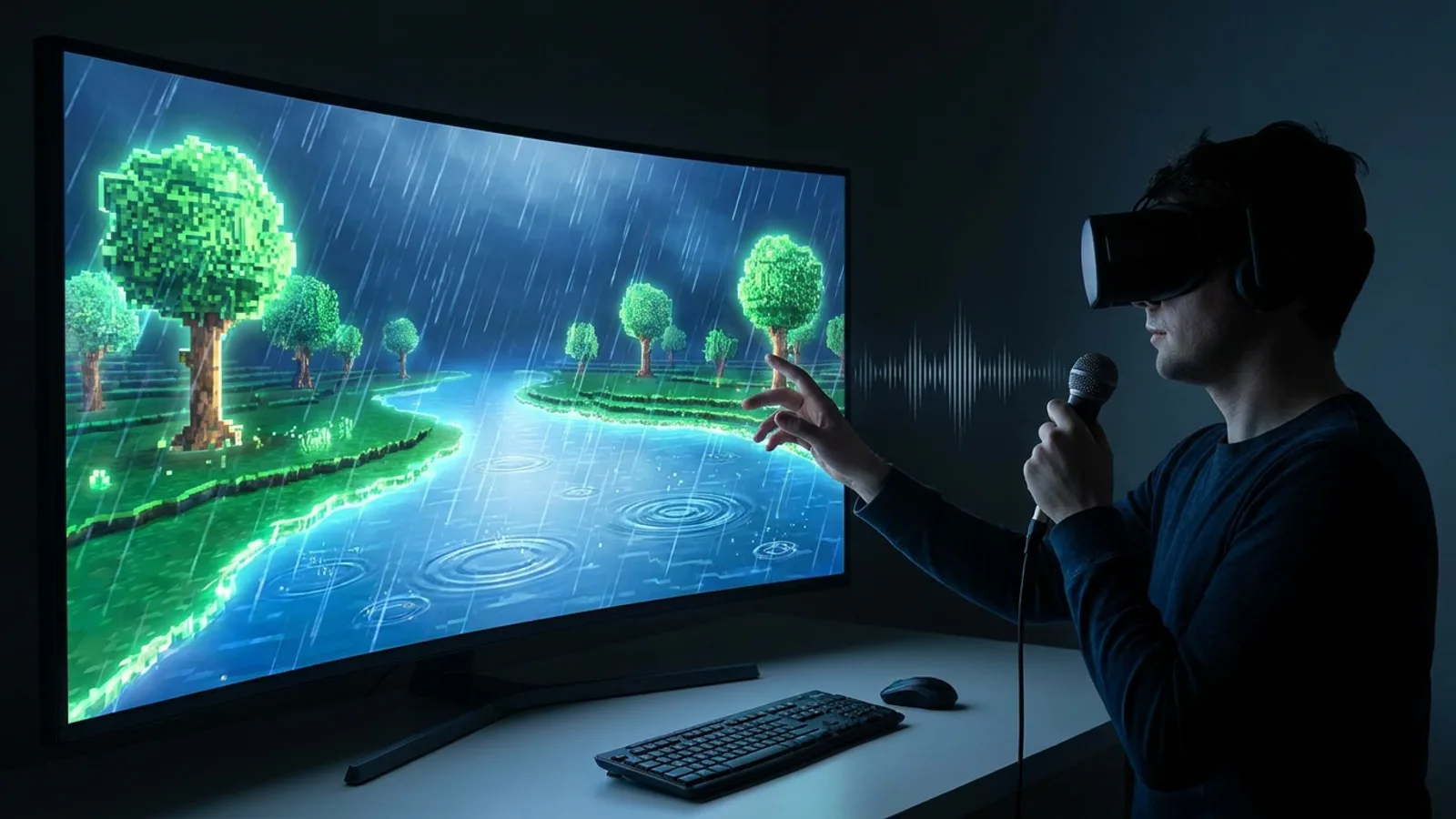
Type a sentence and, instead of receiving an image or a video, be able to enter that scene and navigate it with your keyboard. This is what Genie 4 proposes, the new model from Google DeepMind presented as the next generation of world simulation through artificial intelligence.
The announcement comes at a time when major tech companies are competing to go beyond generating static images or video, seeking interactive experiences that combine text, sound, and movement in real time. Genie 4 is presented as a step in that direction, although it is still limited to a small group of testers.
A world generated with text that makes sound as you walk through it
Genie 4 was presented by Raia Hadsell, Diego Rivas, and Hang Qi, members of the Google DeepMind team. According to the company, it is a world model: an artificial intelligence capable of creating, from a written description, a moving environment that the user can explore using standard computer controls to move around and shift the camera.
What distinguishes this version is that the sound is not added afterward, but is generated along with the scene. Music, ambient noise, and even conversations emerge at the same time as the visual environment. Among the examples shown by Google are a misty lake with a saxophonist playing, a meadow where a pink fabric ripples like a river, and an icy Antarctic landscape viewed from the basket of a hot air balloon.
Real-time commands without breaking the scene
While the user navigates the generated world, they can continue writing instructions: change the weather, move the camera, or introduce a new person or object. Gemini, Google's family of models, is responsible for adapting each request to what already exists on screen, ensuring that the whole maintains coherence between one command and the next.
Google gives the example of a meadow where, if you ask for it to start raining, the rain should fall on the same grass and flowers that were already present, without generating a different scene. The company also claims that the model simulates real physics, including aerodynamics, collisions between objects, the behavior of a watermelon falling onto a rock, or the descent of a maple seed to the lawn.
Characters that move with greater naturalness
According to Google, the biggest advancement in Genie 4 is how people behave within these worlds. The company states that characters move naturally, react to their environment, and can be directed in real time during the interaction.
One of the demonstrations recreated a rural Japanese train station set in the eighties, with passengers walking around, a red train in the foreground, and an inspector in a dark blue uniform. For Google, this type of scenario has two main uses: serving as a training environment for robots and autonomous systems, and paving the way for new interactive experiences.
Still in closed testing phase
For now, Genie 4 is a research preview available only to a group of trusted testers. Google is gathering feedback before considering a wider release, both for the general public and for developers.
Access begins with Google AI Ultra subscribers who are part of Project Genie, as well as partners with early access to the Gemini API and Google AI Studio. There is a waiting list for those who want to try it. So far, everything known about the model comes from the videos and descriptions released by the company itself.
What this means for those following the announcement closely
Anyone who wants to try Genie 4 will need to sign up for the waiting list and, in the early stages, have a Google AI Ultra subscription. Google has not provided a price or a general release date, so it is best to avoid making advance payments or setting expectations.
For those working in video games, film, or training, the tool is proposed as a resource for prototyping scenes simply by describing them. In the field of robotics, the idea is that autonomous systems can practice in simulated environments before operating in the real world.
The remaining question is whether the actual experience of using Genie 4 will match what is shown in Google's promotional videos, something that can only be verified when access is expanded beyond the current circle of testers.
Frequently Asked Questions
What is Genie 4?
It is an artificial intelligence model from Google DeepMind that generates navigable, moving worlds from a written description, including sound and simulated physics.
Who can use Genie 4 right now?
For the moment, only a small group of trusted testers, including Google AI Ultra subscribers in Project Genie and partners with early access to the Gemini API and Google AI Studio.
How much does Genie 4 cost?
Google has not announced a public price or a general release date, so there is currently no defined cost for the end user.
What is this type of world model used for?
According to Google, it can be used to create training environments for robots and autonomous systems, as well as to prototype scenes in video games, film, or training.
Does Genie 4 generate sound in addition to images?
Yes, music, ambient noises, and conversations are generated along with the visual scene; they are not added afterward.
Can the world be modified while navigating it?
Yes, the user can write new commands in real time, such as changing the weather or introducing people or objects, and the model adapts the scene while maintaining coherence.