
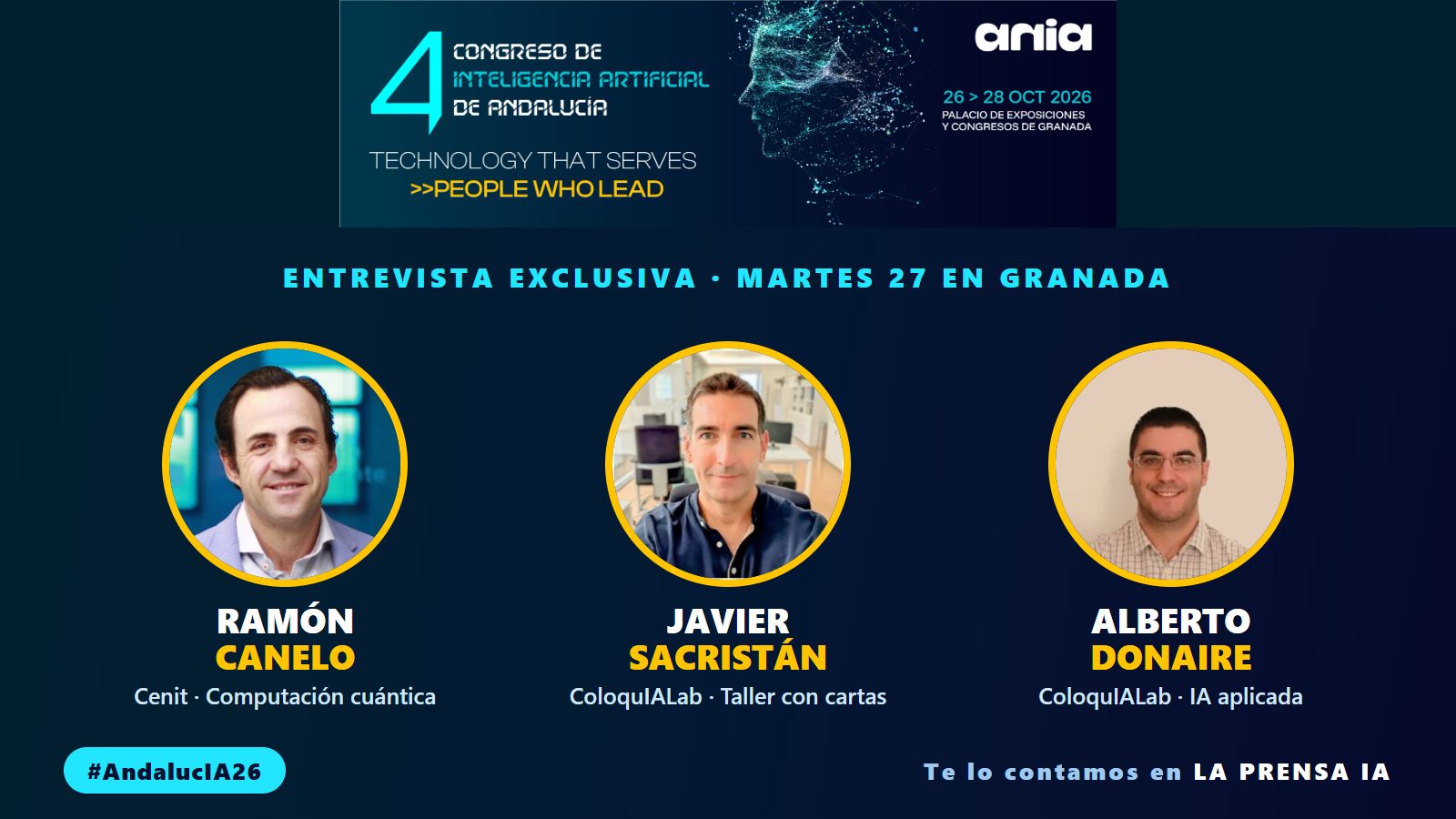
This Tuesday, October 27, Granada hosts the main day of the IV Andalusia AI Congress, under the theme «Technology that serves. People who lead». Among its speakers are very different profiles: a strategy expert who addresses quantum computing without technical jargon, and a duo of communicators who teach how to make decisions about AI products using a board and cards.
Before taking the stage, three of them responded in writing to this outlet's questions. Their answers offer a clear snapshot of where the conversation about AI is heading within the Andalusian business fabric: less technology for technology's sake, and more criteria for deciding when to use it and when not to.
Ramón Canelo Gil: quantum computing advances in stages
Ramón Canelo Gil is Head of Strategy and Innovation at Cenit. He will participate this Tuesday at 1:25 PM in the panel «AI and Quantum Computing: the leap towards a new technological frontier», in the Andalusia III Room of the congress.
What it is and why it is discussed alongside AI
Canelo explains that a conventional computer works with switches that can only be on or off. A quantum one, on the other hand, behaves «more like a coin spinning in the air», which allows it to explore multiple combinations in a different way.
It is not a universal technology: it excels at very specific problems, such as finding the best combination among millions of options or simulating the behavior of molecules and materials. The idea, he points out, is for it to work alongside classical computing.
Regarding the relationship with artificial intelligence, he notes that they already help each other: AI corrects errors in current quantum computers, and in the future, quantum could accelerate certain AI calculations. «They are not rivals, they are teammates», he summarizes.
What a company can do today and what remains science fiction
According to Canelo, there are three fronts that are already exploitable:
- Data protection. Someone could steal encrypted information today to read it when powerful quantum computers exist, which is why he recommends starting to adopt «post-quantum» cryptography, a simple software update.
- Quantum-inspired tools that already help organize shifts, routes, or production, without the need to buy any machine.
- Quantum sensors, capable of measuring magnitudes that were previously inaccessible.
What still belongs to science fiction, he warns, is a quantum computer capable of solving any problem or replacing conventional equipment. That generalized advantage for companies, he says, is still years away.
How to decide what to invest in regarding AI
«The golden rule is to start with the problem, not the technology», says Canelo. The key question is not what to do with AI, but what process or decision causes pain in the company today.
He proposes comparing honestly whether AI improves, cheapens, or accelerates something, and setting from the beginning what measurable result will determine if a project continues or stops. His method advances in steps: an idea, a small test, a serious comparison, a pilot with real data, and only then, the full deployment.
He also recommends distributing the investment like a portfolio: betting on what is mature, experimenting with what is promising, and monitoring what is still far off. «If a project doesn't pass a step, stopping it in time is also a success», he maintains.
Leading AI instead of following it
For Canelo, following AI means buying the trendy tool because the competition has it. Leading it means knowing what you want it for before acquiring it, letting people decide what problem to solve, setting the rules, and being responsible for the results.
«Technology serves; the decision is ours», he summarizes. That implies anticipating—for example, by reinforcing data security today against the quantum threat—and training teams and executives, because, as he states, you cannot lead what you do not understand. In the public sector, he adds, leading means always prioritizing the citizen and trust in the use of their data.
The three ideas he proposes taking home
- Quantum computing is not magic or science fiction, but it is not ready for everything immediately: it will arrive in stages, and the first one, protecting data, has already begun.
- You don't need to buy a quantum computer to start: all it takes is decision, curiosity, and choosing the problem well. Today you can already experiment in the cloud and in public centers, also in Andalusia.
- AI and quantum will be more useful the clearer we are about who they are working for.
ColoquIALab: deciding with cards in hand
Alberto Donaire Ávila, an engineer specialized in artificial intelligence, and R. Javier Sacristán Fresneda, a specialist in UX/UI design and innovation, are part of ColoquIALab, an AI outreach project. This Tuesday at 4:30 PM they are giving the workshop «Product evolution and improvement with AI».
A workshop with a board and cards
The dynamic is carried out in teams. Each group chooses a product or service idea and develops it on a board divided into five zones: what AI capabilities are applicable, what risks it implies, what interfaces or devices are most suitable, how it will be measured if it works, and what resources are required to build it.
Each card must be justified and agreed upon with the rest of the team. In the end, each group presents its proposal and compares it with the others, which often arrive at very different solutions starting from the same starting point.
Donaire and Sacristán explain that they chose the game format so that learning is dialogued and internalized, instead of memorized, and so that talking about AI is not reduced to looking at screens. Their summary: «With slides you listen; with cards in hand, you decide».
The most frequent error when incorporating AI
According to both, the most common mistake is starting with the tool without first understanding what AI can really do and what it implies in terms of risks, regulations, impact on people, measurement, and necessary resources.
With that prior foundation, they state, it is easier to identify the real problem of the company, and sometimes the conclusion is that AI is not the best option. «We are not here to give recipes», they point out: their goal is for the company or its technical team to develop their own criteria to assess scope, risks, and needs.
What a freelancer or an SME would do without knowing where to start
ColoquIALab's answer is deliberately counterintuitive: this week they would not try to improve anything with AI. Launching into testing without knowing capabilities or risks, they warn, usually leads to frustration, to exposing sensitive data where it should not be, or to erroneously concluding that AI is not useful for that business.
Instead, they would dedicate that week to understanding what AI can do today and to identifying, together with the team, the real problems of the business. And they would seek professional accompaniment to decide, pilot, and implement, considering costs, savings, training, and the reaction of the people involved. «There are millions of tools; what makes the difference is the criteria and the accompaniment to choose well», they state.
Making AI accessible to those who don’t know about technology
Both cite as a reference the book Don't Make Me Think, by Steve Krug, about frictionless design. If it is already difficult to simplify a website or an app, it is even more so with a technology that most still do not understand.
Their proposal is to start from the real problem that one wants to solve, approach AI from what each person already knows, put the user at the center, and be willing to change course. They insist on not getting carried away by passing enthusiasm: the important thing is not how much AI a product incorporates, but whether it really solves the problem of the person using it.
What they hope the Granada audience takes away
Donaire and Sacristán seek to transmit a different way of thinking, innovating, and building. «We are not here to tell anyone what they have to do», they emphasize: they want each person to recognize their own problems and discover for themselves where AI can help and where it cannot. And that, in addition, they have fun and leave wanting to get to work. «AI does not transform anything on its own: the people who understand it do», they conclude.
The same message from different angles
A strategy specialist and two product communicators, with apparently distant topics, agree on the same idea: first identify the problem and then choose the tool, with one's own criteria, small tests, and people always in charge. It is, in fact, the motto that presides over the entire congress.
Frequently Asked Questions
What is the IV Andalusia AI Congress?
It is a meeting focused on artificial intelligence held in Granada, under the motto «Technology that serves. People who lead», with presentations and workshops on AI, quantum computing, and business strategy.
What is the relationship between quantum computing and artificial intelligence?
According to Ramón Canelo Gil, they complement each other: AI is already used to correct errors in quantum computers, and in the future, quantum computing could accelerate certain AI calculations.
Can a company already use quantum computing?
It can take advantage of three current aspects: adopting post-quantum cryptography to protect data, testing quantum-inspired tools to optimize processes, and using quantum sensors for advanced measurements, without the need to buy a quantum computer.
What does the ColoquIALab workshop consist of?
It is a dynamic with a board and cards in which teams design an AI-based product or service, deciding what capabilities, risks, interfaces, metrics, and resources they need, in a collaborative and practical way.
What is the main mistake when incorporating AI into a company?
Starting by choosing a tool without first understanding what AI can do, what risks it implies, and what resources it requires, according to the specialists at ColoquIALab.
What should an SME or a freelancer do before using AI?
Dedicate time to understanding the real capabilities of AI and identifying concrete business problems, before rushing to test tools without criteria or professional accompaniment.