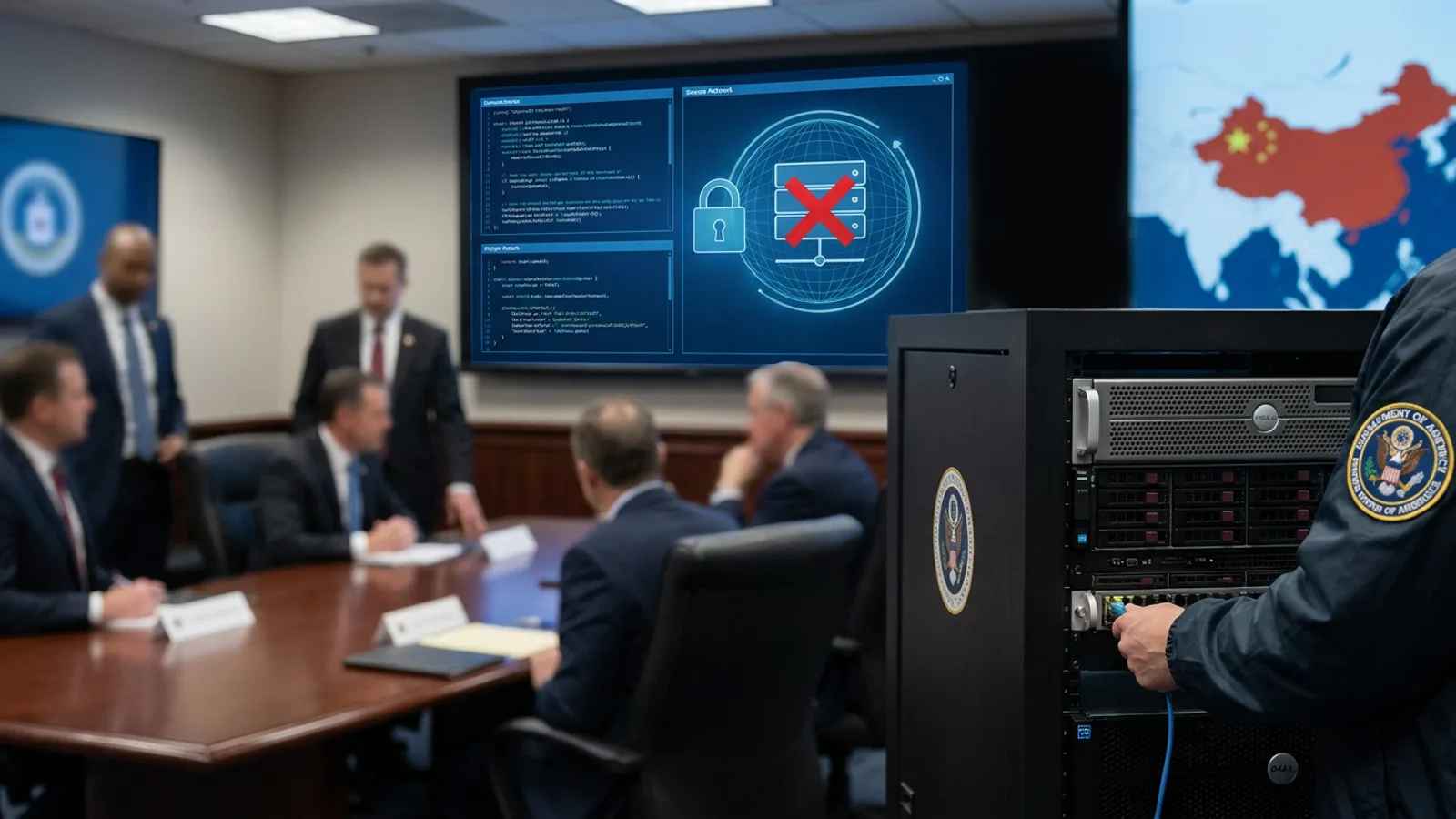
The United States Department of Homeland Security (DHS) has ordered federal civilian agencies to stop purchasing DeepSeek products and to remove the Chinese artificial intelligence model from their computer systems. The move comes amid rising technological tensions between Washington and Beijing and expands restrictions that previously only affected intelligence services.
The decision is significant because it is not limited to blocking the Chinese company's direct product: it also extends to third-party services that incorporate DeepSeek technology, forcing numerous agencies to review contracts and tools they may not have identified as being of Chinese origin.
What the DHS order covers exactly
The instruction affects both new acquisitions and systems already installed in civilian agencies. The DHS does not distinguish between DeepSeek's own product and those developed by other companies that use its technology as a foundation.
Agencies have the option to request exceptions, although the available information does not specify who authorizes them or under what criteria they will be evaluated. This lack of detail could complicate the practical application of the rule in the coming months.
For agencies that have contracted third-party AI services without knowing which model operates behind them, the task is twofold: first, to detect the technological dependency and then to replace it.
Washington’s argument: data and Chinese legislation
The DHS bases the order on DeepSeek's operations in China and concerns regarding the handling of U.S. user data. According to the agency, Chinese legislation could allow the country's authorities to access sensitive information generated by U.S. government users.
The text of the order describes a potential risk of access to such data, without referring to a specific incident that has already occurred. It is, therefore, a preventive measure based on potential exposure rather than a documented case.
Beijing’s response: accusation of politicizing technology
China reacted on Tuesday through Foreign Ministry spokesperson Mao Ning, who stated in a press conference that her country opposes the excessive expansion of the concept of national security and the politicization of technological and commercial issues.
Mao Ning added that Beijing will defend the legitimate rights and interests of Chinese companies. The response confirms that the conflict transcends regulation and is part of the broader technological competition between the two powers, in which DeepSeek has become a direct rival to companies like OpenAI and Meta thanks to its open-weight, lower-cost models.
Background: restrictions tightening since December 2025
The DHS order does not arise in isolation. A law passed in December 2025 had already limited the use of DeepSeek in national security systems linked to U.S. intelligence services.
The new instruction extends that restriction to federal civilian agencies, broadening the scope from intelligence systems to the civil administration in general.
DeepSeek has been under scrutiny by governments and regulators in various countries since January 2025, when the launch of its R1 reasoning model caused a sharp drop in Nvidia shares and generated concern in the global tech industry.
The accusation of model distillation
A report published in September accused DeepSeek and five other Chinese artificial intelligence companies, including Alibaba and Moonshot AI, of resorting to large-scale distillation to extract information from U.S. systems.
Distillation consists of using the responses generated by one model to train another. It is a common and legitimate technique in many contexts, but it becomes controversial when applied to third-party models without authorization.
OpenAI informed U.S. lawmakers that it had detected suspicious attempts by DeepSeek to distill its models. For its part, Anthropic stated it had identified unauthorized attempts by DeepSeek and other Chinese laboratories to collect responses generated by Claude.
What affected technology teams must review
The order poses concrete tasks for both those who manage public systems and the companies that sell software to federal agencies.
First, it is necessary to make a complete inventory of tools. Given that the ban also includes third-party services that use DeepSeek technology, it is not enough to search for the Chinese company's name in existing contracts.
Second, it is advisable to ask providers directly if any contracted product incorporates a DeepSeek model, so that the agency can take action with precise information.
Third, agencies must evaluate whether to request an exception, documenting the use case in detail before submitting the request.
A frequent example illustrates the risk: a department that uses a writing assistant from an external provider, without knowing that it runs on a DeepSeek model, could be violating the order without having decided to do so consciously.
The other front: China evaluates restricting its AI exports
The technological conflict also has a flip side. As reported by Bloomberg last week, China is studying restricting the export of 23 technologies related to artificial intelligence, including chip designs and certain advanced models.
The stated goal of that potential measure, according to the same report, would be to address security risks and prevent misuse of the technology.
If both restrictions end up being consolidated, technological exchange between the United States and China would be limited in both directions, deepening the fragmentation of the artificial intelligence sector on a global scale.
What this measure implies for companies and users
Those who work in the U.S. administration or sell software to its agencies must check if any artificial intelligence component they use depends on DeepSeek and plan for its replacement, as the order also covers products developed by third parties.
For users or developers outside that sphere, the order has no direct effect, as it is directed exclusively at U.S. federal civilian agencies.
However, the case serves as a reminder of the importance of knowing which model operates behind the artificial intelligence tools that handle sensitive data, a question that the DHS itself places at the center of its decision.
Frequently Asked Questions
What is DeepSeek?
DeepSeek is a Chinese artificial intelligence company known for developing open-weight, low-cost language models, including its R1 reasoning model, launched in January 2025.
Who does the DHS order affect?
The order is directed at U.S. federal civilian agencies, which must stop acquiring DeepSeek products and remove both the direct model and third-party services built with its technology from their systems.
Why does the DHS consider using DeepSeek a risk?
The agency alleges that Chinese legislation could allow the country's authorities to access sensitive data of U.S. government users processed through DeepSeek.
Is this measure new or does it come from before?
It expands a previous restriction: a law from December 2025 already limited the use of DeepSeek in national security systems of intelligence services; now it is extended to civilian agencies.
What is the model distillation mentioned in the controversy?
It is a technique that consists of using the responses of an artificial intelligence model to train another. It becomes controversial when applied to third-party models without authorization, as a September report accused DeepSeek and other Chinese companies of doing.
How has China responded to the order?
Foreign Ministry spokesperson Mao Ning accused the United States of excessively expanding the concept of national security and politicizing technological issues, and stated that Beijing will defend the interests of its companies.
Is China also limiting technology to the United States?
According to Bloomberg, Beijing is studying restricting the export of 23 artificial intelligence technologies, including chip designs and advanced models, for security reasons.