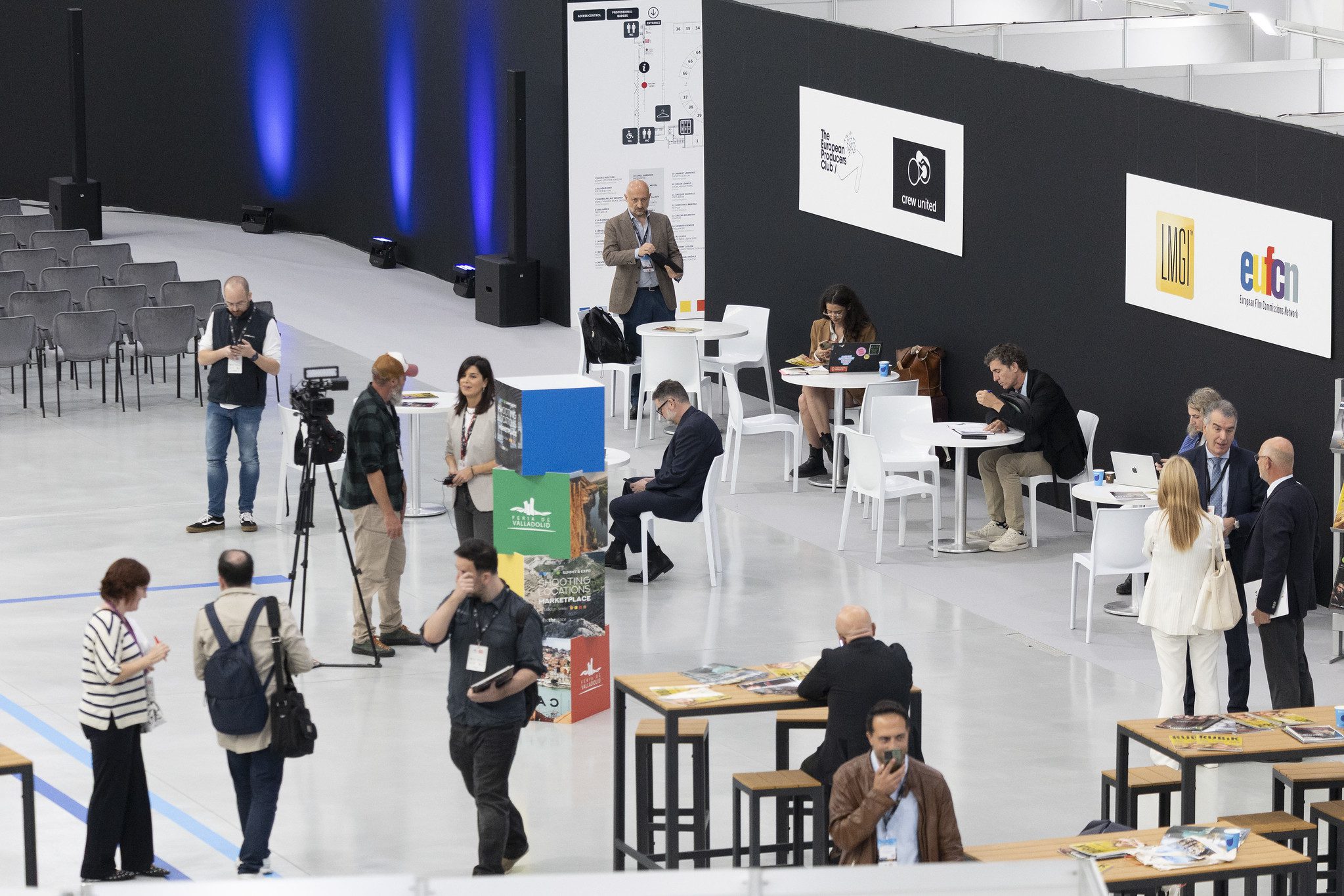
Valladolid has once again become the global epicenter for audiovisual location scouting. The sixth edition of Shooting Locations Marketplace, held on October 14 and 15, 2026, was the most international in its history, with representation from 27 countries across four continents: Europe, Asia, Africa, and the Americas. This figure represents three more countries than in the 2025 edition.
The event, organized by Feria de Valladolid and the Spain Film Commission, takes on special relevance at a time when the Spanish audiovisual industry is seeking to strengthen its position against international competition, amidst ongoing discussions regarding tax incentives and protectionist measures promoted by the United States.
Over 1,500 professional interviews in two days
During the event held in Valladolid, more than 1,500 work interviews were conducted between location scouts, production companies, post-production studios, and auxiliary service companies with film commissions and film offices from around the world.
This year's additions include new territories such as Turkey, Stockholm, Rome-Lazio, the Veneto region, Uruguay, Peru, Mallorca, Calvià, Teruel, and Ávila, as well as studios and service companies from Spain and Morocco, alongside a large Portuguese delegation.
Víctor Caramanzana, president of the Chamber of Commerce, Industry and Services of Valladolid, defended the commitment to specializing the city in the cultural and film industry during the opening ceremony. As he explained, this sector generates not only tourism but also economic activity linked to the territory and the legal certainty sought by international productions.
For her part, the Councilor for Tourism, Events and City Brand of the Valladolid City Council, Blanca Jiménez, recalled that 66 shoots took place in the city in 2024, and stressed that the audiovisual industry is a central part of the municipal strategic plan for economic and tourism returns.
A market dominated by international buyers
85% of the buyers or contractors present at the fair are international, with the United States and the United Kingdom maintaining a combined share of between 50% and 60%, a typical percentage in recent editions.
In total, 66 professionals participated as buyers this year, including 11 Spanish location scouts, a figure very similar to 2025, when there were 67 buyers and ten national scouts. Attendees also included financial executives from companies such as HBO and Disney.
Alberto Alonso, general director of Feria de Valladolid, explained that the event's format is designed to maintain a controlled size, as the number of interviews is limited by time constraints. As he detailed, only 30% of location scouts return each year, implying a turnover of nearly 70% between events. In this edition, 35% of attendees were repeaters and 65% were new.
The working dynamic remains the same: each film office representative holds 20-minute interviews with at least 24 location scouts, 12 per day, a pace that Juan Manuel Guimeráns, president of the Spain Film Commission, described as intense but highly valued by participants.
Internationalization as a strategy to strengthen the national industry
One of the central messages of this edition was that the Spanish filming industry strengthens as the event itself becomes more international. Guimeráns argued that Spain not only receives shoots but also exports them, and that the growth in the presence of foreign film commissions also benefits the national sector.
Alberto Alonso agreed that the diversity of the offer attracts more demand: if international location scouts find options from more than 20 countries in a single trip, the interest in attending increases considerably.
Fam trips: from national to international
This commitment is also reflected in the fam trips, the familiarization trips to filming locations that complement the fair. This year, seven routes were organized, with destinations in Portugal, Turkey, Sweden, Norway, Estonia, the Canary Islands, and Castile and León, starting on October 16.
In the case of Castile and León, nine location scouts, art directors, and production companies from the Americas, Europe, and Spain toured locations in Valladolid, Salamanca, Palencia, Burgos, and Segovia. Guimeráns highlighted that these trips generate a bond with the territory that is harder to achieve in a brief meeting during the fair.
Tax incentives: the great pending debate
Taxation applied to audiovisual productions was one of the most recurring topics in both roundtables and informal conversations at the event. A specific session featured the CEO of Olsberg·SPI, Leon Forde; the vice president of finance for 20th Century Studios at Disney, Nadia Randazzo; the president of the Rome Lazio Film Commission, Andrea Piantoni; and the director of the Estonian company All Film, Kristofer Piir.
Guimeráns was clear when assessing the Spanish situation: the tax incentive system has not improved in the last year, while other surrounding countries have advanced their conditions. As he explained, territories such as the Canary Islands, the Basque Country, and Navarre maintain competitive levels, although the country's general framework remains stagnant.
The president of the Spain Film Commission also referred to the new United States federal incentive, which he considers a warning sign, although he clarified that it will likely have more impact on production movement within the North American country itself than on the Spanish market.
For Guimeráns, the necessary improvement does not only involve increasing the tax deduction percentage, but also streamlining refund processes and strengthening legal certainty from the start of each production. He recalled that the bill that lapsed due to the early elections proposed increasing the deduction to 40% on the first million euros and 35% on the rest, in addition to strengthening incentives in depopulated areas.
Set-jetting and film-related tourism
The Spain Film Commission also presented progress in its screen tourism or set-jetting strategy, a trend that seeks to transform the interest generated by films and series into tourism and economic opportunities for territories.
Among the pilot projects presented this year, four experiences stand out in Formentera, Seville, Rías Baixas, and Burgos. In Formentera, the common thread is the film Lucía y el sexo, by Julio Medem, which celebrates its 25th anniversary since its release. In Rías Baixas, the reference is the series based on the book Fariña, by Nacho Carretero. In Burgos, the proposal revolves around The Good, the Bad and the Ugly, by Sergio Leone, which celebrates its 50th anniversary in 2026. Seville, for its part, chose not to focus its proposal on a single production.
Film Data España, a new technological tool
The conference program concluded with the presentation of Film Data España, a technological project promoted by the Spain Film Commission to connect audiovisual productions with the places where they were filmed.
The initiative, supported by the Ministry of Culture and the Secretary of State for Digitalization and Artificial Intelligence, is part of the Spain Audiovisual Hub Plan, financed with NextGenerationEU funds. The platform, currently in a pilot phase, includes an interactive georeferenced map, location files, and natural language search, conceived as a collaborative tool for professionals and film commissions.
Frequently Asked Questions
What is Shooting Locations Marketplace?
It is a professional fair held in Valladolid that connects location scouts, production companies, and audiovisual studios with film commissions and film offices from around the world, facilitating the search for filming locations.
How many countries participated in the 2026 edition?
27 countries from four continents (Europe, Asia, Africa, and the Americas) participated, three more than in the 2025 edition.
How many professional interviews were conducted at the fair?
More than 1,500 work interviews were held between location scouts, production companies, and film commission representatives during the two-day event.
What percentage of buyers at the fair are international?
85% of the buyers or contractors who participated are international, with the United States and the United Kingdom representing between 50% and 60% of that share.
What are the fam trips organized after the fair?
They are familiarization trips that allow location scouts and producers to see filming locations in person. In 2026, seven routes were organized, with destinations in Portugal, Turkey, Sweden, Norway, Estonia, the Canary Islands, and Castile and León.
What is the situation of tax incentives in Spain?
According to the Spain Film Commission, the Spanish tax incentive system has not improved in the last year, while other surrounding countries have advanced their conditions to attract audiovisual productions.
What is Film Data España?
It is a technological platform promoted by the Spain Film Commission, with the support of the Ministry of Culture, which connects audiovisual productions with the places where they were filmed through an interactive map and a georeferenced database.