
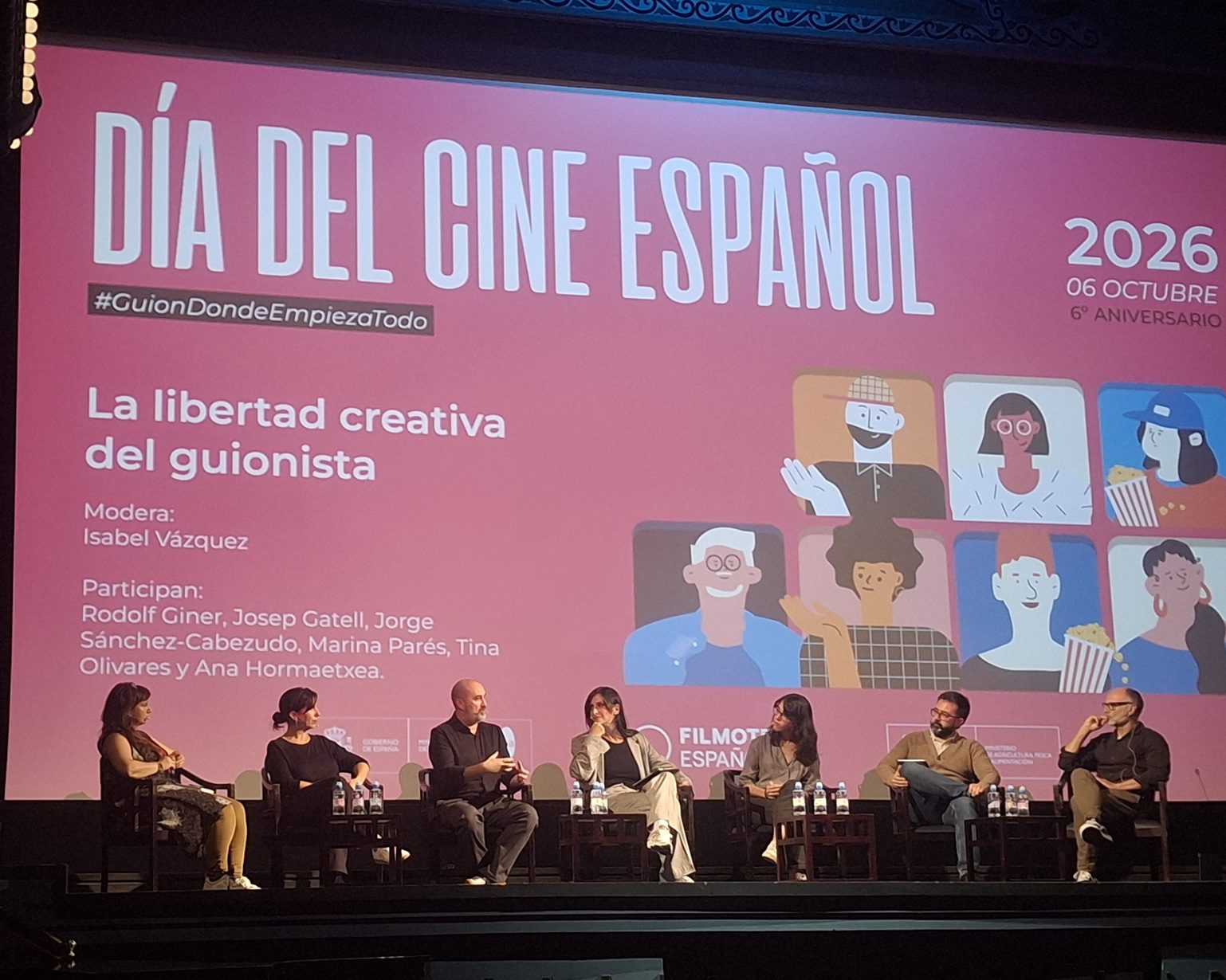
Every October 6, Spain celebrates Spanish Cinema Day, a date that commemorates the end of filming for Esa pareja feliz in 1951, the first film directed and written by Juan Antonio Bardem and Luis García-Berlanga. For the 2026 edition, the Ministry of Culture has decided to focus the celebration on a key and often invisible figure in the audiovisual industry: the screenwriters.
The reason for this attention is no coincidence. The grants for feature film scriptwriting, reinstated by the Institute of Cinematography and Audiovisual Arts (ICAA) last year, have become one of the main tools for sustaining a sector that faces structural problems of precariousness, aging, and now, the threat of generative artificial intelligence.
A roundtable to champion the role of the screenwriter
A roundtable titled The Creative Freedom of the Screenwriter, moderated by Isabel Vázquez, was held at the Cine Doré in Madrid. Participants included screenwriters Rodolf Giner, Josep Gatell, Jorge Sánchez-Cabezudo, Marina Parés, Tina Olivares, and Ana Hormaetxea.
Before the roundtable, Marta Serrano, Director General of the ICAA, presented the event as an opportunity to reflect on the present and future of Spanish cinema. Both her speech and the subsequent debate focused primarily on the scriptwriting grants.
Four million euros to boost new scripts
Serrano confirmed the ICAA's intention to maintain this line of grants, which has a budget of four million euros in 2026, half of what it was in 2025. The Director General detailed some of the call's conditions:
- A minimum of 45% of the funding is reserved for projects written exclusively by women.
- A minimum of 25% is allocated to scripts written in co-official languages other than Spanish.
- Each grant amounts to 30,000 euros for fiction projects and 20,000 euros for documentary projects.
- Only original or adapted, unpublished scripts are accepted, in the development of which no generative artificial intelligence tools have been used.
Data from the 2025 call
In the 2025 edition, 4,080 applications were submitted, with 285 scripts receiving funding. Of these, 224 were fiction projects (84% of the funding), 53 were documentaries (13%), and eight were animation (3%). Thirty-four scripts were developed under co-authorship.
A total of 74 beneficiary scripts were written in co-official languages other than Spanish, representing 25.9% of the funding: 35 in Catalan, 16 in Valencian, 10 in Basque, and 13 in Galician. Additionally, 131 beneficiary scripts were written exclusively by women, 45% of the total.
By autonomous community, the beneficiaries resided in 16 different territories. The Community of Madrid had the highest number with 107 grants, followed by Catalonia with 60 and the Valencian Community with 29. Andalusia received 22, Galicia 18, and the Basque Country 14, among other regions with fewer beneficiaries.
Ínsula, the bridge between screenwriters and the industry
Marta Serrano pointed to the professional market Ínsula, integrated into the Seville European Film Festival, as the natural continuation of the writing grants. As she explained, this space seeks to connect ICAA-supported screenwriters with production companies interested in developing new Spanish audiovisual projects.
Ínsula will be held on November 9, 2026, at the Real Fábrica de Artillería in Seville, as part of the 23rd edition of the Seville European Film Festival, which will take place between November 6 and 14. In total, 48 audiovisual projects will be selected to participate in individual meetings with 20 invited production companies.
Precariousness, invisibility, and professional aging
During the roundtable, the screenwriters highlighted the main problems of their profession: job insecurity, lack of visibility in film promotion, a persistent gender gap, and relatively short professional careers in an aging guild.
The data provided is particularly striking. 30% of screenwriters earn less than 10,000 euros per year for their work, and 56% do not exceed 30,000 euros annually. Rodolf Giner summarized the situation by noting that it is a profession that people often enter late and from which many professionals leave early.
Grants as a vital relief
The participants agreed on the need to maintain and increase writing grants. Ana Hormaetxea highlighted that, in addition to stimulating creation, these calls generate enthusiasm and offer time and peace of mind to screenwriters.
Tina Olivares emphasized that these types of subsidies provide real relief for a particularly tough profession, while Marina Parés defended the gender quotas in the calls as the best way to eventually reach a point where they are no longer needed.
Jorge Sánchez-Cabezudo championed the right to make mistakes within the creative process, noting that public grants are fundamental to allowing for this. For him, the screenwriter profession moves between two possibilities: working to fulfill one's own dreams or working to fulfill the dreams of others. The participants agreed that maintaining these grants should be a priority regardless of the Government's political leaning.
Artificial intelligence, the sector’s great threat
The second part of the meeting focused on another of the guild's main concerns: generative artificial intelligence. Jorge Sánchez-Cabezudo warned that the real risk is convenience, as resorting to AI is a constant temptation, although he insisted on the need to resist so that stories continue to be born from the creators themselves.
Tina Olivares offered a different perspective, considering that the emergence of AI may force screenwriters to reinforce their creative uniqueness. Josep Gatell, for his part, expressed a deeper concern about the lack of ethics in these technologies, pointing out that they have been trained on protected works without the consent of their authors or financial compensation, while attempts are made to present their imposition as inevitable.
Restorations and screenings across the country
The sixth edition of Spanish Cinema Day is organized by the Ministry of Culture through the ICAA, with the collaboration of the Filmoteca Española. In addition to the screenwriters' meeting, the Cine Doré hosted a free day dedicated to three recent restoration works.
The restored version of Esa pareja feliz was screened, as well as the restored and uncensored version of El inquilino (1957), by José Antonio Nieves Conde, created from materials prepared by the director himself in 1993. The program was completed with the restoration of Angustia (1947), also by Nieves Conde.
For its 50th anniversary, El desencanto, by Jaime Chávarri, is being screened in more than 50 cities on five continents through the Instituto Cervantes and AECID network, in cities such as London, Rome, New York, Tokyo, and Sydney.
The Ministry of Culture, together with the Ministry of Agriculture, Fisheries and Food, is also promoting special sessions in small municipalities between October and November, accompanied by their own filmmakers, with titles such as Bodegón con fantasmas, Traineras, pasión por el remo, and Tiempo entre olivos, among others.
Other cultural institutions have joined the celebration with their own programming, including screenings organized by Acción Cultural Española and Cineteca Madrid.
Frequently Asked Questions
What are the ICAA scriptwriting grants?
They are public subsidies intended to finance the writing of original or adapted scripts for feature-length fiction, documentary, or animation films, reinstated by the ICAA in 2025.
How much money do the beneficiary screenwriters receive?
Each grant amounts to 30,000 euros for fiction projects and 20,000 euros for documentary projects.
What is the budget for this grant line in 2026?
The funding for 2026 is four million euros, half of what it was in the 2025 call.
Can artificial intelligence tools be used in the subsidized scripts?
No. The call requires that the projects have not used generative artificial intelligence tools in their preparation or development.
What is Ínsula and when is it held?
It is a professional market that connects screenwriters who have received ICAA grants with production companies. It will be held on November 9, 2026, at the Real Fábrica de Artillería in Seville, as part of the Seville European Film Festival.
What percentage of screenwriters live in precarious conditions according to the data provided?
30% of screenwriters earn less than 10,000 euros per year and 56% do not exceed 30,000 euros annually, according to the data presented at the meeting.