
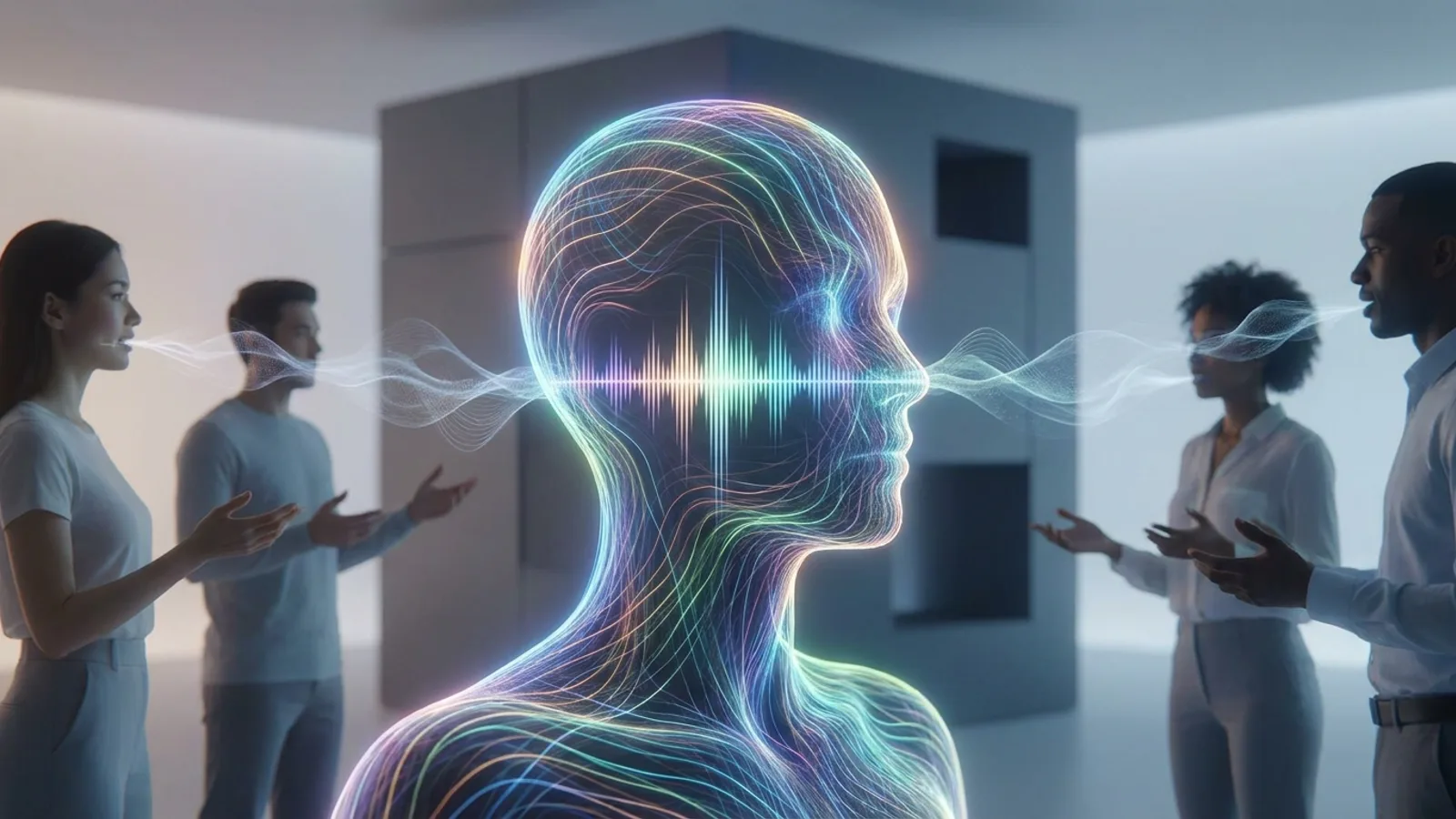
There is a demonstration in which an artificial intelligence calls the person it is speaking to "Ronaldo." It corrects itself immediately, and the conversation continues to flow with a naturalness that is striking. That machine is Dessa, the new voice model presented by Block, Jack Dorsey's company.
The launch is significant because it proposes a different path than the one followed by most current voice assistants, including those from giants like OpenAI. As reported by The Verge, Dessa has been trained "from scratch with nothing but human conversation," without ever passing through written text.
A model that never read a word
Most voice systems work by converting audio into text, processing that text, and then returning a synthesized response. Dessa breaks with that scheme: audio in, audio out, without any textual corpus in between.
The team behind the project uses a simple analogy to explain their approach. Babies learn to speak without ever having seen a written word. According to those responsible, they wanted to see if a model could do the same. The conclusion, they claim, is that it is possible, although they acknowledge that the process turned out to be much more difficult than expected.
The project is led by Ragavan Thurairatnam, who shared one of the sample conversations on social media. In that exchange, a mostly natural dialogue can be perceived, punctuated by the initial slip-up of the wrong name, a detail that has not gone unnoticed.
How Dessa sounds in its demonstrations
The model's official website gathers several conversation examples. In one of them, Dessa talks about Christopher Nolan's films and unexpectedly veers off toward the Superman movies directed by Bryan Singer, a tangent reminiscent of those any human interlocutor might make.
In another sample, a person tells Dessa that they were surprised with a trip to Paris. As the project's own page describes, the AI responds with what sounds like emotional gratitude, almost to the point of tears.
There is also a video in which Dessa participates in a voice guessing game. The Verge describes these exchanges as occasionally awkward, with a certain unsettling air, as if it were a new friend who is somewhat clumsy in social interactions.
Dessa versus OpenAI’s GPT-Live-1
Among the demonstrations, a conversation between Dessa and GPT-Live-1, OpenAI's voice model, stands out. According to The Verge, in that comparison, Dessa sounds more natural than its counterpart.
It is advisable to take that data with caution. It is a sample selected by the Block team itself, not an independent evaluation. There are currently no public metrics that allow for an objective comparison of latency, quality, or accuracy between the two systems.
Even with those reservations, the example makes Block's ambition clear: to compete in the realm of fluid conversation, with turn-taking that does not sound mechanical or artificial.
The security argument
The Dessa team puts forward three reasons to justify the development of the model: scientific curiosity, better understanding between humans and artificial intelligence, and security. This last point is the one they develop most in their communication.
As they explain on their website, voice is the most natural interface for interacting with any intelligence, but current systems waste it by reducing it to text. That conversion, they argue, causes AIs to lose human rhythm and remain almost deaf to the emotion conveyed by the voice.
The team poses a concrete scenario: a person going through intense pain while a voice AI perceives nothing abnormal and continues to converse as if nothing were happening. To move in that direction, Block will provide early access to a small group of researchers specializing in artificial intelligence security. This is an announcement from the company itself: there is still no independent public evidence demonstrating that Dessa detects emotions better than other models.
A model designed to run locally
One of the most practical pieces of information from the announcement is that Dessa can run locally on a MacBook Pro M4 Max or a superior machine. It is a demanding hardware requirement, but it implies that the model does not need to rely on a remote server to function.
That feature has direct implications for privacy. If processing is done on the device itself, the user's voice does not have to travel to any external server. At the same time, it limits access: for now, only those with that specific hardware will be able to test it.
What this announcement means
For those developing voice-based products, Dessa represents an alternative path to models that rely on transcription, with the potential advantage of better capturing the intonation and rhythm of speech. For the moment, access is restricted to a small group of security researchers.
For the average user, the announcement does not yet mean any practical change. What is possible to do is listen to the published demonstrations and pay attention to two aspects: how the model manages its own errors, such as the wrong name, and whether it truly responds to the emotional tone in addition to the literal content of the words. That is the promise that Block will have to prove beyond the presentation videos.
Frequently Asked Questions
What is Dessa?
It is a voice-to-voice artificial intelligence model developed by Block, Jack Dorsey's company, trained exclusively on human conversation, without passing through written text.
How does Dessa differ from other voice assistants?
Most assistants convert audio to text before processing it. Dessa operates directly from audio to audio, which its team claims allows it to better capture the intonation and rhythm of a conversation.
Who leads the Dessa project?
The project is headed by Ragavan Thurairatnam, who has publicly shared some of the model's demonstration conversations.
Is Dessa better than OpenAI’s voice model?
In a demonstration released by the team itself, Dessa sounds more natural than OpenAI's GPT-Live-1, according to The Verge. However, there are no published independent metrics that allow for confirmation of objective superiority.
Can I try Dessa right now?
No. For the moment, Block will only provide early access to a small group of artificial intelligence security researchers. There is no general public availability.
What technical requirements does Dessa need to function?
According to the team, the model can run locally on a MacBook Pro M4 Max or a machine with superior specifications, without relying on remote servers.