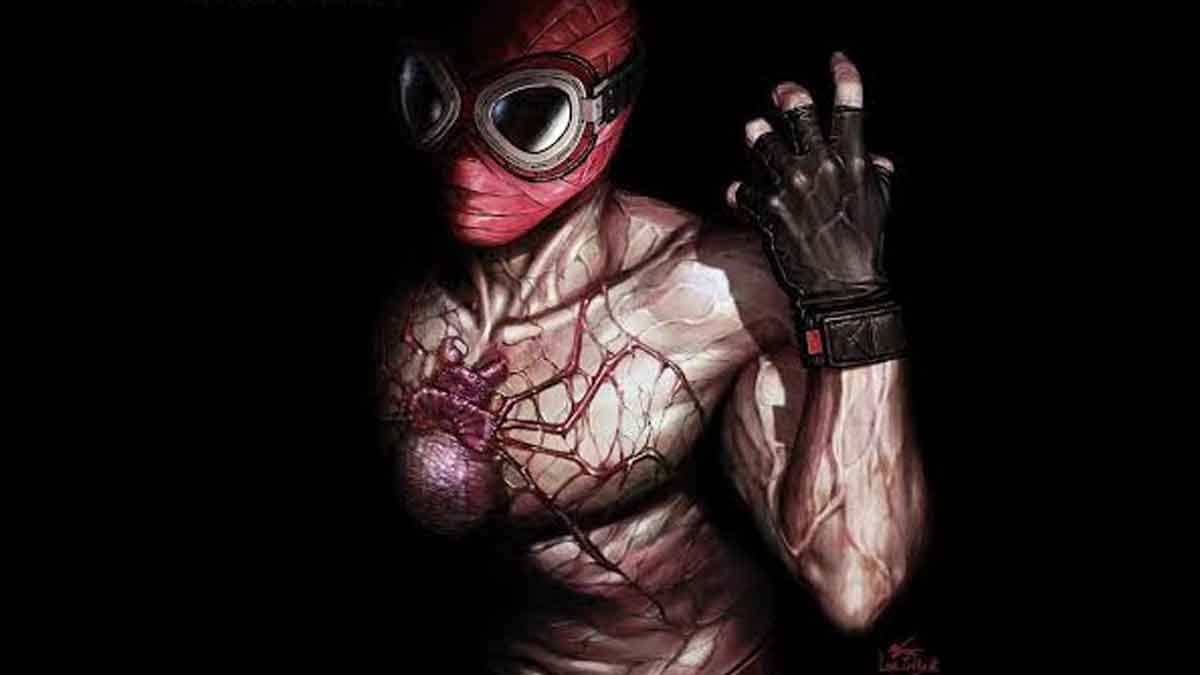
Marvel Comics has launched a new take on the origin of Spider-Man that moves completely away from the usual heroic tone. The comic Midnight Spider-Man #1 asks what would happen if the bite that transforms Peter Parker did not lead to a superhero, but to something much more disturbing.
The proposal arrives at a time when several publishers are exploring alternative versions of their most iconic characters through genres unusual for them, such as horror or manga, which explains the interest this new series is generating among regular readers of the Marvel universe.
A familiar origin told through horror
The comic is written by Philip Kennedy Johnson, with art by Scietronc, colors by Neeraj Menon, and lettering by Joe Caramagna. The story picks up from the classic starting point: a teenager bitten by a spider who begins to undergo a physical transformation.
However, here that change is presented with a much more disturbing weight, leaning into body horror rather than traditional superhero fantasy.
A childhood marked by cruelty
To understand the vision of this Peter Parker, the comic recovers a painful episode from his childhood. At age six, he lost his cat after it ran away from home during a family trip, and he later discovered that the animal had been killed by a dog.
The narrative does not shy away from the impact of that scene, even showing the decomposing body of the animal. The goal is not just to generate a disturbing image, but to justify the conclusion Peter draws from that experience.
In this version, the famous phrase that defines the character disappears. Instead, Peter believes that power ends up turning people into monsters, and that the greater the power, the more monstrous the person who possesses it becomes.
A disillusioned teenager facing the powerful
Approaching his 18th birthday, this Peter Parker is convinced that those who hold power rarely face consequences for their actions. Even so, he decides to take action through anonymous posts on the internet, with which he denounces abuses by various influential figures.
One of his main targets is Oscorp, the company against which his family has been in litigation since his parents' death. In this story, Peter lives with his Uncle Ben, while the situation of Aunt May is left deliberately ambiguous, implying that she could still be alive but separated from the family.
Oscorp, the setting for a scientific nightmare
The central plot twist arrives when Oscorp identifies the person responsible for the anonymous reports. Instead of pursuing him, the company chooses to offer him a job.
It is at this point that Felicia Hardy, the Black Cat, appears, presented as an Oscorp employee tasked with convincing Peter to join the company. Her role introduces a different relationship between two regular characters of the Spider-Man universe.
Experiments with devastating consequences
Through Peter's own posts and leaked internal Oscorp documents, the comic reveals details about experiments conducted on human subjects, including the use of a mutant growth hormone that causes destructive effects on one of the participants.
The existence of other test subjects, whose identities have not yet been revealed, opens the door for some of them to be alternative versions of characters already known to readers.
A manga-influenced aesthetic
The visual aspect of Midnight Spider-Man also marks differences compared to other versions of the character. The artist Scietronc comes from the manga field, an influence that is key to the overall tone of the series.
This approach connects with common trends in contemporary manga, where bodily transformation is often represented as something disturbing rather than heroic.
A path similar to Ultimate X-Men
The commitment to Japanese visual codes is not foreign to Marvel. Artist Peach Momoko already applied a similar aesthetic in Ultimate X-Men, reinterpreting the mutants from a different perspective.
Midnight Spider-Man follows a similar direction, although focused on exploring the horror that can hide in a superhuman transformation. Furthermore, it considerably expands the original tale: if the classic origin of Spider-Man occupied barely eleven pages, this new series uses documents, posts, and additional scenes to develop a much more extensive story, in line with what Ultimate Spider-Man already did with six issues dedicated to reinterpreting the character's origin.
Hero or monster?
The main mystery of this new series is not just what Peter Parker will look like after his transformation, but what he will do with the power he obtains.
The comic preserves the connection to the death of Uncle Ben, although it introduces a significant twist: in this version, Peter is a direct part of the chain of monstrous events that trigger that tragedy.
If Peter is convinced that power inevitably corrupts, becoming someone powerful could end up confirming his worst fears. It remains to be seen if he will use that strength to confront those he considers responsible for injustices or if he will end up transforming into that which he always rejected.
Frequently asked questions
What is Midnight Spider-Man #1?
It is a Marvel comic that reinterprets the origin of Spider-Man from a horror perspective, showing Peter Parker's transformation as something monstrous rather than heroic.
Who writes and draws this new series?
The script is by Philip Kennedy Johnson, the art by Scietronc, colors by Neeraj Menon, and lettering by Joe Caramagna.
How does this Peter Parker differ from the classic Spider-Man?
Instead of being guided by the idea that with great power comes great responsibility, this Peter believes that power turns people into monsters, which completely changes his way of understanding justice.
What role does Felicia Hardy have in the story?
Felicia Hardy, the Black Cat, works for Oscorp and is the one who convinces Peter to join the company after discovering his anonymous posts.
What relationship does Oscorp have with the plot?
Oscorp is the company against which Peter's family has been litigating since his parents' death, and also the one responsible for experiments on human subjects that include a mutant growth hormone.
What visual influence does the comic have?
The artist Scietronc brings an aesthetic influenced by manga, which reinforces the body horror tone of Peter Parker's transformation.