
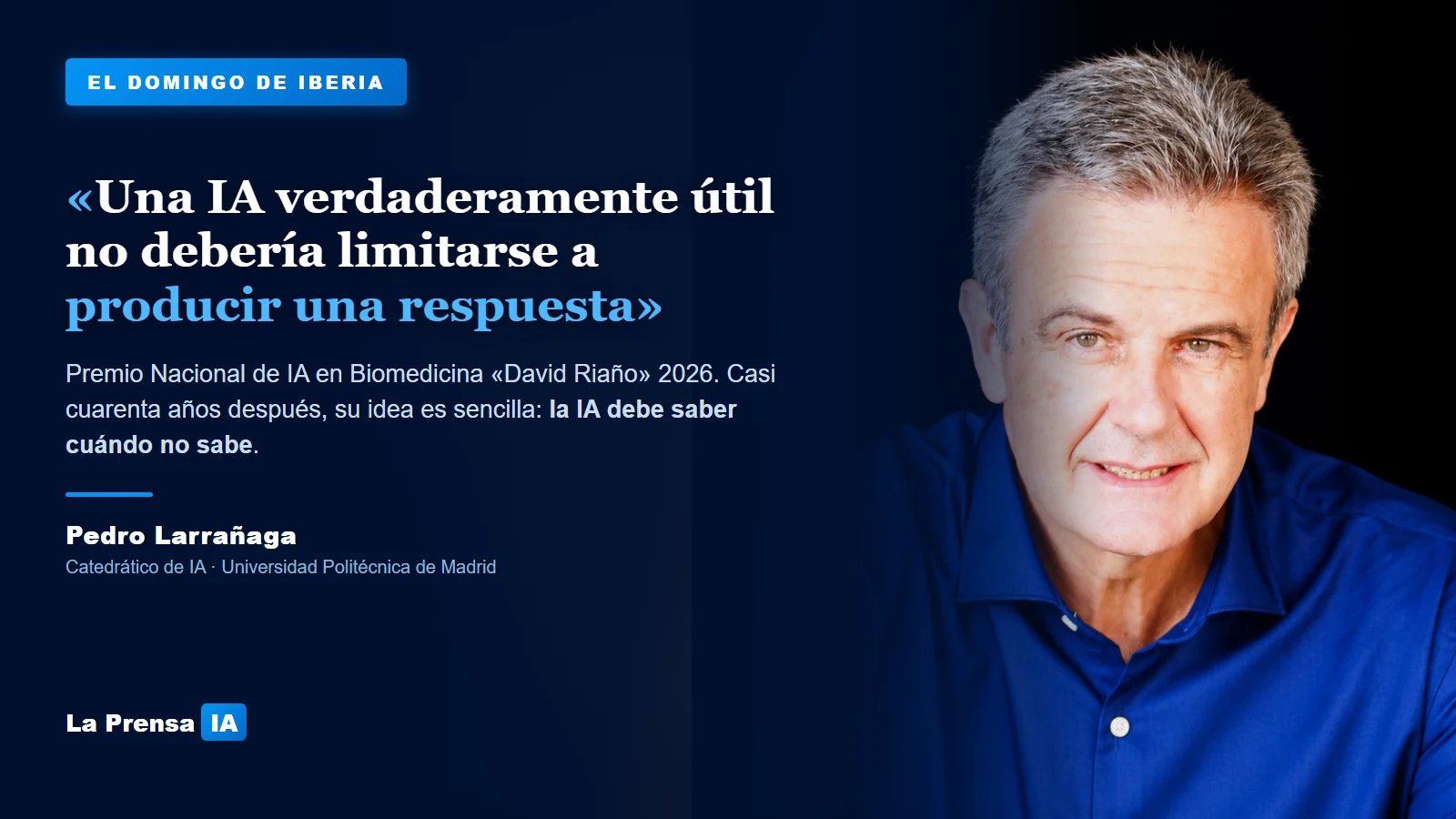
Amid the fever surrounding large language models, a researcher who has spent nearly four decades working on artificial intelligence applied to medicine is receiving one of the most significant recognitions in the sector in Spain. The Spanish Society for Artificial Intelligence in Biomedicine (IABiomed) announced on October 11 that Pedro Larrañaga, Professor of Computer Science and Artificial Intelligence at the Technical University of Madrid (UPM), is the winner of the 2026 David Riaño National Award for Artificial Intelligence in Biomedicine in the Senior Researcher category. The award ceremony will take place on October 30 in Barcelona during the society's II Annual Conference.
The award comes at a time when much of the public debate on artificial intelligence revolves around generative models and their ability to produce fluid responses on almost any topic. Larrañaga, however, represents a different tradition: that of systems designed to be understandable, rigorous, and useful for doctors and biologists, even before ChatGPT existed.
A career that began before generative AI
Larrañaga began working in artificial intelligence applied to medicine in the late 1980s. He later expanded his field to bioinformatics in the early 2000s and to computational neuroscience starting in 2013, participating in large-scale international projects such as the Human Brain Project.
Throughout his career, he has worked in areas such as cancer, HIV, embryo selection, autoimmune diseases, the microbiome, Parkinson's, epilepsy, and Alzheimer's. As he explains, the idea that has guided all his work is simple: artificial intelligence must be at the service of relevant biomedical problems, not the other way around.
Beyond publications, Larrañaga highlights another indicator of his career: he has supervised 37 doctoral theses, and many of those researchers now lead their own research groups. "A scientific career is not measured only by what one publishes, but also by the school one leaves behind," he states.
When a black box is unacceptable in medicine
One of the central axes of his reflection is the explainability of AI systems in clinical contexts. For Larrañaga, a black box is unacceptable when a decision can have serious consequences for the patient and directly influences the diagnosis, treatment, or prognosis.
If an AI recommends surgery, rules out cancer, or proposes stopping medication, the doctor must be able to ask why and obtain a clinically understandable answer. It is not about knowing every mathematical operation of the algorithm, he clarifies, but about understanding which variables have weighed on the decision, what evidence supports it, and what degree of uncertainty exists.
Conversely, he considers a certain degree of opacity tolerable in lower-risk tasks, such as improving the quality of a medical image or prioritizing studies for a specialist to review, provided the final decision remains under human supervision. The criterion, he summarizes, is the impact of the decision: the higher the risk and the more difficult it is to reverse an error, the greater the requirement for transparency.
Bayesian networks versus deep learning
Larrañaga argues that, despite the current dominance of deep learning, Bayesian networks retain clear advantages in problems where it is not enough to predict, but rather to reason under uncertainty. In medicine, he states, this is fundamental: a Bayesian network can combine symptoms, history, and test results to estimate probabilities and update them with new information, similar to how a clinician reasons.
These networks are also useful when data is scarce or heterogeneous, unlike deep learning, which usually requires large volumes. Furthermore, their structure allows for the explicit representation of relationships between variables and opens the door to causal reasoning, which is essential for moving from predicting what will happen to deciding what should be done.
The next leap: person-centered medicine
When asked about an advance that has not yet made headlines, Larrañaga points to the design of truly personalized treatments that integrate not only clinical history, genetics, or imaging tests, but also the patient's own preferences.
As he explains, two patients with the same diagnosis may want to experience their illness differently: one may prioritize survival at all costs, while another may prioritize quality of life. Machine learning, he maintains, can help anticipate how each patient will respond to different alternatives and incorporate those values into the clinical decision.
The most common error in medical AI projects
After years of collaborating with hospitals and clinical groups, Larrañaga identifies a recurring flaw: starting by asking what AI model can be applied instead of what specific clinical problem needs to be solved. Many projects are born from an interesting database and only later is it sought where it would fit in practice, which frequently causes the project to stall.
Added to this problem is data quality: biases, missing values, protocol changes, and differences between hospitals. Larrañaga points out that techniques such as transfer learning or federated learning can mitigate the lack of data in a specific center. Formulating the clinical question well from the start, he argues, would save years of work and significant amounts of money.
Should you trust a chatbot for symptom checking?
Regarding large language models, Larrañaga considers it a mistake to confuse their verbal fluency with reliable medical knowledge. These tools, he notes, are extraordinarily useful for summarizing documentation or facilitating access to knowledge, but they can produce plausible and, at the same time, incorrect answers.
When asked directly if he would advise a patient to consult a chatbot about their symptoms, he responds that yes, but with many caveats: it can serve as a first orientation to understand a medical term or prepare questions before a consultation, but it should not replace a professional diagnosis, among other reasons because a chatbot does not examine the patient or observe clinical signs directly.
What neuroscience has taught him about AI
Larrañaga, who also researches in computational neuroscience, highlights that the brain functions in many aspects as an extraordinary Bayesian machine: it starts from prior beliefs, incorporates new evidence, and continuously updates its conclusions without starting from scratch every time.
In his view, artificial intelligence should incorporate that philosophy much more: systems capable of representing what they know, expressing their uncertainty, and modifying their beliefs with new information, instead of just increasing the size of the models.
Does Spain have an advantage in biomedical AI?
Larrañaga believes that Spain has valuable ingredients for biomedical AI: a broad public health system, widespread electronic health records, good hospitals, and competitive universities. It is not about competing with the United States or China by building ever-larger models, he states, but about combining good health data with top-tier clinical knowledge.
Among the obstacles, he identifies the fragmentation of data between autonomous regions and hospitals, the difficulty of turning research into products that reach clinical practice, and a bureaucracy that complicates agile and secure access to health data.
The hospital ten years from now
Looking to the future, Larrañaga anticipates that it will be common for hospitals to work with continuously integrated AI systems: reviewing images, anticipating complications, or helping to personalize treatments based on each patient's progress.
What will not happen, he insists, is the replacement of the doctor by artificial intelligence, because medicine involves context, personal values, and decisions that do not always have a single correct answer. The hospital of the future, he summarizes, will have more artificial intelligence, but not necessarily fewer doctors.
An internationally recognized career
Since 2008, Larrañaga has led the Computational Intelligence Group at the UPM. In 1995, he founded the Intelligent Systems Group at the University of the Basque Country (Euskal Herriko Unibertsitatea), and under his leadership, the ELLIS Unit Madrid was approved in 2022. He has supervised 37 doctoral theses and 71 master's theses.
According to the Web of Science, his 405 scientific contributions have accumulated more than 16,700 citations, a figure that exceeds 33,600 according to Google Scholar. Since 2019, he has appeared on the Stanford University list of the world's top 2% most-cited scientists.
Among his previous positions, he served as manager of the National Plan for Information Technologies (2007-2010), member of the CNEAI (2010-2011), and part of the group of experts that designed the first Spanish Strategy on Artificial Intelligence in 2018. His awards include the Aritmel National Computer Science Award (2013), the Spanish Association for Artificial Intelligence Award (2018), the Amity Award in Machine Learning (2020), and Fellow distinctions from the Academia Europaea (2018), ELLIS (2023), and IEEE (2024).
Frequently Asked Questions
What is the David Riaño National Award for Artificial Intelligence in Biomedicine?
It is an award granted by the Spanish Society for Artificial Intelligence in Biomedicine (IABiomed) that recognizes careers and contributions in the field of AI applied to medicine. The 2026 edition was decided on October 11 and will be presented on October 30 in Barcelona during the society's II Annual Conference.
Who is Pedro Larrañaga?
He is a Professor of Computer Science and Artificial Intelligence at the Technical University of Madrid, where he has led the Computational Intelligence Group since 2008. He has been working in artificial intelligence applied to medicine since the late 1980s and has supervised 37 doctoral theses.
Why should an AI not be a black box in medicine, according to Larrañaga?
Because when an AI decision can have serious consequences for the patient, the doctor needs to understand which variables have influenced that recommendation, what evidence supports it, and what degree of uncertainty exists, in order to contrast it with their own clinical judgment.
Are Bayesian networks still useful compared to deep learning?
Yes, according to Larrañaga, especially in problems where one must reason under uncertainty, data is scarce or heterogeneous, and interpretability or causal reasoning is needed—aspects where traditional deep learning has limitations.
Do you recommend consulting medical symptoms with an artificial intelligence chatbot?
Larrañaga considers it can be useful as a first orientation, for example, to understand a medical term or prepare questions for a consultation, but he warns that it should not replace a professional diagnosis or a doctor's direct examination.
What is holding Spain back in biomedical artificial intelligence?
Larrañaga points to the fragmentation of health data between autonomous regions and hospitals, the difficulties in transferring research to real clinical products, and the bureaucracy that complicates agile access to health data for research.