
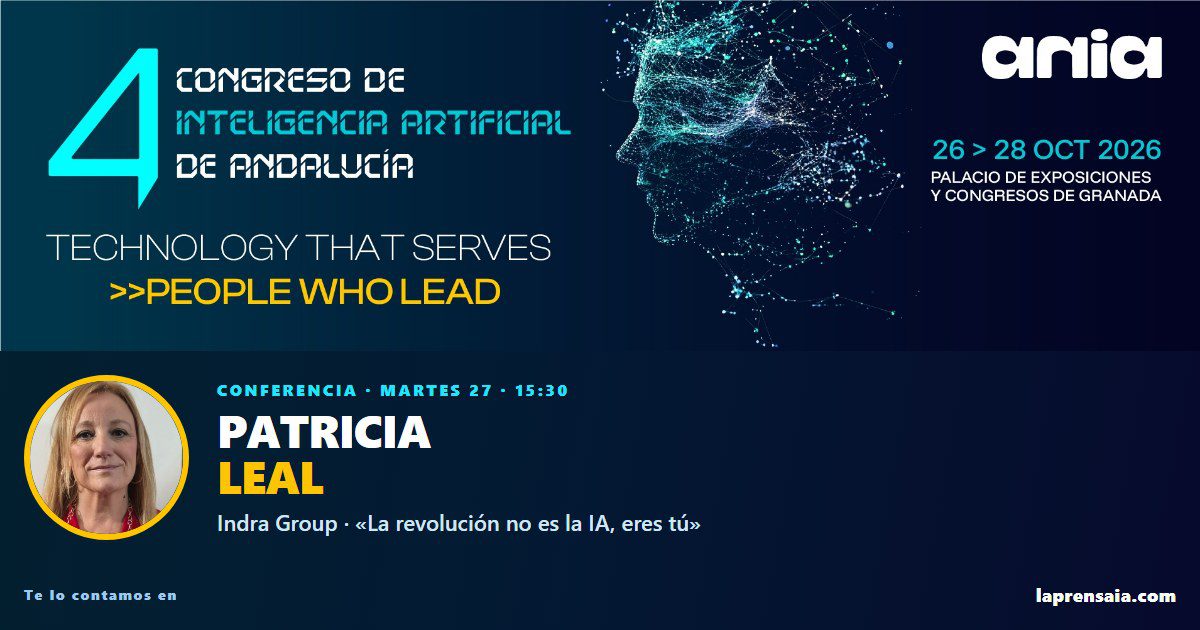
Artificial intelligence is beginning to reach the offices of Public Administrations, but not all projects share the same goal. For Patricia Leal Freire, head of the Social Services and Clear Communication areas at Minsait, the division of Indra Group dedicated to the public sector, the objective is very specific: to ensure that citizens understand and use public services without having to decipher legal or bureaucratic language.
Leal is participating this Tuesday in the IV Andalusia AI Congress, held in Granada under the slogan «Technology that serves. People who lead». Together with Jorge Martos Pardo, she is giving a talk titled «The revolution is not AI, it is you», in the Manuel de Falla Hall, at 3:30 PM.
The meeting comes at a time when numerous Spanish administrations are exploring how to incorporate conversational assistants and generative AI tools to improve citizen services, without losing sight of issues such as data protection or human oversight of decisions.
«The revolution is not AI: it is the potential it unleashes in every person»
Leal summarizes the approach of her presentation this way. For decades, she explains, people have had to adapt to technology. Now, she argues, the process is beginning to reverse: it is technology that must adjust to the real needs of each user.
For the Minsait executive, artificial intelligence should not be at the center of the narrative. «It is not the protagonist,» she maintains. That role belongs to the people who bring judgment, empathy, and purpose to its use.
What changes for the citizen when the Administration speaks clearly
One of the pillars of her speech is the concept of Clear Communication applied to public management. According to Leal, when AI is combined with this approach, the relationship between citizens and the Administration is significantly transformed.
It is no longer necessary, she explains, to know procedures, forms, or legal terminology in advance to access the rights that correspond to each person. With intelligent conversational assistants, citizens can describe their situation in their own words and receive understandable guidance adapted to their case in return.
Leal defines this application of AI as an accessibility tool: a resource that informs, guides, and accompanies people when they need it most, especially those who have the most difficulty navigating administrative language.
An example in social services
To illustrate this, Leal uses an everyday case. Imagine a woman who cares for her mother and does not know what public aid or resources exist for her situation. Through an intelligent assistant installed on her own mobile phone, she can explain her case in a normal conversation.
The system, as she describes it, understands the situation presented, provides guidance on available resources, and facilitates the preparation of the necessary procedures. A nuance she emphasizes: the final decision and professional judgment remain in human hands.
The result, Leal argues, is a reduction in bureaucracy and manual processes, which leaves social services professionals more time to dedicate to guiding, caring for, and accompanying the people they serve.
The fear of AI and the need for control
Leal acknowledges that suspicion toward these technologies is a common reaction, comparable to that generated by other major technological transformations in the past. However, she insists that the model they propose for organizations and public administrations does not consist of AI without supervision.
It is, according to her description, a sovereign, governed, traceable, secure, and responsible artificial intelligence, in which it is possible to know how data is used, who supervises each decision, and what limits have been established.
Her condition for advancing in this field is clear: apply defined rules, respect privacy, maintain ethical principles, and always retain human oversight over automated processes.
The final message for Granada
Leal summarizes in two ideas what she hopes the audience will take away from her presentation. The first is that AI represents an extraordinary opportunity to address problems that until now seemed out of reach, from improving public services to accelerating scientific and medical advances.
The second is that the real challenge is not technological, but one of collective decision-making: how that capacity is used to build a more human, inclusive, and just society.
Leal's talk is part of the program of the IV Andalusia AI Congress, which this year brings together representatives from different sectors under the official hashtag #AndalucIA26.
Frequently Asked Questions
Who is Patricia Leal Freire?
She is the head of the Social Services and Clear Communication areas at Minsait, the division of Indra Group dedicated to the Public Administration sector.
What is the talk «The revolution is not AI, it is you» about?
It is a presentation that Patricia Leal is giving together with Jorge Martos Pardo at the IV Andalusia AI Congress in Granada, regarding how artificial intelligence can facilitate citizen access to public services without losing human control.
What is Clear Communication in Public Administration?
It is an approach aimed at ensuring that administrative procedures and communications are explained in language understandable to any citizen, without the need for prior legal knowledge.
What guarantees does Indra propose for the use of AI in the Administration?
Patricia Leal advocates for a model of sovereign, governed, traceable, secure, and responsible artificial intelligence, with clear rules on data usage, decision oversight, and respect for privacy.
Where and when is the IV Andalusia AI Congress held?
The congress is held in Granada, in the Manuel de Falla Hall, under the slogan «Technology that serves. People who lead», with the official hashtag #AndalucIA26.
Does AI replace the judgment of social services professionals according to Indra?
No. As Patricia Leal explains, the final decision and professional judgment always remain in human hands, while the AI is responsible for guiding and streamlining the preliminary procedures.