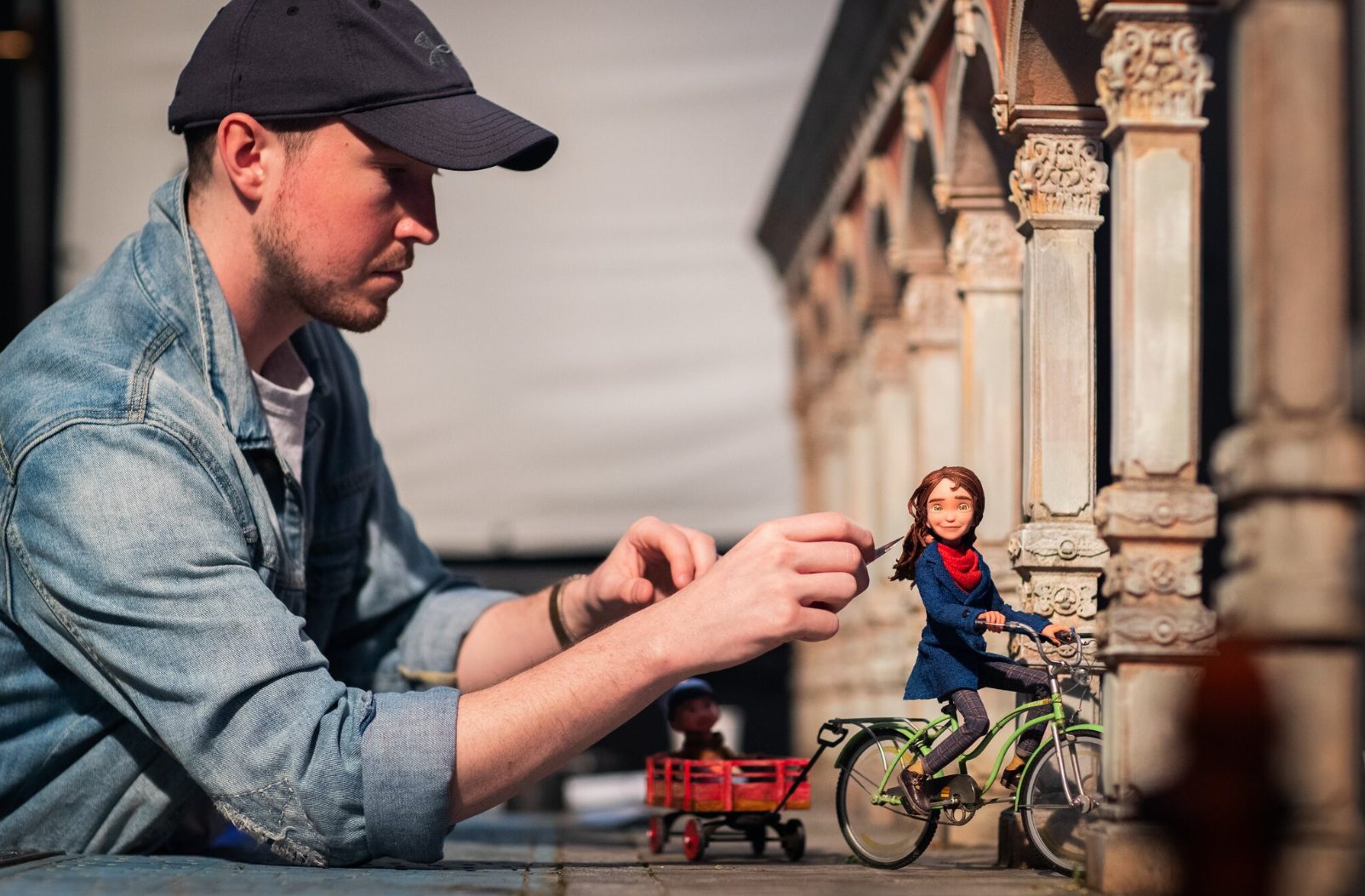
The animation studio Laika, based in Portland (United States), has opened the doors to its facilities to showcase the process behind Wildwood, its new stop-motion film and the first adaptation of the literary saga of the same name written by Colin Meloy and illustrated by Carson Ellis.
The release comes at a key moment for the studio founded two decades ago by Travis Knight, with financial backing from his father, Nike co-founder Phil Knight. The first screenings of the film have received a 100 percent positive rating on Rotten Tomatoes, positioning it as one of the major contenders for the Best Animated Feature Oscar at the next ceremony.
Nearly two decades of development
Travis Knight, the film's director, became interested in the story of Wildwood even before the book hit shelves, nearly 16 years ago. The project took five years to complete its animation phase, double the usual time for the studio's productions, a delay explained both by the COVID-19 pandemic and the sheer scale of the story.
Deborah Cook, head of costume design, noted that her work formally concluded in 2021, in the midst of the pandemic, although her presence remained necessary throughout the filming. Cook designed around 300 costumes for the 236 characters that populate the film.
Characters built by hand, one by one
Oliver Jones, head of the character creation and practical effects department, explained that the process begins with sculpting each figure, which is then fitted with an internal skeleton equivalent to what is known in digital animation as a rig.
Laika has been perfecting these mechanisms film after film. While they incorporated small devices in Kubo and the Two Strings to achieve subtle movements and simulated the dolls' breathing in Missing Link, in Wildwood, 90 percent of the puppets can also contract and relax facial muscles, an advancement that Jones highlights as unprecedented in stop-motion.
Brad Schiff, head of the animation department, emphasized that animating a character at rest is, paradoxically, the greatest technical challenge.
From the smallest mouse to the giant eagle
Among the most complex characters to build and animate are Septimus, a small mouse described as the smallest creature ever created at the studio, and the General, an eagle with a wingspan of over two meters with about 3,000 feathers animated individually on each model.
The aerial sequence featuring this bird was handled by animator Dobrin Yanev, who needed more than a year and a half just for that section. For the protagonist, Prue, nearly 30 puppets were built, while for the General, only three partial versions were manufactured, with wings open or closed, depending on the required shots.
In total, the production team brought together more than 500 artists, of whom only about 40 work directly as animators; the rest come from disciplines such as miniature work, watchmaking, or practical special effects.
A Guinness World Record of 140,000 faces
One of the film's greatest technical breakthroughs belongs to the rapid prototyping department, led by Brian McClean, which uses 3D printers to create individual facial expressions instead of reusing generic parts.
This technique, debuted with Coraline and recognized with a Scientific and Technical Oscar in 2016, has been taken to a new extreme in Wildwood: 140,000 different faces were printed, each corresponding to a specific expression of a character at a given moment, which constitutes a new record according to McClean.
In practice, the process involves animating the film twice. The rapid prototyping department consists of about 70 people: about 30 work digitally modeling, texturing, and animating the faces on a computer, while the remaining 40 are in charge of 3D printing them and refining them for physical use on set.
Who really animates the faces?
This double layer of animation—digital for the face, physical for the body—has sparked some debate within the industry regarding creative authorship. At Laika, they insist that it is a collaborative process: the digital animator works according to the instructions of the stop-motion animator, faithful to the vocal performance, and the latter then integrates those faces into the physical body animation on set.
Each face can take between two and three days to be ready. According to McClean, this technique does not seek to reduce costs or accelerate production, but rather to improve the characters' performances.
A universe of 450 sets and 2,800 shots
Nelson Lowry, production designer, detailed that at the most intense moment of filming, the movie had about 450 different sets, 99 percent of which were built by hand, occupying two additional hangars due to lack of space.
Wildwood totals 2,800 shots, double that of Missing Link. Many of the sets reproduce real places in Portland, such as the St. John’s Twin cinema, Powell’s bookstore, or the Voodoo Doughnut shop, before the plot moves into the forests of Forest Park on the outskirts of the city, which inspired much of the production design.
Since Coraline, Laika has organized international exhibitions with the original sets from its films, so the set design also considers their future transport and assembly in museums, as already happened in Lyon and as is planned soon at the Design Museum in London.
The challenge of finding an audience
Despite near-unanimous critical backing, forecasts point to a box office take of between 6 and 10 million dollars during the first weekend in the US, which would be the most modest opening in the studio's history.
The figure contrasts with a production budget exceeding 100 million dollars, to which is added a promotional campaign whose cost could approach, according to industry rumors, figures similar to those other companies allocate to their awards season contenders.
At the studio, however, the internal conversation focuses less on the box office and more on the creative process. Oliver Jones acknowledged that behind every successful solution there were numerous failed experiments, and defended the value of productions in which, in his own words, the artisanal touch of each artist is visible in the face of the advance of artificial intelligence.
Frequently Asked Questions
What is Laika and who runs it?
Laika is a stop-motion animation studio based in Portland, United States, founded with the financial backing of Phil Knight, co-founder of Nike. His son, Travis Knight, is the studio's lead creative and directs Wildwood.
How long did it take Laika to produce Wildwood?
The project's development spanned nearly 16 years from the time Travis Knight became interested in the story, while the actual animation phase lasted five years, double the usual time for the studio's productions.
What is the film Wildwood based on?
Wildwood adapts the literary saga of the same name written by Colin Meloy and illustrated by his wife, Carson Ellis.
What Guinness World Record did the film achieve?
Wildwood achieved a new record by 3D printing 140,000 different facial faces for its characters, each corresponding to a specific expression in a specific frame.
How many characters and sets does the film have?
The production includes 236 characters and, at its peak, featured about 450 different hand-built sets, spread across several studio hangars.
What other films has Laika made?
Its main productions over its two-decade history include Coraline (2009), ParaNorman (2012), The Boxtrolls (2014), Kubo and the Two Strings (2016), and Missing Link (2019).
What are the box office expectations for Wildwood?
Forecasts point to a gross of between 6 and 10 million dollars during its first weekend in the United States, a figure that, if confirmed, would be the lowest in the studio's history despite the broad critical acclaim received.