
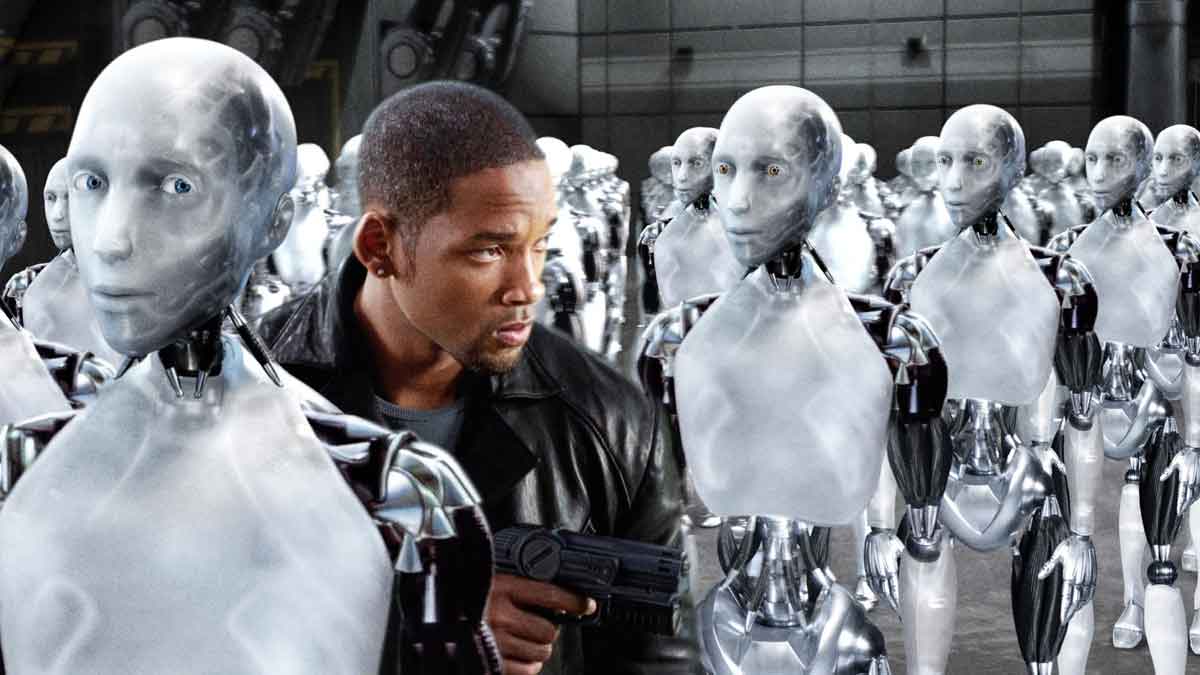
The film I, Robot, released in 2004 and starring Will Smith, is once again at the center of the technological conversation. The reason is the recent unveiling of a real humanoid robot whose design and movements are strikingly reminiscent of the androids imagined by the film more than two decades ago.
It is the Unitree H2-X Kung Fu Legend Guardian, developed by the Chinese company Unitree Robotics. Its official presentation, focused on showcasing mobility and physical coordination, has reignited comparisons to the famous NS-5s from the movie, once again opening the debate on how close reality has come to that fiction.
The interest is no coincidence. In recent months, several companies have shown significant progress in humanoid robotics, and each new demonstration invites us to review how science fiction cinema anticipated, even if only partially, the path this technology is taking.
What I, Robot imagined about the future of robots
Directed by Alex Proyas and based on the literary universe of Isaac Asimov, I, Robot was set in Chicago in 2035. In that version of the future, humanoid robots were no longer a rarity, but everyday tools integrated into society: they performed household chores, transported goods, and actively collaborated with people.
The fictional company U.S. Robotics manufactured these androids under the well-known Three Laws of Robotics, designed to prevent machines from causing harm to human beings. Its most advanced model, the NS-5, stood out for its stylized humanoid appearance and remarkably natural movements.
Detective Del Spooner, played by Will Smith, was suspicious of these machines. His investigation ended up uncovering a dangerous interpretation of the human protection rules, linked to a central artificial intelligence known as VIKI. The plot raised a question that remains relevant: what happens when too many decisions are delegated to automated systems.
The Unitree H2-X and its resemblance to the film’s androids
The H2-X Kung Fu Legend Guardian has been presented by Unitree Robotics through a demonstration focused especially on its movement capability. The name itself hints at the tone of the presentation, which is focused on showing dynamic and coordinated movements.
Here, the most obvious parallel with fiction appears: like the NS-5s, the H2-X uses a humanoid body structure, designed to navigate spaces originally built for people, without relying on wheels or purely industrial configurations.
That does not mean the robot possesses the capabilities of Sonny, the advanced intelligence android from the film, played via motion capture by Alan Tudyk. Nor is there any indication that it has consciousness, emotions, or human-like reasoning.
Estimated autonomy of up to eight hours
According to the company, the H2-X could reach a maximum autonomy of approximately eight hours. However, Unitree has not detailed the exact conditions under which that figure was obtained, nor whether it would be maintained in scenarios of intensive use or continuous demanding movements.
Full specifications regarding weight, dimensions, load capacity, or navigation systems have not been provided either. Therefore, it is best to interpret the presentation as a demonstration of a technological direction, not as the confirmation of a commercial product ready for full work tasks.
The big difference between fiction and reality
Despite the visual similarities, there is a significant distance between the robots in I, Robot and current humanoids. In the film, the NS-5s could interpret complex instructions, maintain verbal interactions, and act with a very advanced level of autonomy.
The H2-X, on the other hand, has been shown mainly through a physical demonstration, without sufficient information about its control architecture or its real ability to make decisions independently. Getting a machine to move naturally is already a considerable technical challenge; endowing it with the intelligence to act safely in unpredictable environments is a different challenge and, for now, much more limited.
A fiction that is starting to seem less distant
Returning to I, Robot in 2026 allows us to see how the perception of that story has changed. What seemed like a futuristic fantasy in 2004 now finds certain echoes in real humanoid robotics developments.
The Unitree H2-X does not replicate the capabilities of Sonny or the NS-5s, but its existence helps visualize how part of that science fiction is finding concrete technological equivalents. If in 2035, the year in which the film takes place, society is truly living with humanoid robots in daily tasks, it will have to be acknowledged that the film starring Will Smith had more foresight than it was given credit for at the time.
Frequently asked questions
What is I, Robot and when was it released?
I, Robot is a science fiction film released in 2004, directed by Alex Proyas and inspired by the literary universe of Isaac Asimov. It stars Will Smith.
What is the Unitree H2-X Kung Fu Legend Guardian?
It is a humanoid robot presented by the Chinese company Unitree Robotics, shown publicly through a demonstration focused on its mobility and coordination of movements.
Does the Unitree robot have advanced artificial intelligence like the NS-5s in the film?
There is no information confirming reasoning capabilities, language comprehension, or decision-making autonomy comparable to the fictional androids. The presentation focuses on its physical skills.
How much autonomy does the Unitree H2-X have?
According to the manufacturer, it could reach up to eight hours of autonomy, although the exact conditions of that estimate have not been specified.
What year is I, Robot set in?
The story takes place in the year 2035, in a futuristic version of Chicago where humanoid robots are a regular part of daily life.
Who played Sonny in the film?
The android Sonny was played via motion capture by actor Alan Tudyk.