
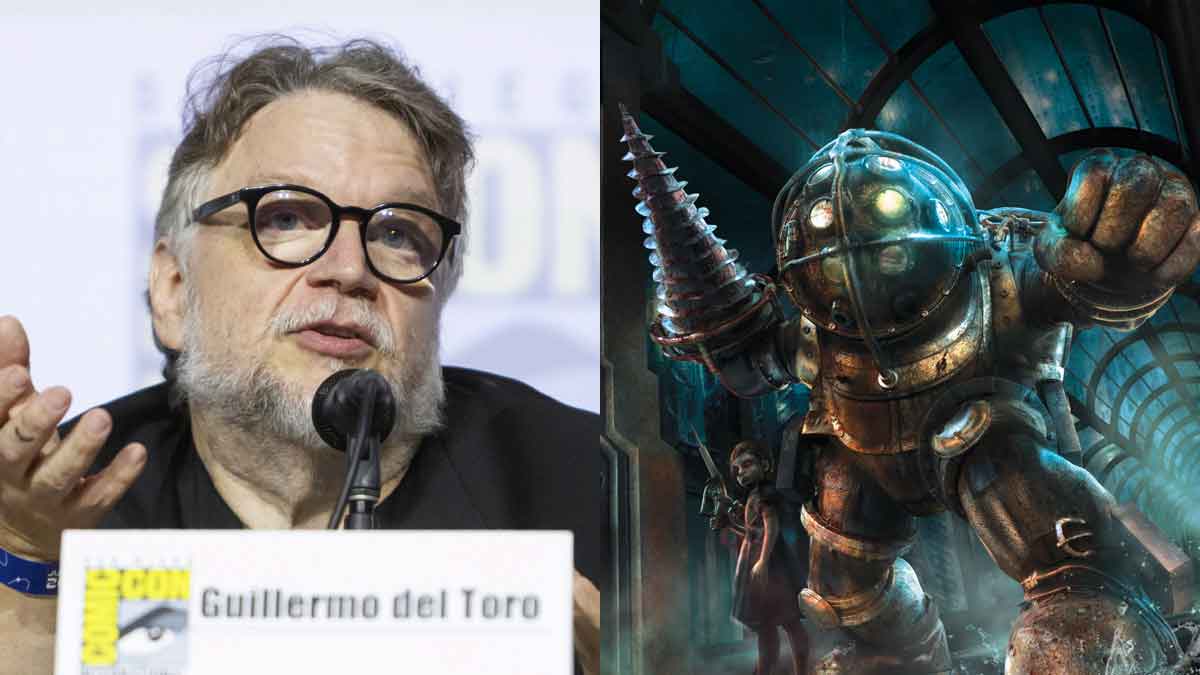
Guillermo del Toro has confirmed something that video game fans had been speculating about for years: he was in talks to adapt BioShock for the screen. The director himself has explained why that project never went anywhere, and his account is as revealing as the final result itself.
The confession comes at a time when the adaptation of video games for film and television is experiencing a constant boom, with Netflix developing its own live-action version of BioShock since 2022. The fact that one of the directors most associated with that universe due to its aesthetic has acknowledged his previous failure adds valuable context to a project that still has no release date.
Del Toro admits he tried, and that it went wrong
During an interview with IGN, Guillermo del Toro directly addressed the difficulties of turning video games into movies. It was then that he admitted he participated in conversations to develop a BioShock adaptation himself.
In his own words, those meetings did not get far. The director described them as some of the most disastrous professional calls he has experienced in his career, noting that the dynamics of a video game and a movie are fundamentally different, even if they share certain visual resources like camera movement.
Del Toro explained that the narrative of a video game is built through puzzle-solving and direct player interaction, something that has no natural equivalent in cinematic language. That difference, as he recounted, was precisely what caused the project to derail.
The filmmaker did not detail who he held those conversations with or in what year they took place, but he was clear in ruling out any possibility of reconsidering the idea in the future.
A director who seemed tailor-made for Rapture
It is striking that it is precisely Guillermo del Toro who acknowledges this failure, as few filmmakers seem so aesthetically aligned with the BioShock universe.
Rapture, the underwater city where the saga takes place, combines monumental architecture, deformed creatures, and a decadent aesthetic that recalls several of the worlds the director has built throughout his filmography.
The Big Daddies, the imposing guardians locked in diving suits who protect the Little Sisters, also share that mix of menace and physical tragedy that has characterized many of the creatures devised by Del Toro in his own films.
Despite that clear visual affinity, the very narrative functioning of the video game ended up being the insurmountable obstacle to moving it to the big screen.
Why BioShock is so difficult to adapt
The first BioShock places the player in Rapture, a city built under the ocean as a refuge for some of the brightest minds in society. What began as a utopian project degenerates into a dystopian nightmare caused by the excessive ambition of its founder.
Upon arriving at its flooded ruins, the player encounters the Splicers, inhabitants deranged by the uncontrolled use of genetic substances, while the Little Sisters roam the halls protected by the Big Daddies. To survive, the protagonist combines weapons with Plasmids, substances capable of altering DNA and granting special abilities.
A good part of the game's appeal lies in the progressive exploration of Rapture, where the player reconstructs the history of the city through their own active participation. It is precisely that difference between participating and simply observing that, according to Del Toro, greatly complicates any attempt at cinematic translation.
The Netflix adaptation is still underway, though without a date
Guillermo del Toro's abandonment does not mean that Hollywood has stopped trying. Netflix announced in 2022 the development of a live-action adaptation completely independent of any previous project.
Francis Lawrence, director of The Hunger Games: Catching Fire, is linked to the direction, while Michael Green, screenwriter of Blade Runner 2049, is in charge of the script.
The project remains active, although its progress has been slower than expected by many of the saga's followers. Producer Roy Lee attributed this delay to other professional commitments of Francis Lawrence, without offering a specific release date for now.
Meanwhile, Rapture continues to wait for someone to solve one of Hollywood's great challenges: moving a world built to be explored and played to the screen, without losing along the way what made it unique.
Frequently Asked Questions
Did Guillermo del Toro ever direct a BioShock movie?
No. The director held conversations to develop the project, but it never advanced beyond those initial meetings, which he himself described as a failure.
Why did the conversations between Del Toro and the people in charge of BioShock fail?
As the filmmaker himself explained, the main obstacle was the difference between the narrative of a video game, built on interaction and puzzle-solving, and that of a traditional movie.
Who is currently developing the BioShock adaptation?
Netflix has been working on a live-action film since 2022 with Francis Lawrence as director and Michael Green as screenwriter.
When will the Netflix BioShock movie be released?
There is no confirmed release date yet. Producer Roy Lee has indicated that Francis Lawrence's commitments have delayed the project's development.
What is the BioShock video game about?
BioShock places the player in Rapture, an underwater city conceived as a utopia that ends up turned into a dystopian nightmare, inhabited by Splicers, Little Sisters, and Big Daddies.