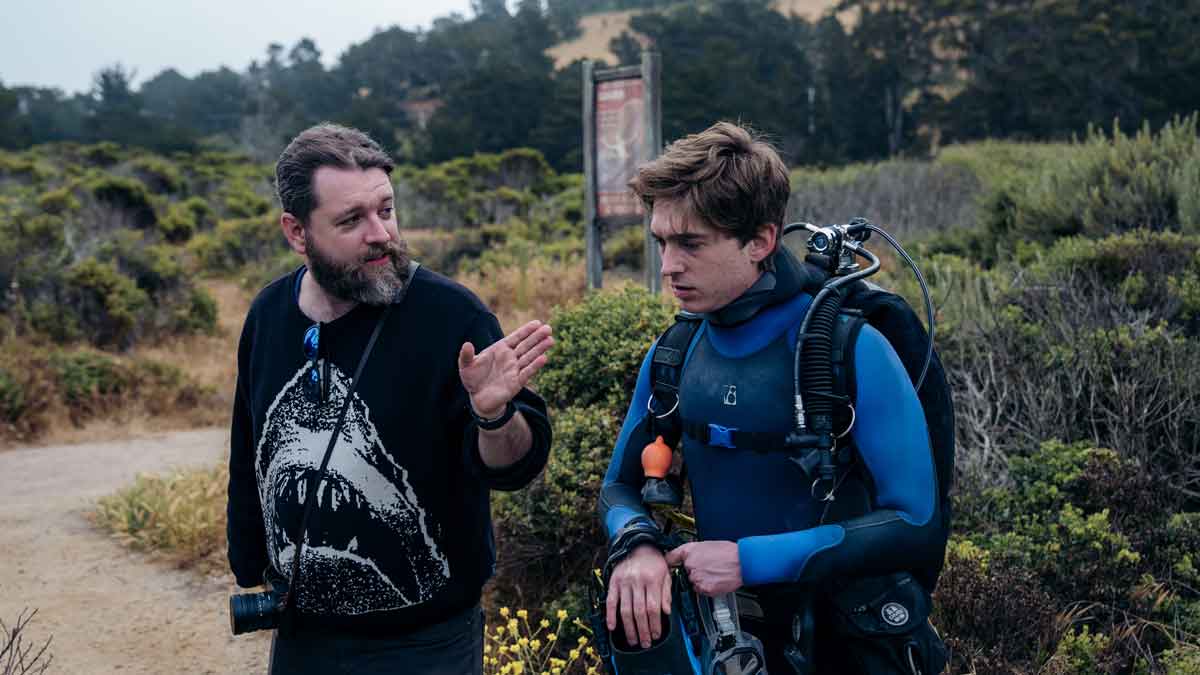
The arrival of Whalefall in theaters coincides with an exclusive interview in which its director, Brian Duffield, details for the first time the enormous challenges involved in filming a survival story set inside the body of a sperm whale. The filmmaker offered these statements during San Diego Comic-Con Málaga, accompanied by Josh Brolin and Austin Abrams, the stars of the film, which premieres on October 16, 2026, courtesy of 20th Century Studios.
The interest in the behind-the-scenes of this production is no coincidence. Whalefall presents an unusual narrative and technical challenge: telling a survival story with almost no dialogue, inside an organic set built on a large scale, and with an actor subjected to extreme physical conditions for weeks.
Austin Abrams’ commitment, according to Brian Duffield
Duffield did not hesitate to point to the underwater sequences and the scenes inside the sperm whale as the most complicated of the entire shoot. As he explained, Austin Abrams committed to the project in a way that surprised the director himself.
"He is the most committed actor I have ever worked with," Duffield stated, recalling that Abrams hired an instructor to learn how to dive until he obtained an advanced certification that allowed him to participate directly in a good portion of the underwater action scenes.
The actor also traveled to Dominica, in the Caribbean, to observe sperm whales in the wild alongside documentarian Patrick Dykstra, an experience that helped him understand the real behavior of these animals before facing their recreation on set. According to Duffield, Abrams even walked around his own neighborhood carrying his full scuba gear to get used to its weight and physical demands.
Staying still was also an action scene
One of the most striking details of the interview has to do with the difficulty of filming even the seemingly quiet moments. Abrams had to remain inside a mobile structure, surrounded by water and breathing from his own scuba tank, while the technical team tried to reproduce the movements of the sperm whale.
"Even when he is sitting still inside the stomach, it is an action scene," explained Duffield, who detailed that some sequences required months of prior preparation.
To achieve this, Wētā Workshop built different versions of the whale's digestive system using flexible structures, hydraulic platforms, and mechanisms capable of rotating 360 degrees. The production also built an underwater tank of about 662,000 liters to film the most complex sequences. According to data provided during the interview, Abrams spent 35 days of filming inside the sets that represented the animal's stomach, throat, and esophagus.
Plans that had to be redone on the fly
Duffield, who also wrote the screenplay with Daniel Kraus, author of the original novel, acknowledged that much of the planning became obsolete as soon as they started working on the actual sets.
"We planned for Austin to turn to one side and move to a certain point, but then he would get stuck. Physically, he couldn't move," recalled the director, who also mentioned cameras and lenses damaged during filming and entire days spent reinventing scenes that had been prepared for months.
Despite the difficulties, Duffield highlighted the enthusiasm shared by the entire technical team. "We all wanted to face the challenge of creating something that really hadn't been done before," he noted.
From a tweet to a personal obsession
Duffield's relationship with Whalefall began even before the book existed. The director said that Daniel Kraus posted the premise of his next novel on social media and that, without knowing him personally, he wrote to him immediately to show his interest.
"Daniel posted a tweet saying what his next book was going to be about. I had never spoken to him, but I wrote him a direct private message because I loved the idea," recounted Duffield, who at that time only knew the survival part inside the whale.
The emotional component of the story, centered on the relationship between a father and his son, took on special strength for the director because he had just become a father when he received the manuscript. After reading the entire novel in a single night, he called Kraus the next day, determined to bring it to the big screen. "If someone else made this movie, I knew I would feel miserable for years," he admitted.
Acting without words or a visible face
Another of the great challenges of Whalefall is the acting. Much of the narrative depends on the physical reactions of the protagonist, who can barely speak for a good part of the film. Duffield had already explored this approach in No One Will Save You, starring Kaitlyn Dever.
"I love that there is no dialogue. It would be my dream," he confessed with a laugh, although he acknowledged that working with Abrams was a different challenge, as the actor spent much of the shoot with a hood, mask, or scuba regulator, which greatly limited his ability to gesture.
According to the director, Abrams himself discovered that his usual acting resources did not work the same way under those conditions. "There were moments when he would come to see the monitor and say he thought he was overacting, but because his face was so covered, practically none of that reached the camera," explained Duffield.
Fear as a creative engine
When asked if filming a story set in the deep sea had changed his perception of the ocean, Duffield responded with humor that fear is part of his usual creative process.
"I'm afraid of everything, so I don't know if this movie has changed things too much," he said, adding that those anxieties often become the starting point for his projects. "The things that scare me are also the ones that excite me the most when it comes to making movies. I guess my therapy consists of turning them into cinema," he explained.
What is Whalefall about?
Whalefall follows Jay Gardiner, played by Austin Abrams, a young man who returns to Monterey after the death of his father, Mitt, played by Josh Brolin. Searching for his father's remains in the ocean, Jay ends up trapped inside a sperm whale with a limited amount of oxygen, forced to use everything he has learned to find a way out.
The adaptation of the novel of the same name by Daniel Kraus rounds out its cast with Elisabeth Shue, John Ortiz, Jane Levy, and Emily Rudd. The film combines physical sets, visual effects, and scientific research on the anatomy of sperm whales, although for Duffield the goal was never just to make the audience believe in the setting, but to make them understand what his protagonist is going through emotionally.
Frequently asked questions about Whalefall
When does Whalefall premiere?
The film hits theaters on October 16, 2026, courtesy of 20th Century Studios.
Who directs Whalefall?
Brian Duffield, also known for directing No One Will Save You, is responsible for the direction and co-wrote the screenplay with Daniel Kraus, author of the original novel.
What is the story about?
It narrates the experience of Jay Gardiner, played by Austin Abrams, trapped inside a sperm whale after diving to search for the remains of his father, Mitt, played by Josh Brolin.
How much time did Austin Abrams spend filming inside the whale sets?
As Duffield explained, the actor accumulated 35 days of filming inside the sets that recreated the animal's stomach, throat, and esophagus.
What physical preparation did Austin Abrams do for the role?
He obtained an advanced scuba certification, traveled to Dominica to observe sperm whales alongside documentarian Patrick Dykstra, and trained by carrying full scuba gear outside the set.
Who else is in the cast?
The cast is rounded out by Elisabeth Shue, John Ortiz, Jane Levy, and Emily Rudd.