
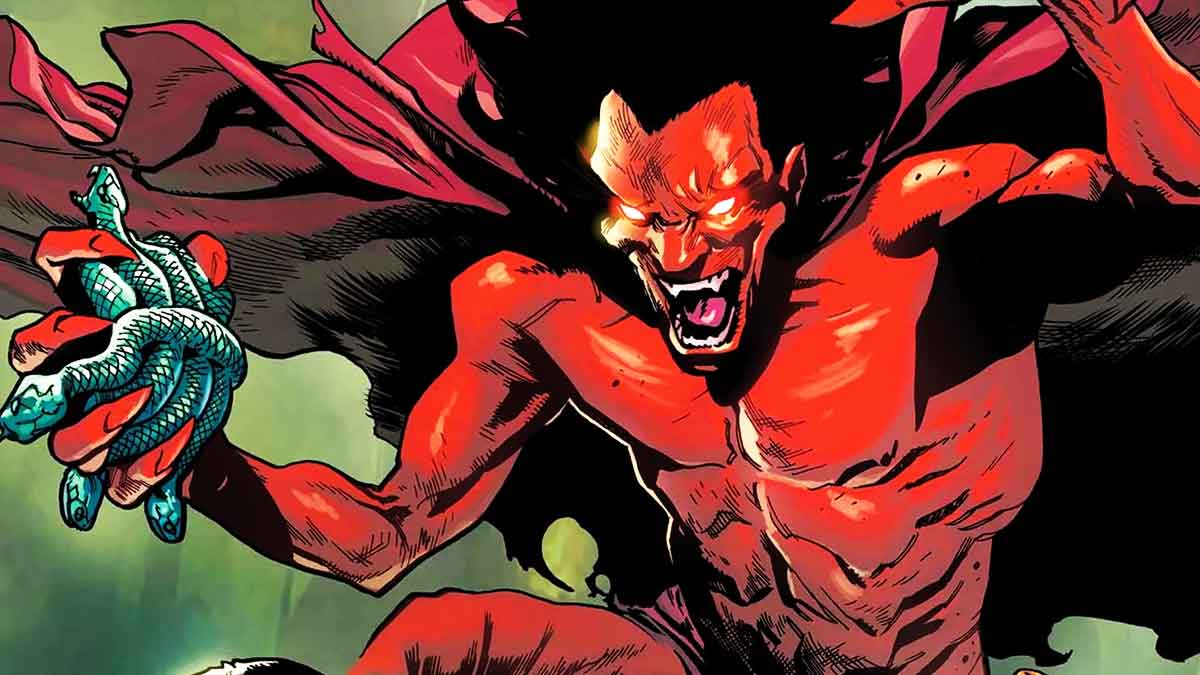
For years, Mephisto became an obsession for fans of the Marvel Cinematic Universe. Every mysterious detail in a series or film fueled theories about his long-awaited arrival. Now that the character has finally debuted in Disney+'s Ironheart, a detail few expected has come to light: the main dilemma behind his casting was not narrative, but cultural.
Sacha Baron Cohen, the actor who brings the villain to life in the Marvel Universe, has revealed that the series' creative team had a very specific concern before offering him the role. They feared that playing a figure linked to the devil could be offensive to him due to his Jewish heritage, because of the antisemitic stereotypes that have historically associated Jewish people with demonic representations.
The topic is relevant now because Cohen addressed this episode publicly, offering an unusual perspective on how major productions manage cultural sensitivity when casting roles, even when dealing with fictional characters like those from Marvel comics.
From WandaVision to Ironheart: the long wait for Mephisto
The anticipation surrounding Mephisto dates back to 2021, when Marvel premiered WandaVision. That series sparked theories about who could be behind the strange events in Westview, and Mephisto quickly became the prime suspect for a large portion of the audience.
Viewers analyzed every line of dialogue and every supporting character in search of clues to confirm his appearance. However, the series ended without introducing the villain, and that search turned into one of the most remembered anecdotes of the Marvel fandom.
The character finally arrived with the premiere of Ironheart, played by Sacha Baron Cohen. His debut confirmed that Marvel was willing to explore darker narrative territory, although it is now known that there were specific precautions taken before finalizing the casting.
The delicate reason why Marvel hesitated with Mephisto
During his appearance on the Happy Sad Confused podcast, reported by Variety, Sacha Baron Cohen explained that the Ironheart team wanted to address a cultural issue directly before offering him the character. There were no doubts about his acting ability, but rather about the implications of linking a Jewish actor to a demonic figure.
The actor recalled that the production and directing team was composed, in his own words, almost entirely of Black professionals, who wanted to ensure that the proposal would not be offensive, given the historical antisemitic representations that link Jewish people to the devil.
According to Cohen, those in charge told him they were aware of the negative association that has historically existed between Jewish people and the devil, and they wanted to ensure he would not feel insulted by being offered the role. The actor's response was immediate: he had no objection to accepting it. Far from being annoyed, he especially appreciated that conversation and described it as a display of consideration and empathy that is quite rare.
Sacha Baron Cohen appreciated Marvel’s sensitivity
The star of Borat and Ali G knows firsthand the risks of working with provocative characters. Much of his career has been built on satire and exposing social prejudices through deliberately exaggerated situations.
For that reason, the Marvel team's concern had a special meaning for him. In previous work, Cohen had used antisemitic stereotypes as part of his critique of racism, including depictions of Jewish people with horns, a historical prejudice also present in certain versions of the devil.
The actor appreciated that those in charge of the series were aware of that context. As he explained, for the Jewish community, there is sometimes a feeling of not being seen or understood in their own suffering, so that gesture of care from the team had special value.
Mephisto could become a major problem for the future of the MCU
Beyond the circumstances of his casting, Mephisto's appearance in Ironheart left an especially interesting plotline open. In the comics, the character is a demonic entity that enjoys manipulating humans through pacts whose results are usually worse than their victims imagine. His classic representation, with red skin, horns, and a clear resemblance to Satan, makes him one of the publisher's most unsettling antagonists. His television debut respected that very negotiating facet.
Riri Williams’ dangerous pact
The conclusion of Ironheart showed Riri Williams accepting a pact with Mephisto to get her best friend, Natalie, back. A decision that closed an emotional part of the story, but left an unsettling question open regarding the price the young inventor will have to pay.
Those who know the character know that deals with Mephisto rarely end well. And if someone capable of building technological armor comparable to Iron Man's becomes linked to a demonic entity, the narrative possibilities are especially attractive for future MCU stories.
For the moment, Marvel has not confirmed when the character will appear again or if the consequences of that pact will be explored directly. There are also no guarantees that Mephisto will become a central threat to other heroes in the cinematic universe. What is clear is that Sacha Baron Cohen was comfortable with the role from the very first moment, so Marvel's initial concern did not pose any obstacle to his joining the project.