
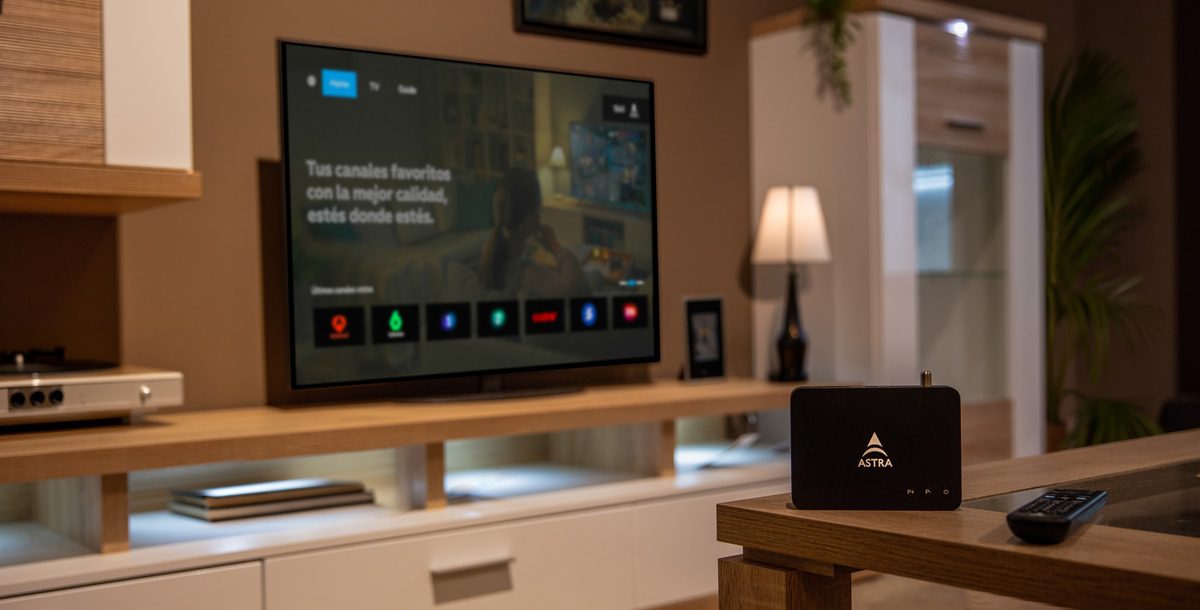
Digital terrestrial television still fails to reach every Spanish household with reliable quality. Years after the analogue switch-off, areas with challenging terrain or low population density continue to struggle with interference and signal dropouts. Against this backdrop comes ASTRA TV, a new satellite platform from operator SES that promises to solve this problem without requiring monthly fees.
The service, already available across the entire national territory, offers a selection of national and regional TDT channels, plus a few international channels, with the quality that satellite technology allows.
A one-time payment of 199 euros, no fees
Luis Sahún, general director of SES Satélites Ibérica, has explained that the goal of ASTRA TV is to guarantee television reception anywhere in the country, "regardless of terrain, interference, population dispersion" and other difficulties stemming from the analogue switch-off.
According to Sahún, this is "a service for life, subject to a one-time payment of 199 euros," which will also serve as a complement to the transition process toward Ultra High Definition.
HD now, UHD in the future
Users will be able to access channels in High Definition from the outset, and progressively in Ultra High Definition as well. The platform also leaves the door open to adding new thematic, provincial or local channels, as negotiations with various industry players remain ongoing.
One of the standout selling points is that the service will not require new TV retunings, neither now nor in the future, a recurring issue that has historically affected TDT users.
How ASTRA TV works
The service setup is automatic and does not require an internet connection. To enjoy it, users only need a compatible receiver and a satellite installation aimed at the ASTRA satellites, which they must arrange privately if their home does not already have that infrastructure.
The service can be subscribed to through the platform's official website or through the network of authorized installers and distributors.
Why this alternative emerges now
SES points out that, during the rollout of TDT in Spain, only terrestrial technology was considered, leaving aside alternatives such as satellite. Thousands of transmission centers have since been equipped and maintained with substantial public subsidies that, according to the company, the European Union has declared not to be technologically neutral.
The sector now faces a new transition: adapting to the DVBT2 standard, essential for TDT to broadcast in Ultra High Definition. This change will require new investments to upgrade the transmission centers spread across the country.
Miguel Pingarrón, Business Development manager at ASTRA TV, believes public administrations now have the opportunity to opt for solutions that are "more efficient for public funds and technologically robust" when it comes to bringing television to the entire population.
"Any public subsidy must comply with the principle of technological neutrality, especially when several operational platforms exist," Pingarrón noted, presenting ASTRA TV as a useful tool for regional governments to bring generalist television to their entire territory, adapting to the particularities of each area.
SES maintains that collaboration between the public and private sectors would help avoid a digital divide in Ultra High Definition reception, especially in extended coverage areas where, for now, there are no plans to upgrade the centers to the DVBT2 standard.
The shadow of the third digital dividend
ASTRA TV is also presented as a future-proof alternative in the face of a possible third digital dividend. The debate arises at a time when mobile operators are demanding more space in the 700 MHz band of the radio spectrum.
According to SES, most European countries, with the exception of Spain and Italy, already plan to facilitate the expansion of mobile services in that band. It is estimated that 5G could contribute around 26 billion dollars to European GDP by 2030, in a scenario of growing traffic driven by 5G, the future 6G, and the internet of things.
This greater network capacity would improve coverage in rural areas, strengthen communications restoration in critical situations, and be key in defense operations. "Spain is already at a disadvantage compared to other countries, and it shouldn't miss out on this opportunity either," Pingarrón warned.
Who is behind ASTRA TV
ASTRA TV is a service launched by SES, a global satellite and space solutions operator with annual revenue of 3.5 billion euros. Its satellites reach more than 2.3 billion people in 80 countries and broadcast more than 10,900 television channels worldwide.
The company has more than 4,000 employees and collaborates with more than 60 government organizations, eight of the world's ten leading mobile operators, and 30 commercial airlines. Its clients include platforms such as Sky, Canal+ and Movistar Plus.
SES operates a network of 120 multi-orbit satellites, made up of 90 geostationary satellites (GEO) and 30 medium-orbit satellites (MEO). The company claims to be the only operator in the market capable of managing a consolidated MEO constellation, through its O3b and O3b mPower systems, alongside its fleet of GEO satellites and strategic access to low-orbit (LEO) solutions through the IRIS2 program.
Frequently Asked Questions
What is ASTRA TV?
It is a satellite television platform launched by SES, designed to offer national, regional and international TDT channels in areas where terrestrial signal does not reach with sufficient quality.
How much does ASTRA TV cost?
The service is subscribed to through a one-time payment of 199 euros, with no subsequent monthly fees, as confirmed by Luis Sahún, general director of SES Satélites Ibérica.
What do I need to have ASTRA TV at home?
A compatible receiver and an installation aimed at the ASTRA satellites are enough. If the home does not have this prior infrastructure, the user must arrange for its installation.
Does ASTRA TV need an internet connection?
No. Its setup is automatic and it works without needing an internet connection, unlike other streaming services.
Does ASTRA TV broadcast in Ultra High Definition?
It currently offers channels in High Definition, with plans to progressively add Ultra High Definition content.
Where can ASTRA TV be subscribed to?
The service can be subscribed to through the platform's official website or through the network of authorized installers and distributors.
Why is this platform emerging now?
It coincides with the debate over the transition to the DVBT2 standard for Ultra HD TDT and with pressure from mobile operators to obtain more spectrum in the 700 MHz band, which could affect terrestrial coverage in the future.