Enid Blyton's stories have been a part of the British childhood since 1939, becoming one of those imaginary universes that many readers remember almost as their own experiences. Now, its film adaptation arrives at a time when the family fantasy genre seeks to recover that balance between nostalgia and innovation that films like Paddington 2 or Wonka already proved is possible to achieve.
The Magic Faraway Tree was released on October 9, 2026, and is written by Simon Farnaby, screenwriter of the two aforementioned films, with direction by Ben Gregor. The proposal seeks to bring to the big screen that magical tree inhabited by impossible creatures that has accompanied generations of readers, without losing sight of the risk involved in any adaptation of this type: modernizing too much can destroy its innocence, but following it to the letter can result in something cloying.
A family that needs to reconnect before finding the magic
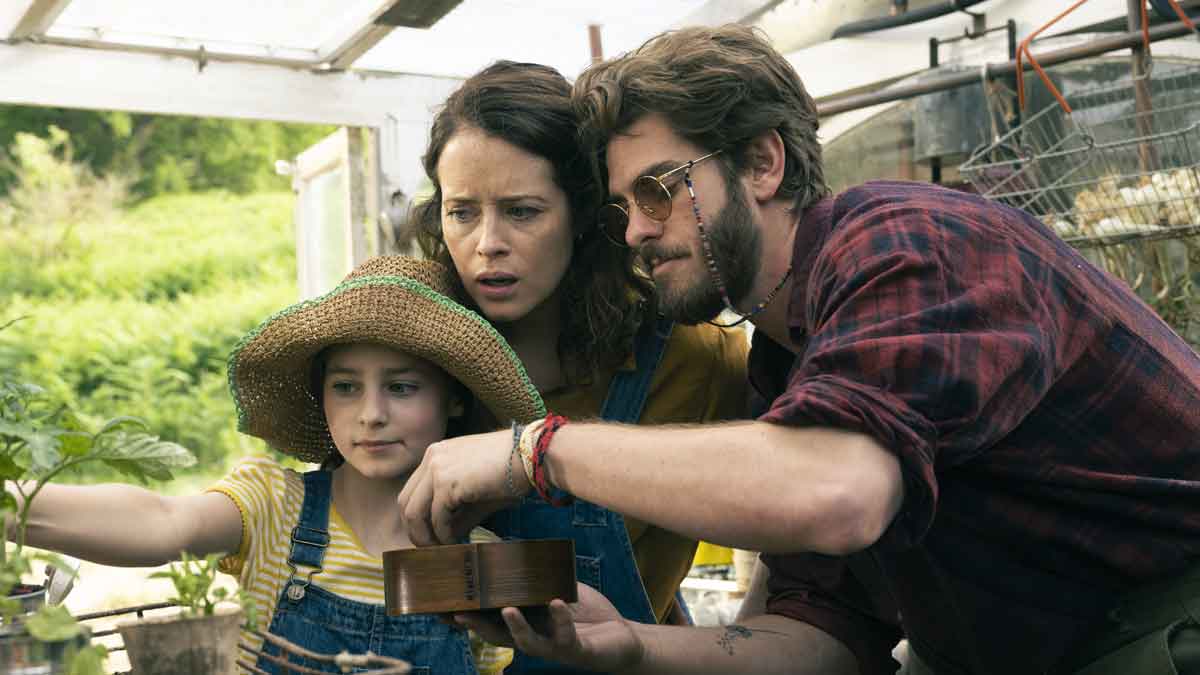
The story follows Polly and Tim, played by Claire Foy and Andrew Garfield, a couple exhausted by the pace of modern life. She works as an engineer at a company that develops a smart refrigerator capable of monitoring the habits of the entire family, with Judi Dench's voice giving personality to the appliance.
When Polly discovers to what extent that product invades the privacy of its users, she decides to resign on principle. The decision forces the family to leave their apartment and company car, recover old dreams of youth, and move to the countryside with their three children to settle in an old barn.
That narrative base, simple but effective, gives meaning to the fantasy that will come later. Beth is glued to her phone, Joe is obsessed with his favorite video game, and little Fran has almost stopped talking. It is not a family broken by a great tragedy, but something more everyday: five people living together without paying real attention to each other.
The performances of Claire Foy and Andrew Garfield
Claire Foy brings remarkable humanity to Polly, especially in moments when the script allows her to show fatigue, insecurity, or frustration instead of limiting her to the role of the responsible mother. Andrew Garfield, for his part, offers fun moments as Tim and conveys the character's kindness well, although in certain scenes he takes his enthusiasm to such an infantile level that he ends up seeming less mature than his own children.
That imbalance does not break the film, but it does anticipate one of its weaknesses: the attempt to make practically all the characters adorable or eccentric at the same time, which ends up generating a certain saturation.
The magic tree, the film’s great visual success
When Fran enters the forest and meets Silky, the fairy played by Nicola Coughlan, the film finds its clearest visual identity. The girl discovers a gigantic tree inhabited by impossible characters and crowned by a ladder that leads to different changing worlds.
Alexandra Walker's production design plays a fundamental role in this achievement. The tree retains a handcrafted look that recalls a children's illustration turned into a real set, and the film avoids presenting the everyday world as something gray to make the fantasy more colorful. Both universes have their own beauty.
Nicola Coughlan understands that she should not play Silky with irony, and that respect for the material is key. Moonface, played by Nonso Anozie, the Saucepan Man by Dustin Demri-Burns, or the frantic Dame Washalot by Jessica Gunning are absurd characters, but none are treated with condescension toward the child audience.
Too many characters for a single film
The problem arises when too many new characters accumulate, each with their own makeup, exaggerated voice, and particular gag. If Enid Blyton could afford loose episodes without great narrative progression, a film of almost two hours needs a bit more cohesion.
Simon Farnaby tries to solve this by relying on the Thompson family as the backbone of the plot, and it works to a certain extent, although even he has difficulty turning so many extravagances into a completely unified story.
When the story turns down the volume, it works better
The different worlds that appear on the tree allow for the introduction of wishes, cakes, and increasingly outlandish situations. In the Land of Birthdays, children can make wishes that inevitably go wrong, forcing them to face the consequences of what they thought they wanted.
This segment has a classic children's tale structure and works well because the three siblings begin to change without the film turning the learning process into a solemn lesson. Billie Gadsdon is natural as Fran, avoiding the character being reduced to a simple magical girl. Delilah Bennett-Cardy and Phoenix Laroche also gain nuances when their characters stop being only the teenager with the phone and the boy with the video game.
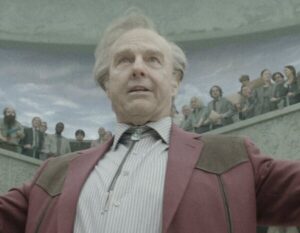
The film loses strength when it feels the need to fill every minute with color and eccentricity. The five-headed monster, with the face of Michael Palin, has its charm; Rebecca Ferguson appears as a delirious Dame Snap; Jennifer Saunders steals several scenes as Polly's mother. Everything works separately, but together it ends up generating a certain saturation.
The true charm is in the family, not in the magic
The most interesting thing about The Magic Faraway Tree is that its best idea is also the simplest. As the children discover extraordinary places, those worlds begin to lose their appeal compared to something less spectacular: being together.
The film avoids having that evolution remain a simple speech against screens. There is an obvious critique of the mobile phone, video games, and technology that claims to solve everything, but the message works better when it moves away from the idea that the internet is bad and approaches something more human: the Thompsons had stopped looking at each other, and the magic forces them to do so again.
A moment related to Tim's childhood connects that learning with a melancholic idea: growing up implies losing things, even without being aware of it. There appears a sensitivity that recalls Farnaby's best work in Paddington and Wonka.
A sweet proposal, but difficult to look at with cynicism
The Magic Faraway Tree does not manage to completely escape what could alienate part of the adult audience. There are very cheesy moments, some supporting characters seem taken from an early Christmas pantomime, and the episodic structure is noticeable as the magical lands and creatures increase.
Tim's enthusiasm could also have been better dosed in certain scenes, since Andrew Garfield has the talent to be relatable, but the direction pushes him at times toward an excessively frantic energy.
Even with these nuances, it is difficult to be cynical about a film that never looks down on children nor turns its own fantasy into a joke. Ben Gregor directs with visual confidence, Claire Foy provides the necessary emotional anchor, and Simon Farnaby manages to build a solid family story within material that was not originally intended to support a large cinematic plot.
It does not reach the precision of Paddington 2 or the balance between melancholy and spectacle of Wonka, but it does not need to. Its purpose is more modest: to return for a couple of hours that childish feeling that, behind the forest, something impossible can exist. And when it stops trying so hard to be adorable, it manages to be exactly that: a warm and genuinely charming family film, although with enough sugar to be grateful that the adventure ends before asking for another helping.
Frequently Asked Questions
When was The Magic Faraway Tree released?
The film was released on October 9, 2026.
What books is the film based on?
It is based on the stories by Enid Blyton, originally published starting in 1939, centered on a magical tree and the fantastic worlds connected to it.
Who directs and who writes the script?
The direction is by Ben Gregor, while the script is by Simon Farnaby, also responsible for Paddington 2 and Wonka.
Which actors star in the film?
Claire Foy and Andrew Garfield play Polly and Tim, the parents, along with Nicola Coughlan as Silky, Nonso Anozie as Moonface, Jessica Gunning, Rebecca Ferguson, Jennifer Saunders, Michael Palin, and Judi Dench, among others.
How long is the film?
It has a duration of 110 minutes.
Is it a suitable film for the whole family?
Yes, it is intended as a family fantasy, with a warm and accessible tone for both children and adults, although some adult viewers may perceive its tone as excessively sweet in certain sections.